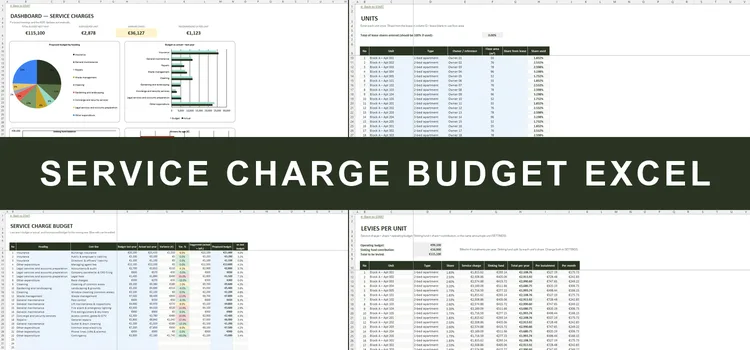
Service Charge Budget Excel
Budget, levies, arrears & sinking fund for OMCs
- Budget in the 9 categories of the MUD Act, vs actual
- Levy per unit from the lease share or floor area
- Arrears aged 0–30 / 31–60 / 61–90 / 90+ days
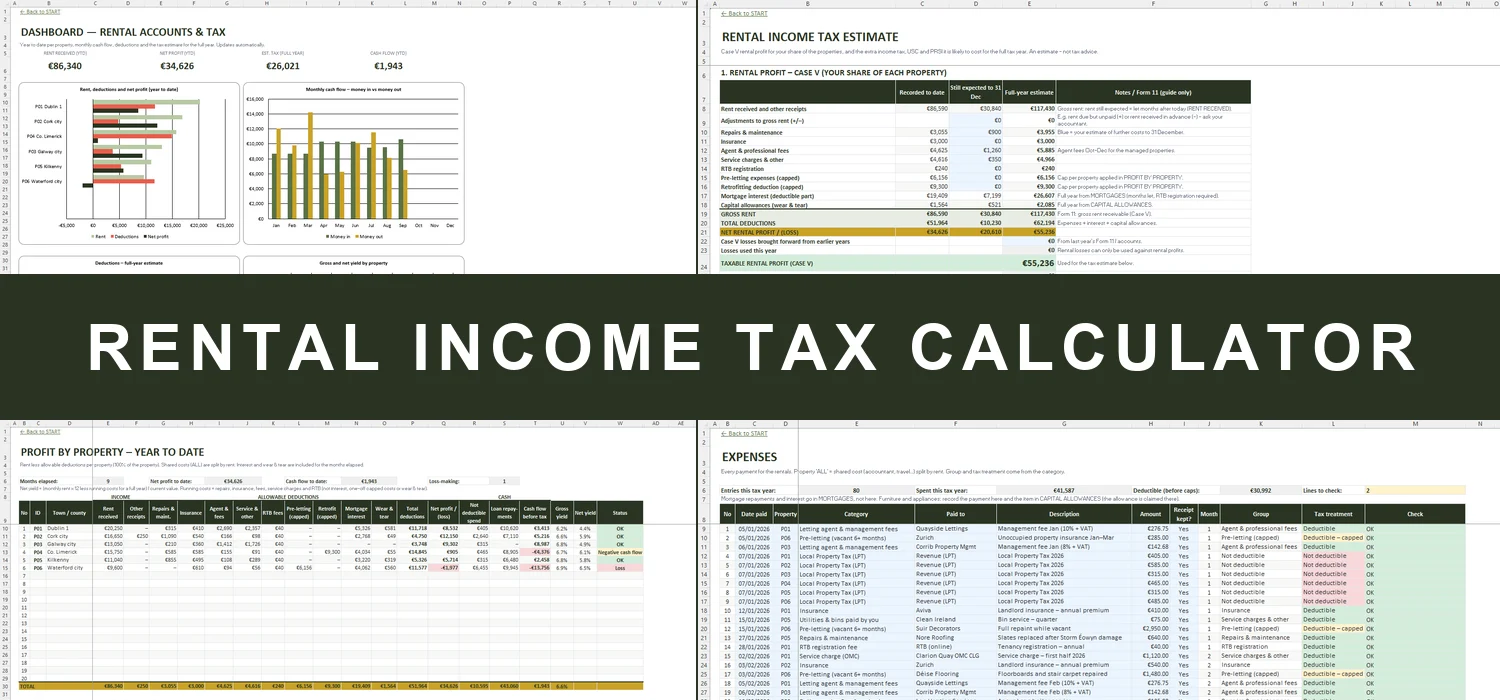
Landlord accounts for Ireland: rent, expenses, Case V profit and a tax estimate per year


Record the rent and every expense per property. The workbook works out the Case V profit with the usual deductions, the cash flow and yield of each property, and an estimate of the income tax, USC and PRSI on your rental income for the year.
Rental income in Ireland is taxed at your marginal rate, plus USC and PRSI, and the rules on what you can deduct are specific: mortgage interest on a residential letting counts only if the tenancies are registered with the RTB, Local Property Tax never counts, furniture is claimed as wear and tear over 8 years, and pre-letting and retrofitting costs have their own caps. On top of that come the Residential Premises Rental Income Relief (up to €1,000 for 2026 and 2027) and preliminary tax by 31 October.
This workbook keeps the accounts the way Revenue and your accountant expect them: rent received per property and month, an expense journal with a tax treatment for each category, loans with the interest for the year, a wear and tear register, a profit and cash flow statement per property and a full-year Case V estimate with the tax per person. It works alongside our RTB Rent Calculator Excel, which covers tenancies, rent reviews and RTB deadlines.
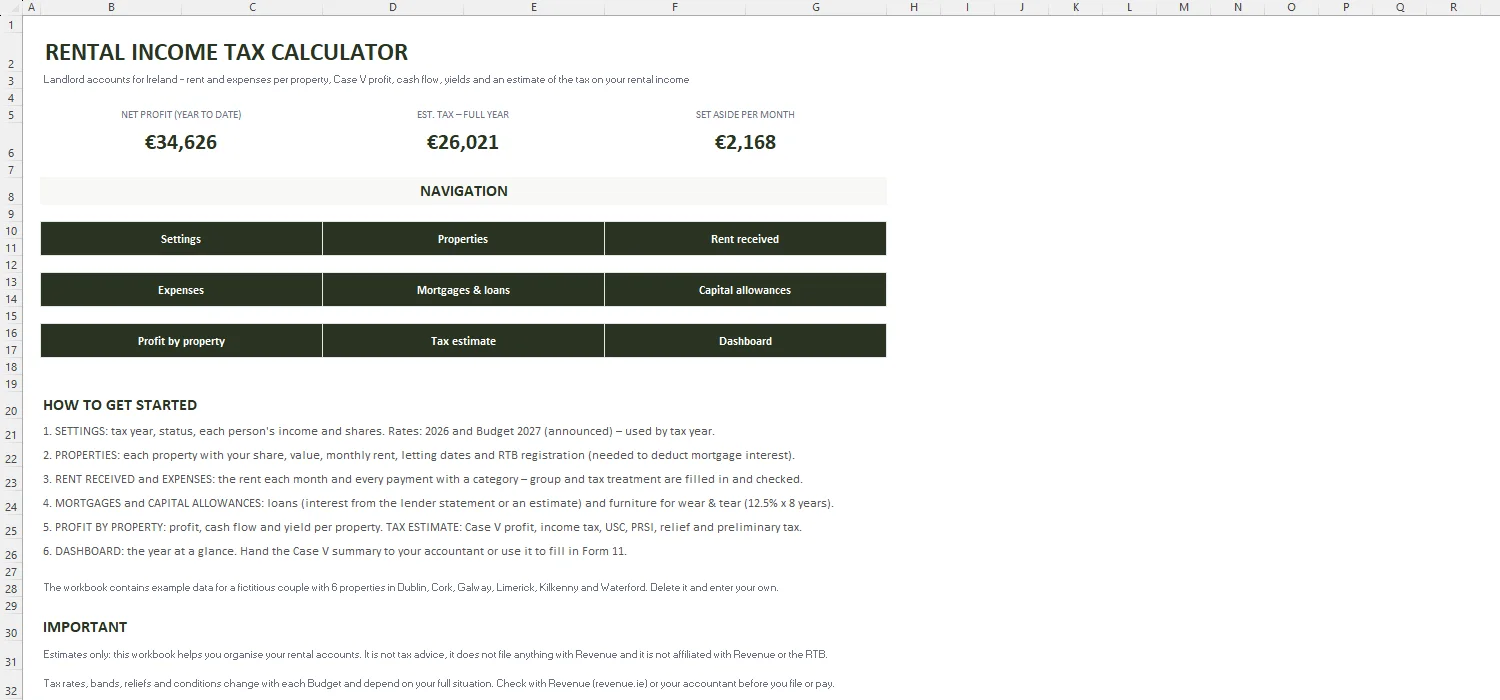
Key figures, quick links and a step-by-step guide.
Tax year, assessment status, each person's income and shares, 2026 rates and the announced Budget 2027 figures (picked by tax year), caps, relief by year and expense categories.
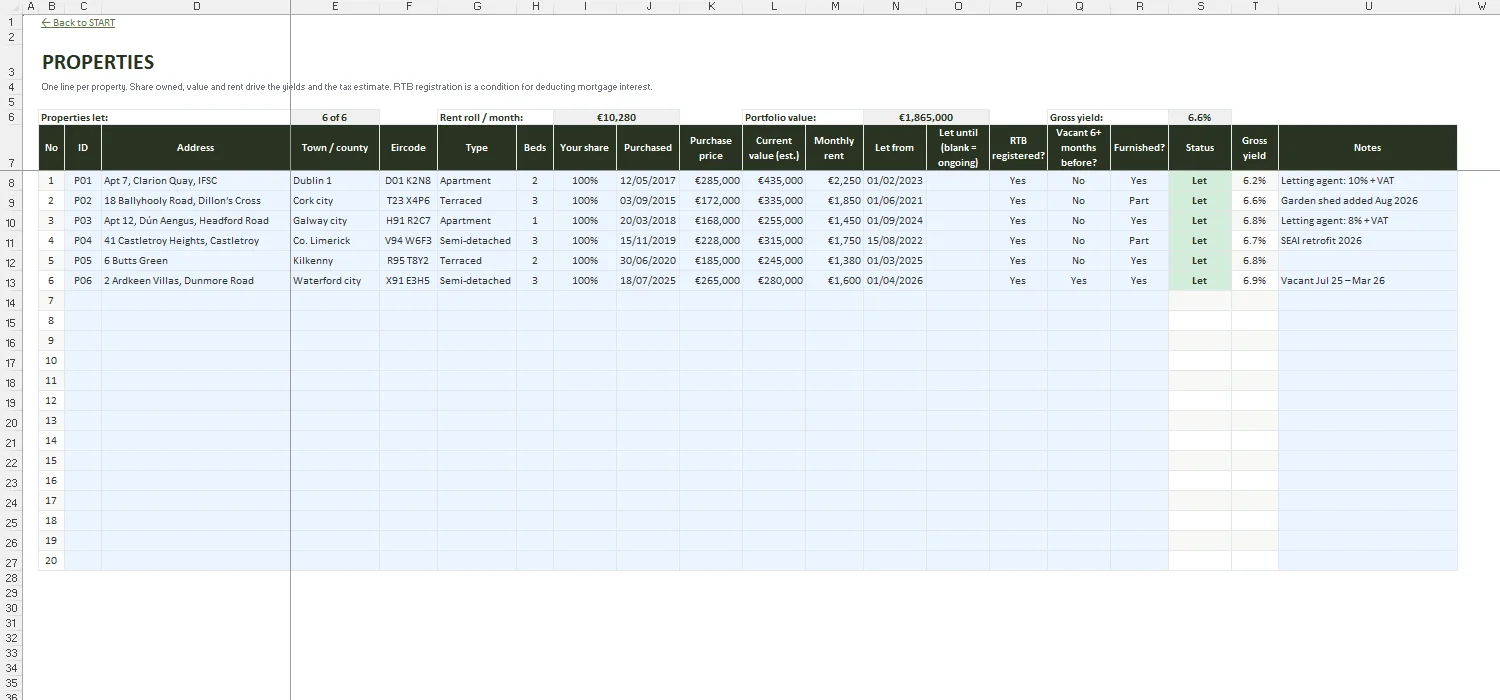
Up to 20 properties with share owned, value, monthly rent, letting dates, RTB registration and the vacant 6+ months flag for pre-letting.
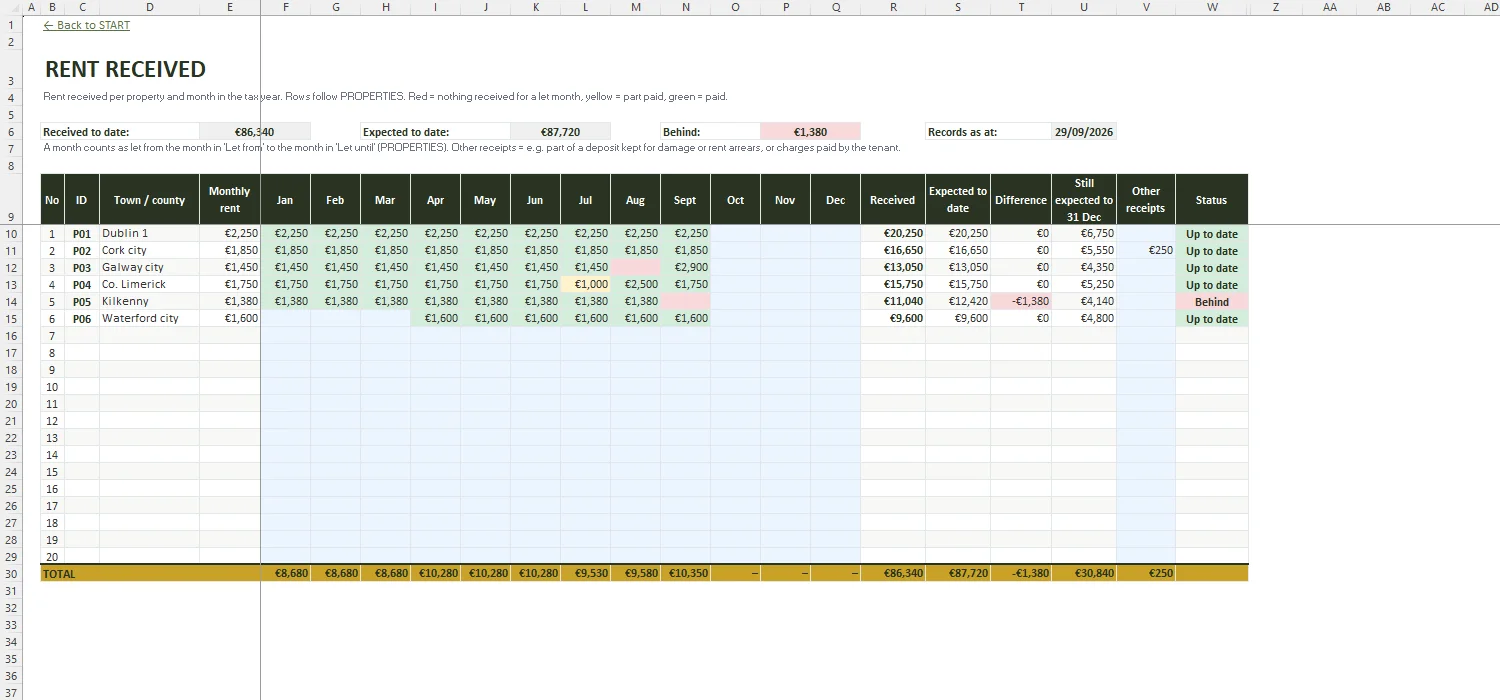
Rent per property and month against the rent expected, the amount still expected to 31 December and other receipts.
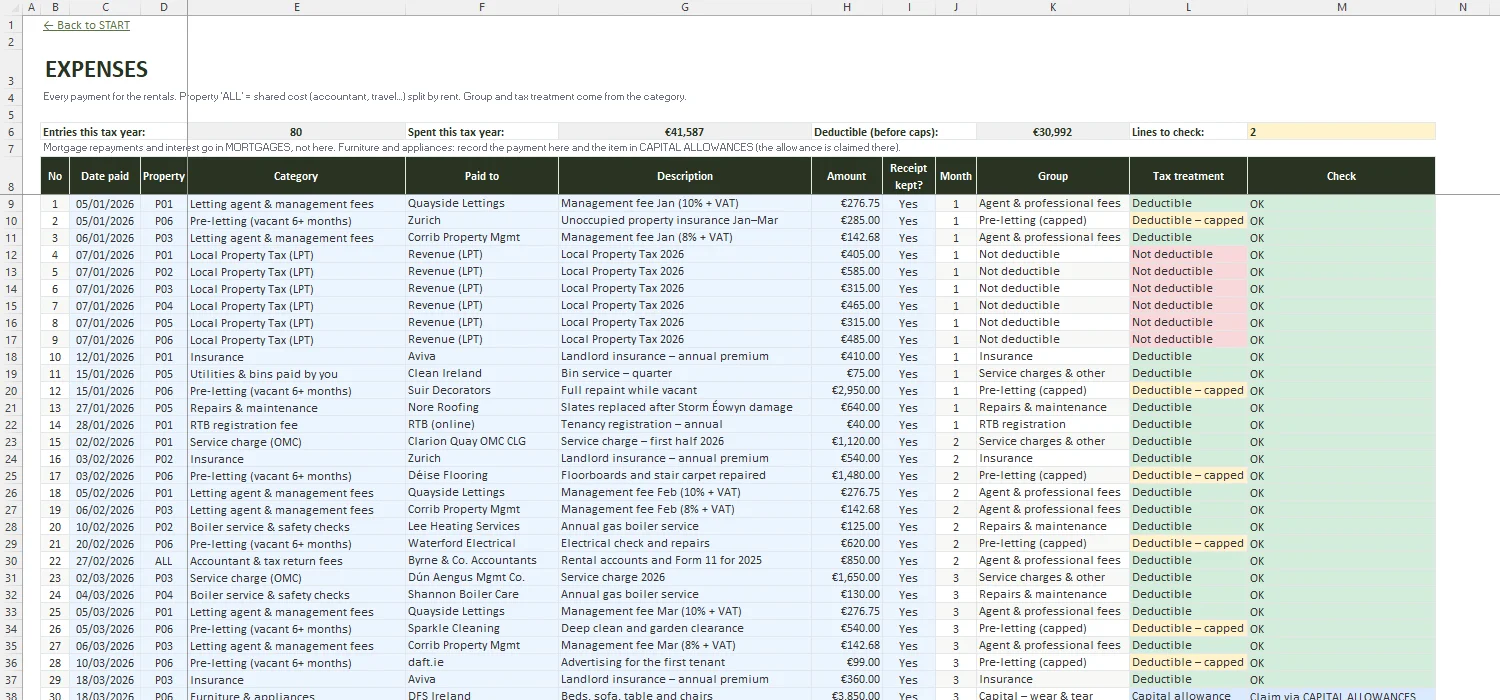
Every payment with property (or ALL, split by rent), category, group and tax treatment – with checks for receipts, tax year and caps.
Loans per property: interest from the lender statement or an estimate, deductible share (RTB, purpose, months let) and repayments.
Wear and tear register for furniture and appliances: allowance this year, year of claim and value still to claim.
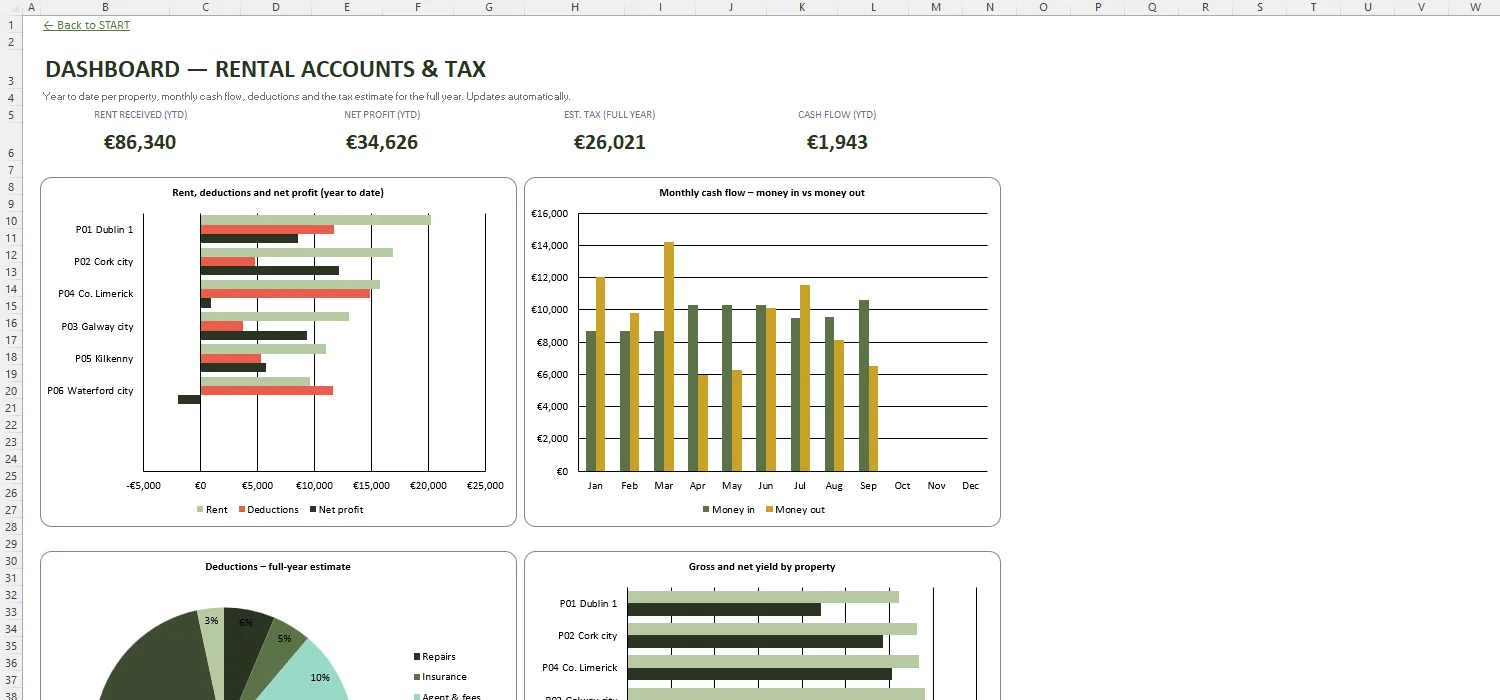
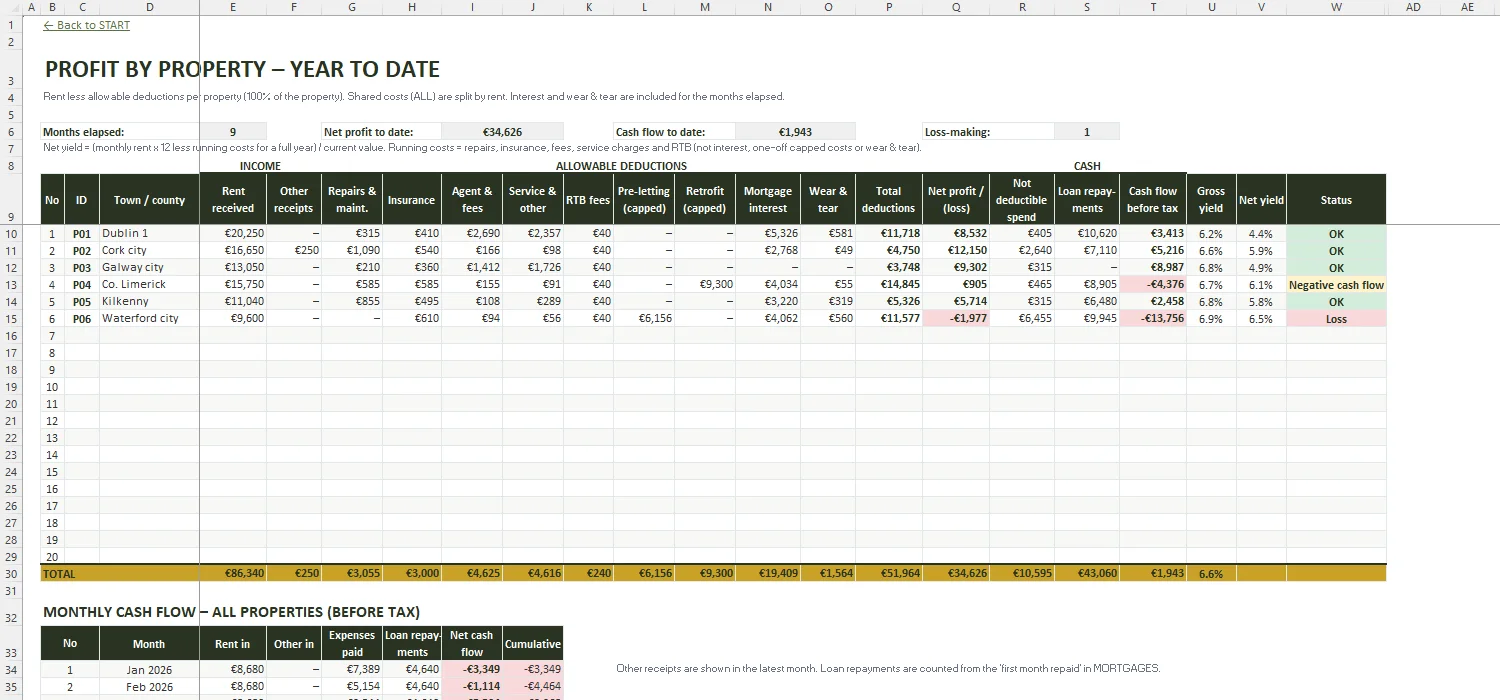
Year-to-date income, deductions, net profit, cash flow, gross and net yield per property, plus monthly cash flow.
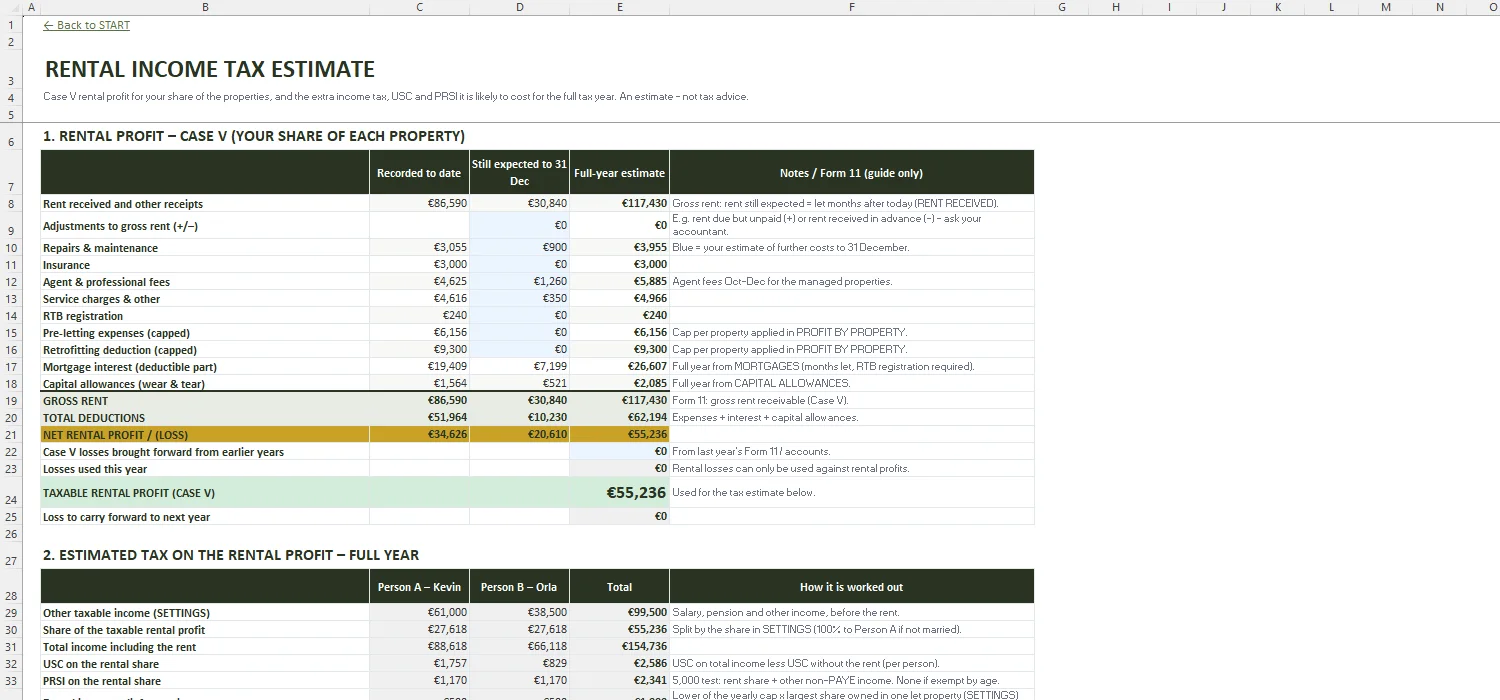
Case V profit for the full year, losses, income tax, USC and PRSI per person, rental income relief per owner, Form 11 check and preliminary tax (90% / 100% / 105% by direct debit).
Rent, deductions and profit per property, monthly cash flow, deductions by type and yields.
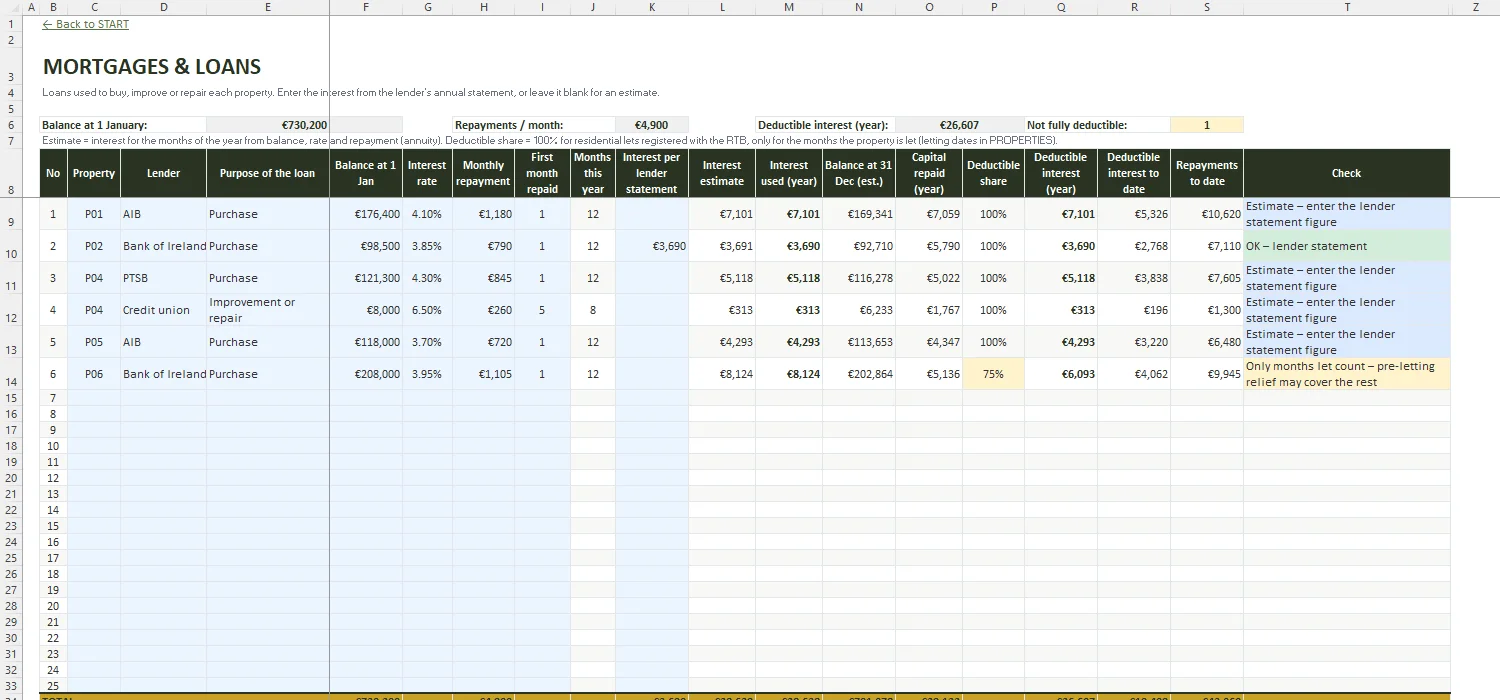
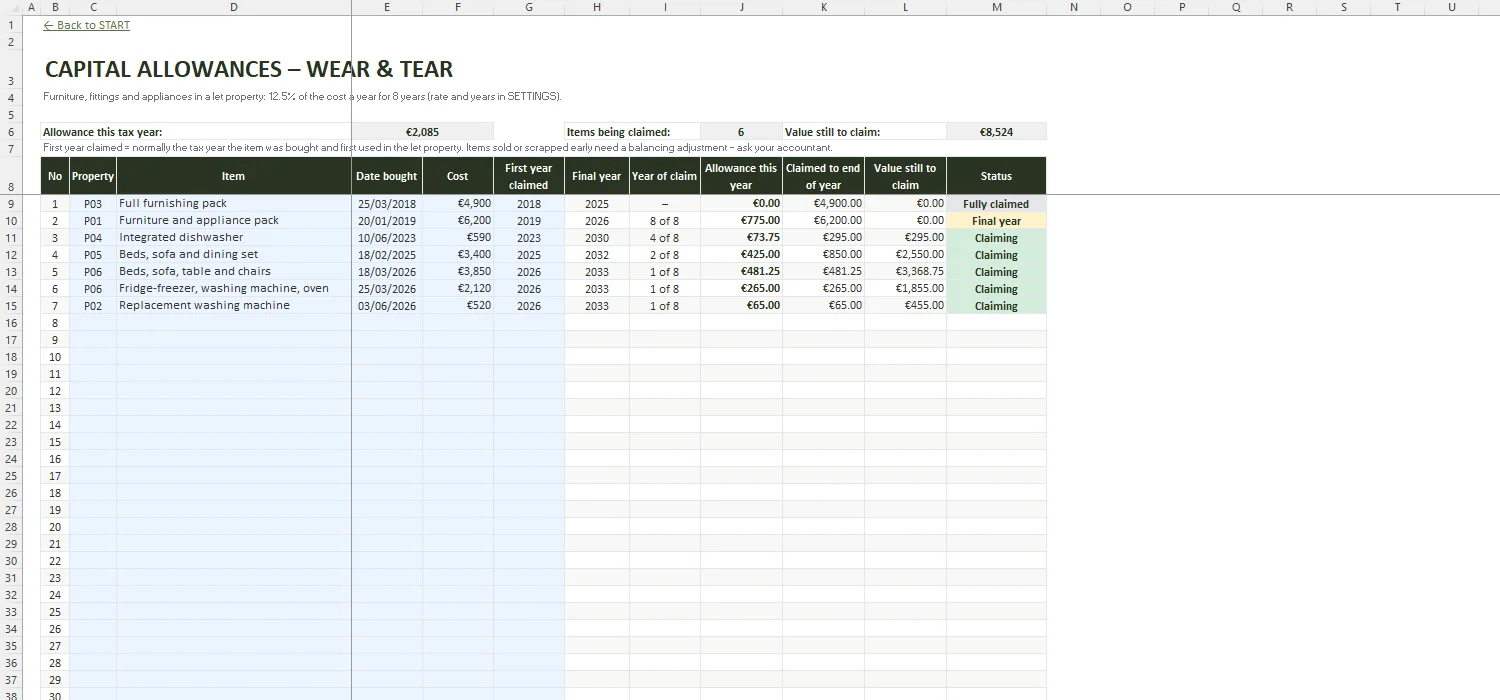
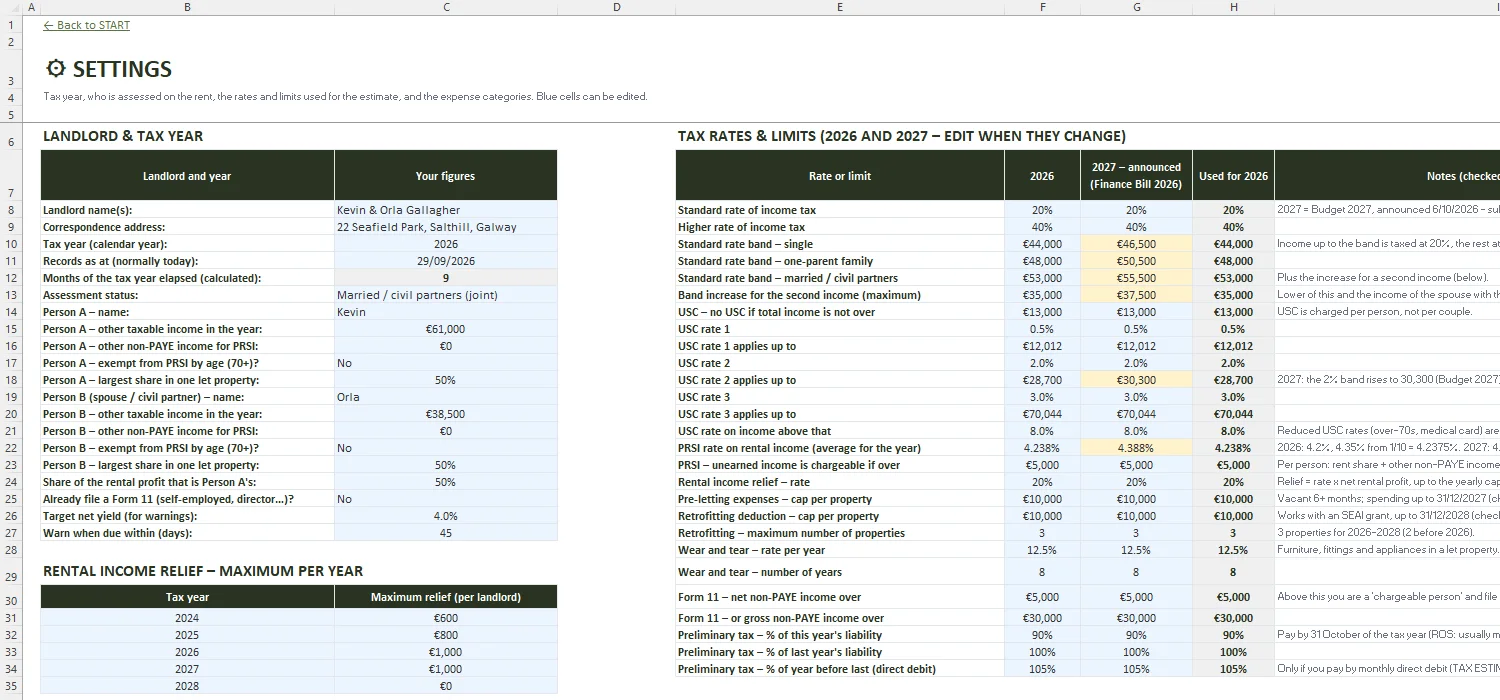
In general: repairs and maintenance, insurance, letting agent and management fees, accountancy fees, service charges, RTB registration fees and mortgage interest on a residential letting (100% if the tenancies are registered with the RTB). Furniture and appliances are claimed as wear and tear at 12.5% a year for 8 years. Local Property Tax, the capital part of repayments and improvements are not deductible. The SETTINGS sheet lists each category with its treatment, and you can edit it.
It takes the Case V profit (rent less allowable expenses, interest and capital allowances, after losses) and works out the extra income tax, USC and PRSI it causes for each person, less the rental income relief. It is an estimate – your Form 11 is the final figure.
Make sure you claim everything you are entitled to: register every tenancy with the RTB so the mortgage interest counts, record wear and tear on furniture, use the pre-letting and retrofitting deductions where they apply, carry forward rental losses and check whether you qualify for the rental income relief. The workbook flags missing receipts, interest that is not deductible and costs that are capital. For planning beyond that, speak to your accountant.
All rent from Irish property is declared, less the allowable deductions. If your net rental income is over €5,000 (or the gross over €30,000) you are a chargeable person and file a Form 11, usually by 31 October with preliminary tax for the current year. Below that, PAYE workers can usually declare it through myAccount. Rent-a-room relief for a room in your own home works differently and is not covered here.
The Residential Premises Rental Income Relief is a tax credit of up to €600 for 2024, €800 for 2025 and €1,000 for 2026 and 2027, limited to 20% of your net rental profit. Each landlord has their own cap; co-owners of the same property share it in proportion to the rent, and the workbook works it out per person. You must, on 31 December, have the tenancies registered with the RTB, be LPT compliant and hold tax clearance, and it is clawed back if the property leaves the rental market within 4 years. The caps are in SETTINGS so you can update them if the relief changes.
No. It is an independent Excel workbook that organises your figures and estimates the tax so there are no surprises. It does not file anything with Revenue and is not tax advice. Many landlords use it to hand clean, property-by-property accounts to their accountant or to fill in the Rental Income (Case V) panel of Form 11 themselves.
Guide for this template
Budget, levies, arrears & sinking fund for OMCs
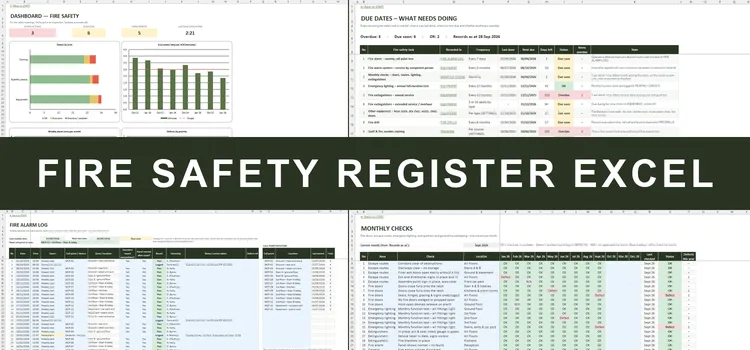
Fire safety log book with due-date alerts for Irish buildings
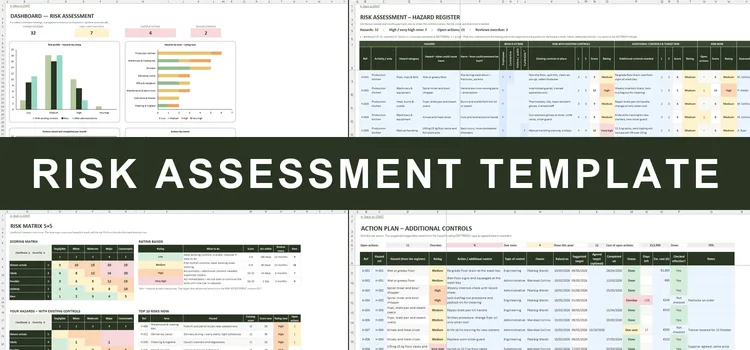
Hazard register, 5×5 risk matrix, action plan & Safety Statement checklist
Landlord accounts for Ireland: rent, expenses, Case V profit and a tax estimate per year · €69
A rental income tax calculator for Ireland is most useful when it is fed by your real figures. This Excel workbook lets you calculate the tax on rental income in Ireland from your own rental income and expenses spreadsheet – rent per property, allowable expenses, mortgage interest and wear and tear – and shows the income tax, USC and PRSI per person.
It also works as a landlord spreadsheet and a landlord tax calculator for Ireland in one: profit and cash flow per property, a rental yield calculator, the rental income tax relief, losses carried forward and preliminary tax, ready for your Form 11 or your accountant.