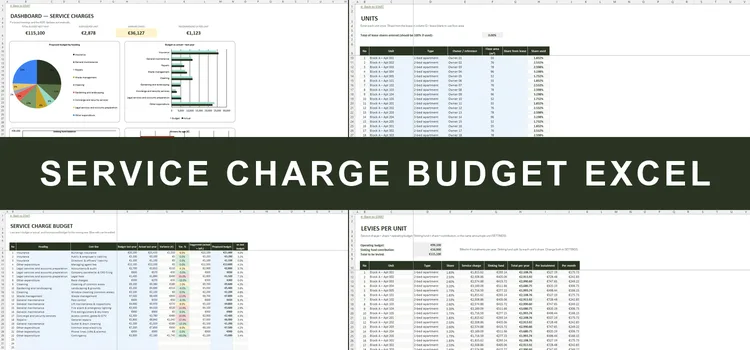
Service Charge Budget Excel
Budget, levies, arrears & sinking fund for OMCs
- Budget in the 9 categories of the MUD Act, vs actual
- Levy per unit from the lease share or floor area
- Arrears aged 0–30 / 31–60 / 61–90 / 90+ days
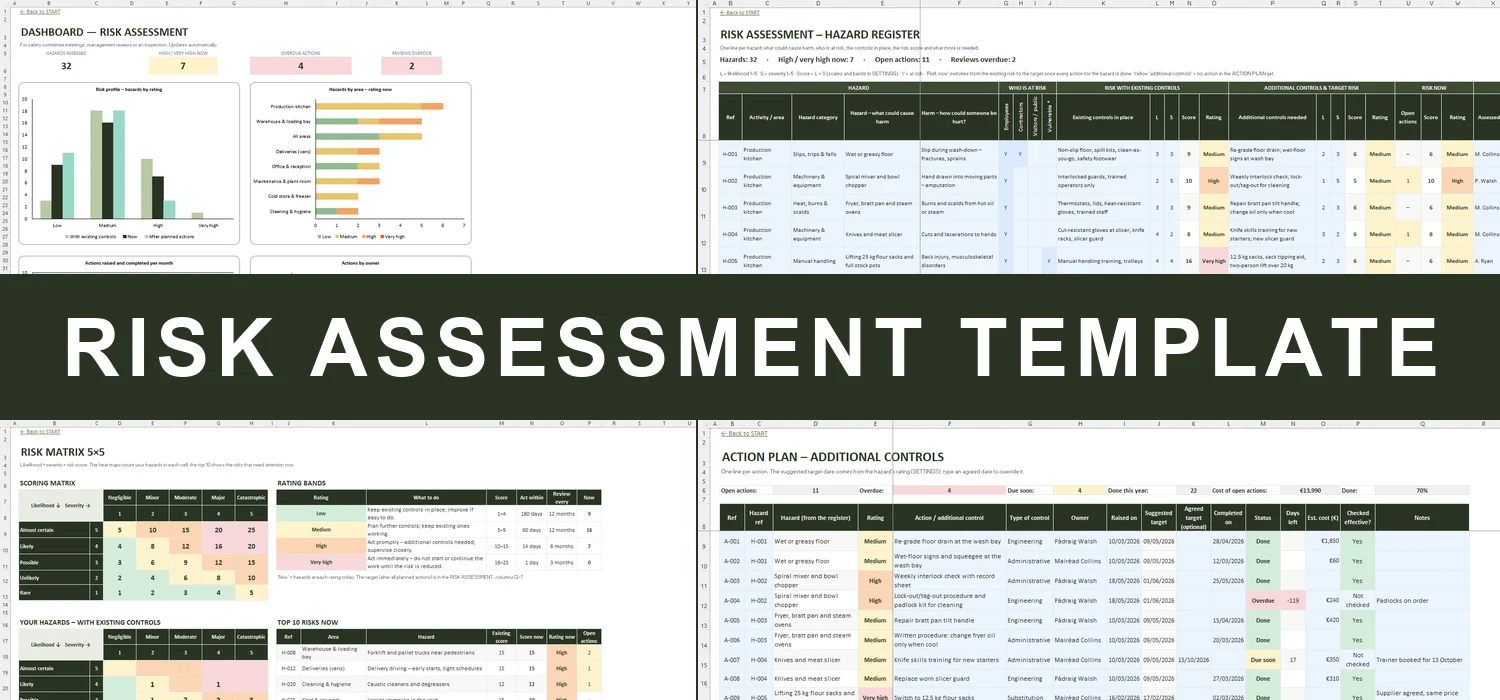
Hazard register, 5×5 risk matrix, action plan & Safety Statement checklist


List your hazards, score them on a 5×5 matrix, give every extra control an owner and a date – and see at a glance which risks are still high and what is overdue.
Most risk assessments are written once, filed and forgotten. The form says 'install barrier' or 'train new starters', but nobody checks whether it happened, the review date slips and the Safety Statement no longer matches how the business really works. Under the Safety, Health and Welfare at Work Act 2005, the written risk assessment and Safety Statement are meant to be living documents.
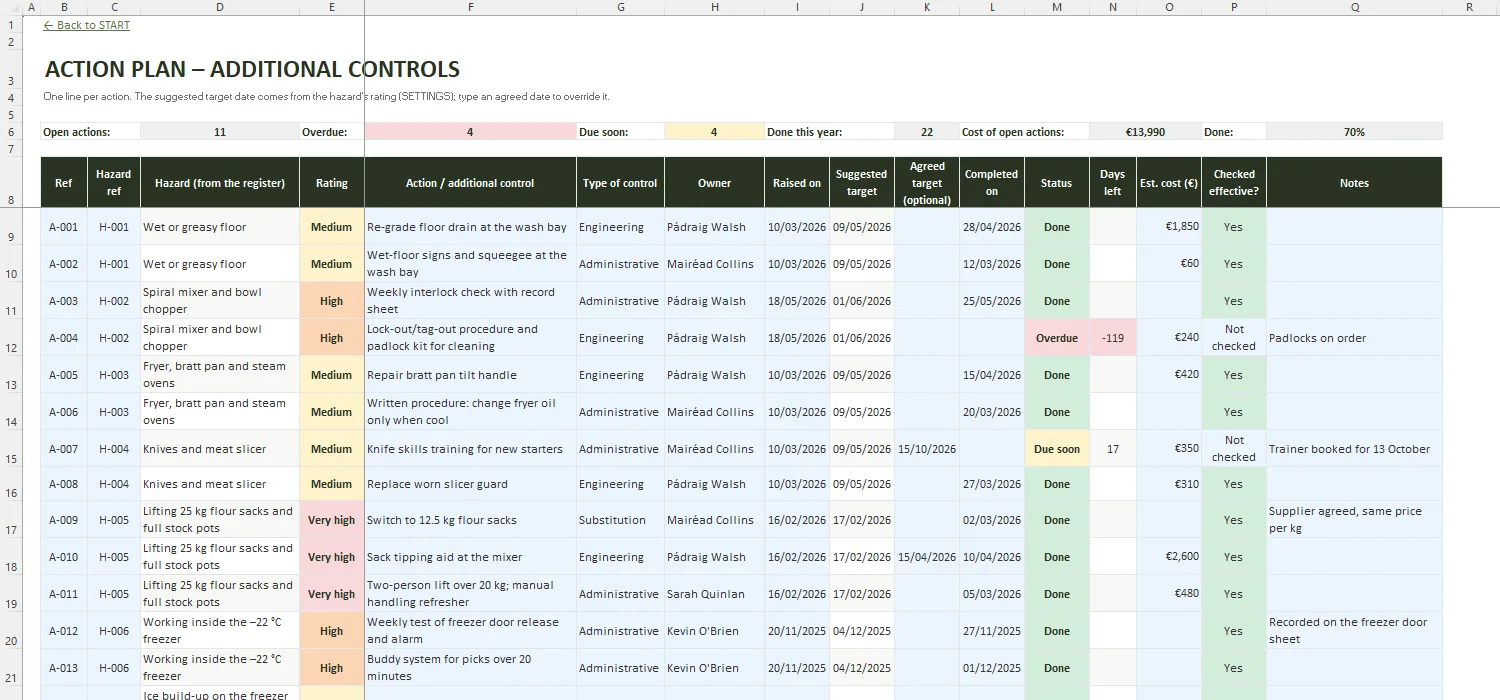
This workbook keeps the familiar layout – hazard, who might be harmed, existing controls, likelihood × severity, additional controls – and adds the follow-up. Each additional control becomes an action with an owner and a target date suggested by the rating. When all actions for a hazard are done, the current risk drops to the target. Reviews, consultation with employees, staff briefings and a Safety Statement checklist sit alongside, with a dashboard for your safety committee.
Key figures, quick links and a step-by-step guide.
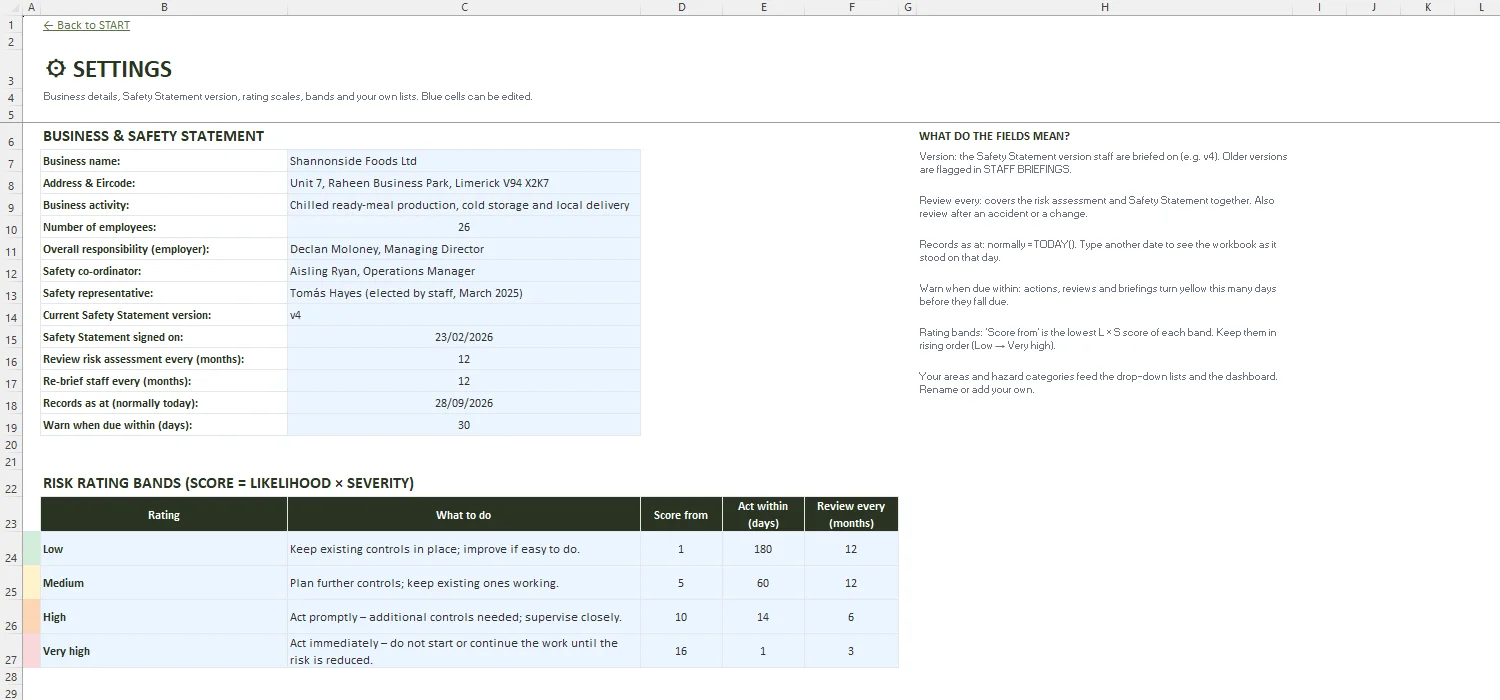
Business details, Safety Statement version, 5×5 scales, rating bands, action times, review intervals and your own areas.
Hazard register: area, hazard, harm, who is at risk, existing controls, score, additional controls, target and risk now.
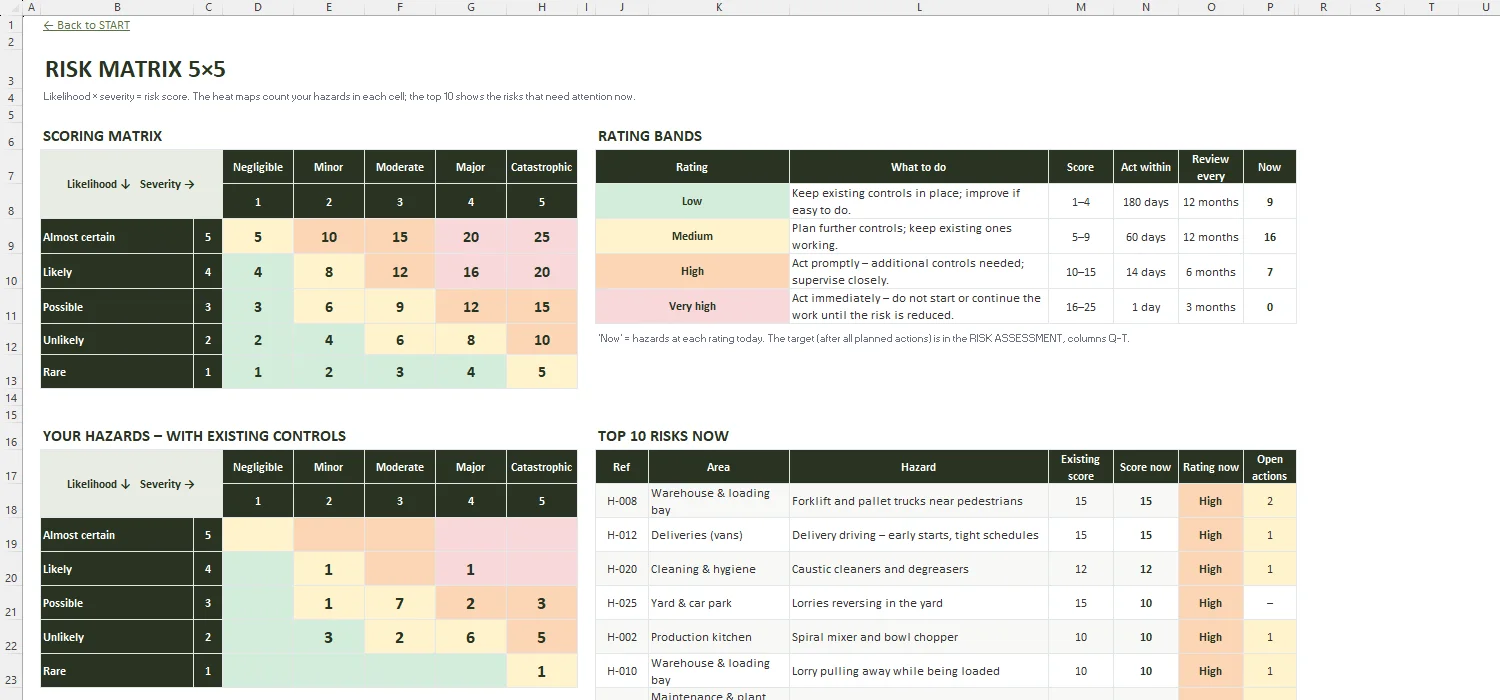
5×5 scoring matrix, rating bands, heat maps of your hazards and the top 10 risks now.
Every additional control with owner, suggested and agreed target date, status, cost and effectiveness check.
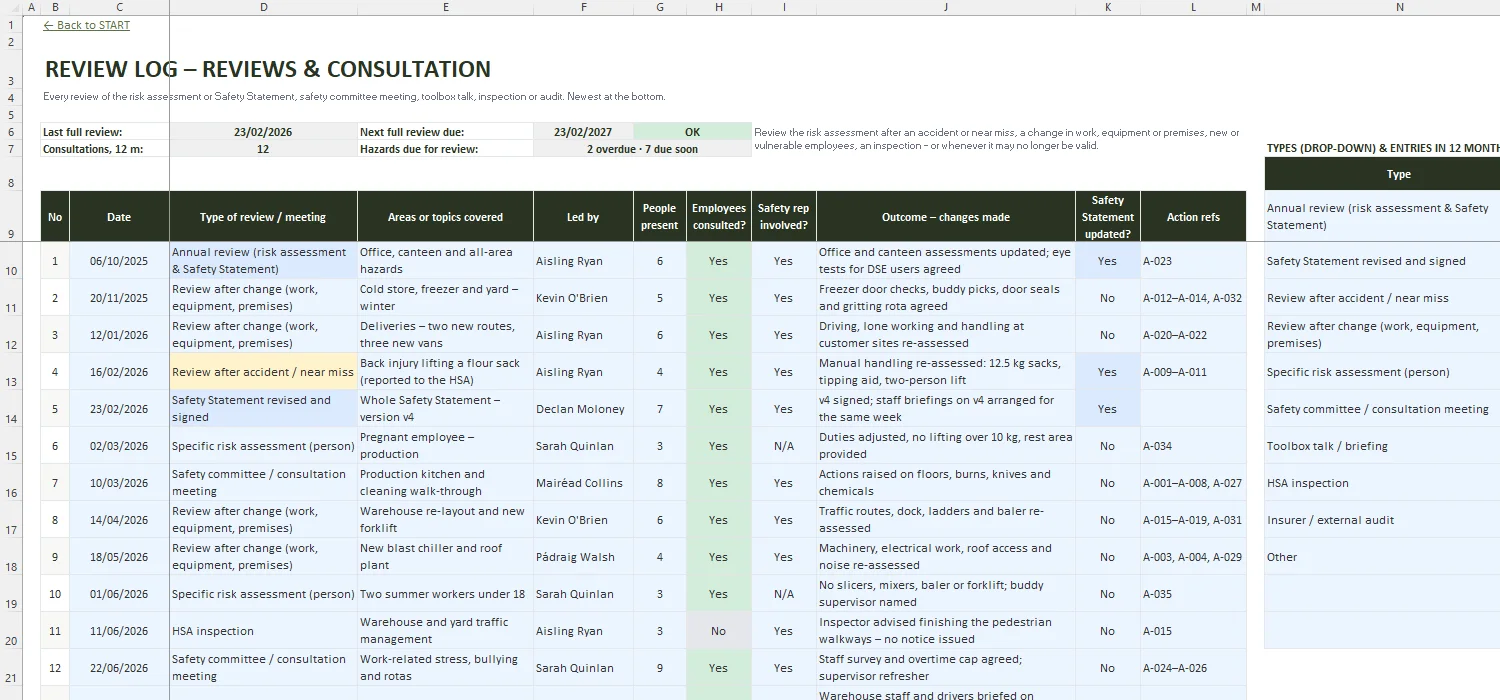
Reviews, safety committee meetings, toolbox talks and inspections – with the next full review date.
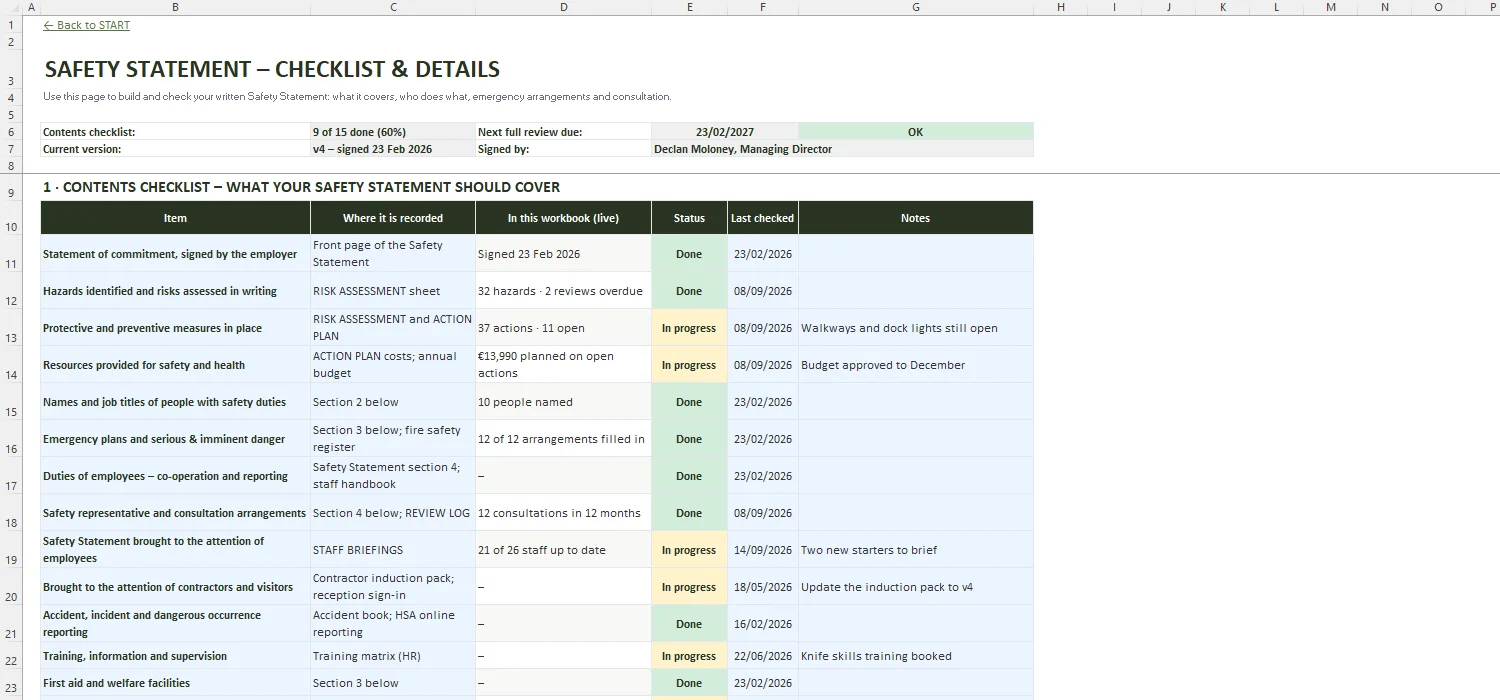
Contents checklist with live evidence, responsibilities, emergency arrangements and consultation.
Who has been briefed on the current version, re-brief dates and specific risk assessments (young, pregnant, night workers).
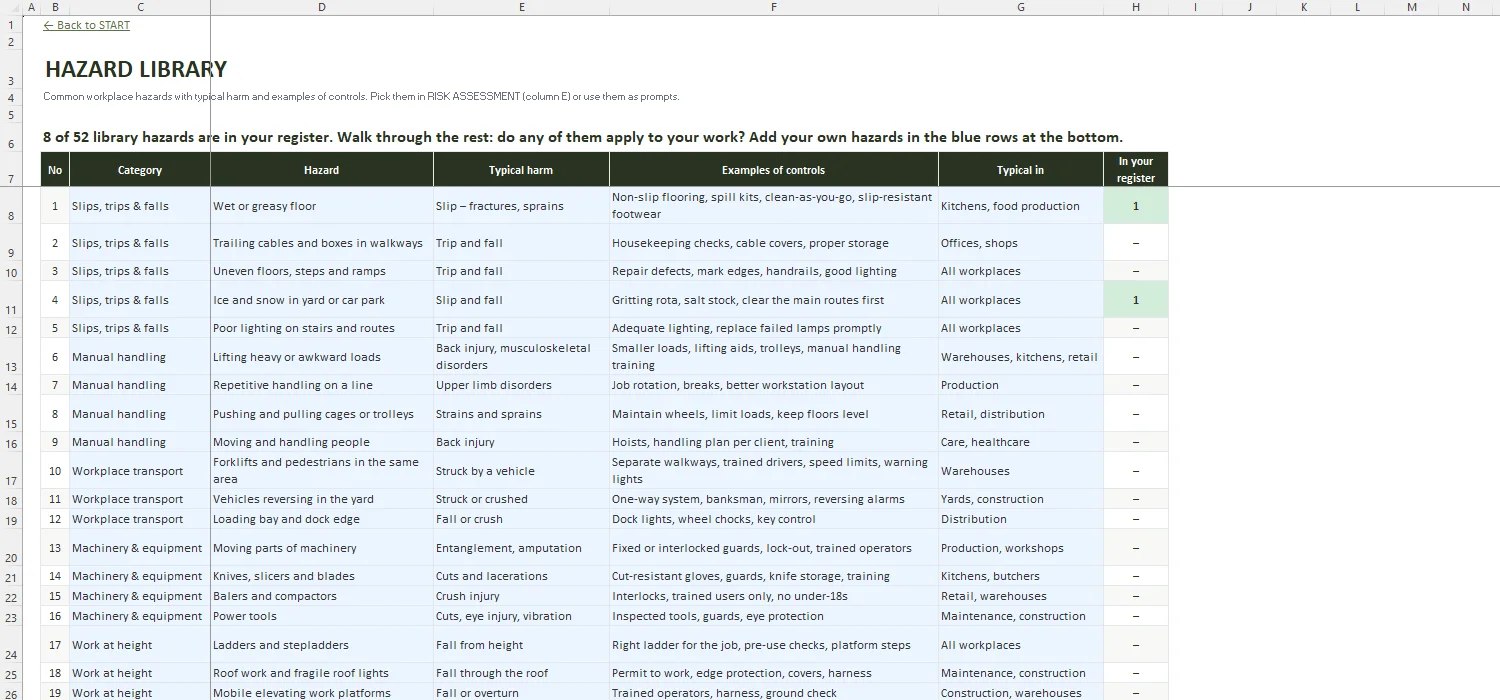
52 common workplace hazards with typical harm and examples of controls – also the drop-down for the register.
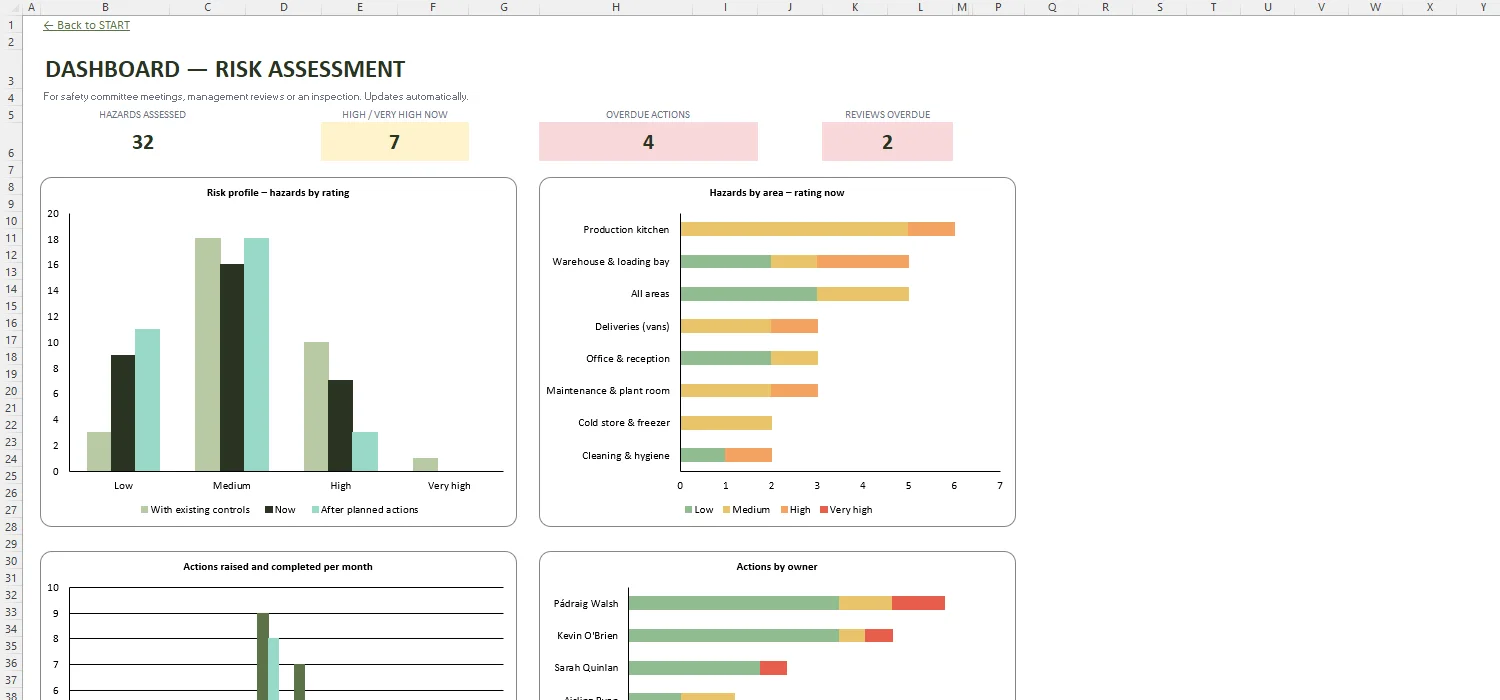
Risk profile before and after controls, hazards by area, actions per month and by owner.
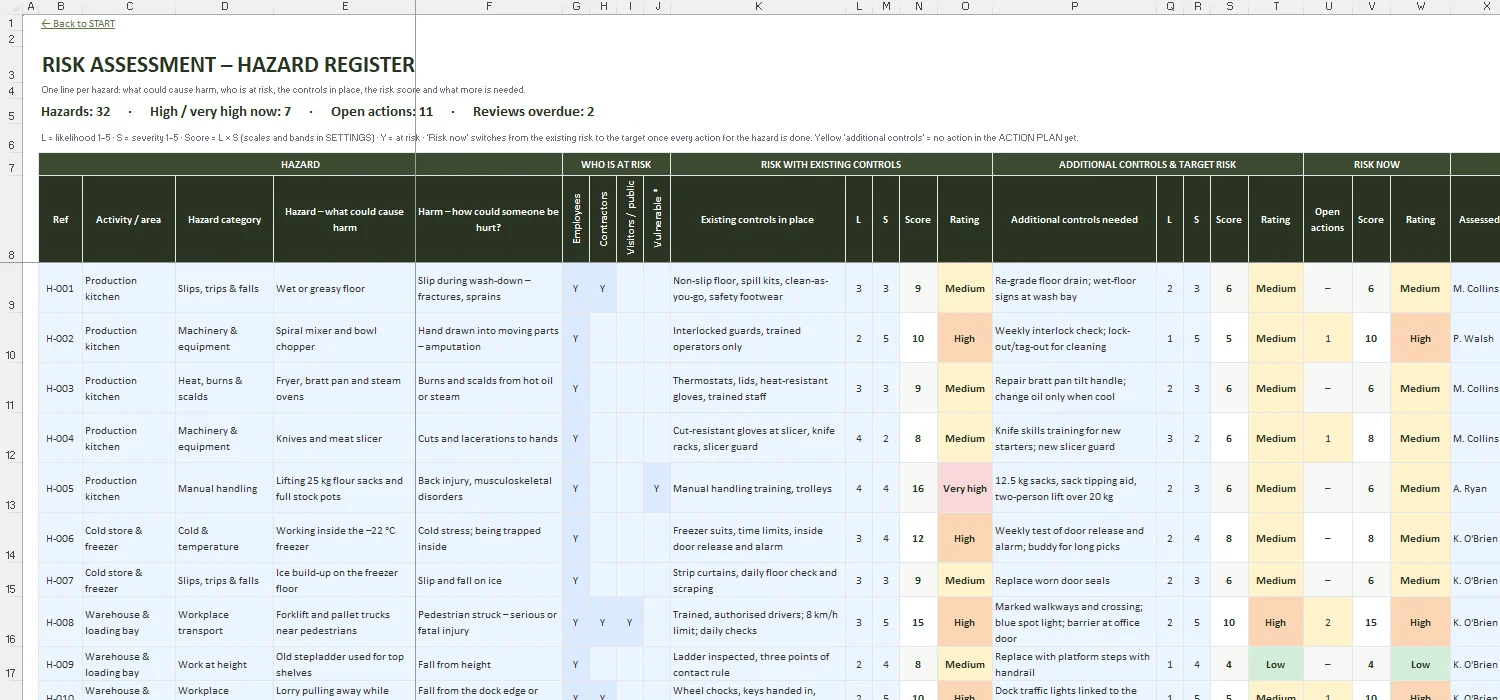
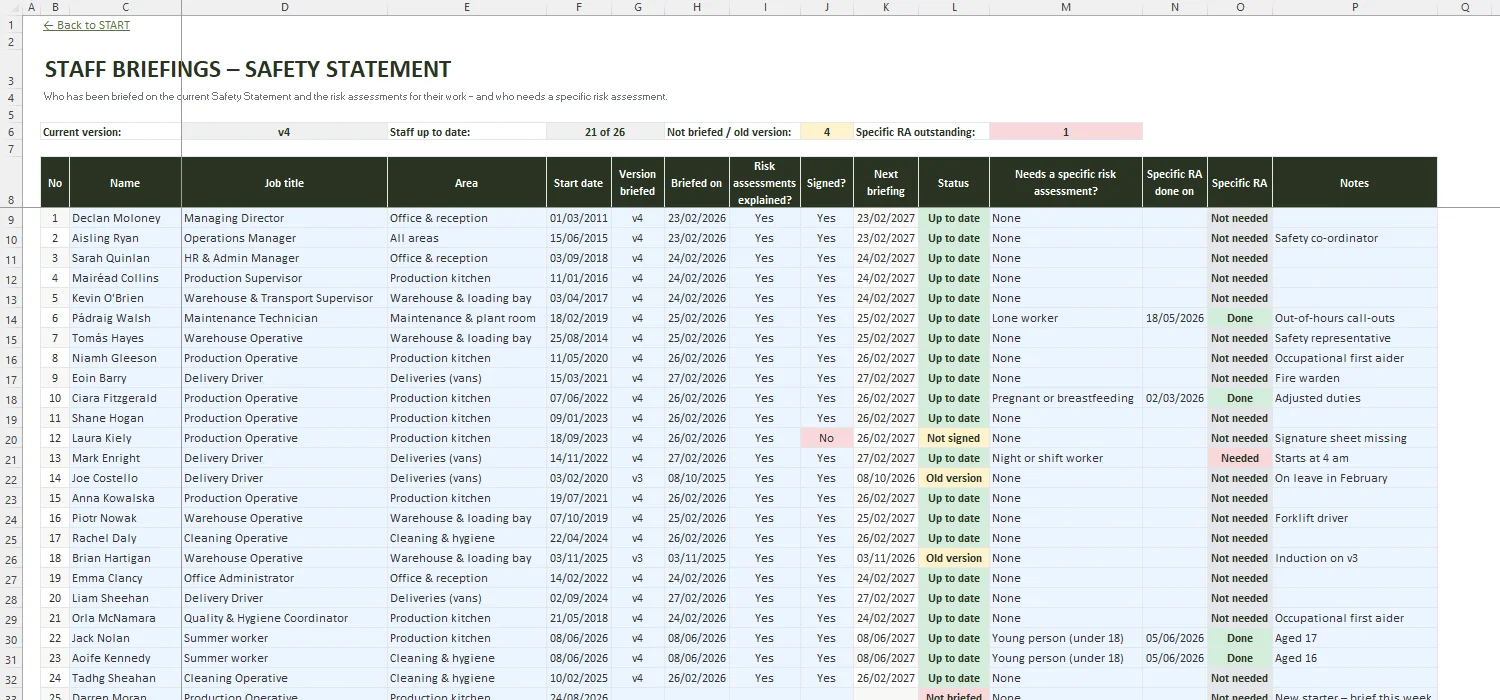
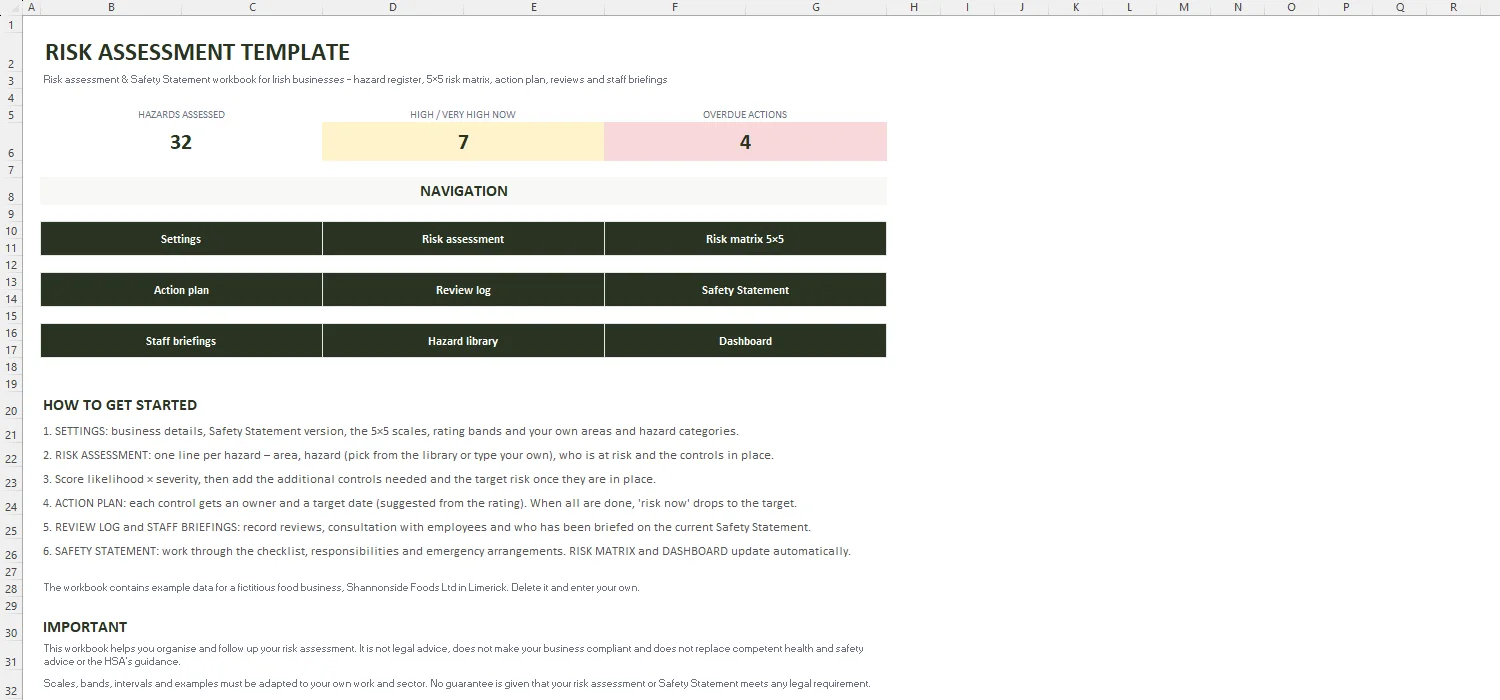
Usually: the hazards, who might be harmed and how, how serious the risk is with the controls you already have, what more you need to do (and who does it, by when), and when you will review it. The RISK ASSESSMENT sheet has a column for each of these, and the ACTION PLAN and review dates make sure the last two actually happen.
Walk through each area and activity, list what could cause harm and who could be hurt, note the controls already in place and score likelihood × severity from 1 to 5. Where the risk is not low enough, add further controls and the target score. The hazard library gives 52 common hazards as prompts, and involving the people who do the work usually gives the best results.
Section 20 of the Safety, Health and Welfare at Work Act 2005 requires employers to prepare a written Safety Statement based on the hazard identification and risk assessment, and to bring it to the attention of employees and others at risk. It also covers matters such as emergency plans, the people responsible and consultation. The workbook gives you a checklist and the supporting records – check the HSA's current guidance for what yours must contain.
Likelihood (1 = rare to 5 = almost certain) is multiplied by severity (1 = negligible to 5 = fatality or permanent disability). The score from 1 to 25 falls into a band – low, medium, high or very high – that sets how quickly you act and how often you review. You can rename the bands and change the thresholds in SETTINGS.
BeSMART.ie from the HSA is free and a good way to create a risk assessment and Safety Statement. This workbook focuses on managing them afterwards: owners and target dates for every action, overdue warnings, the current risk versus the target, review dates, consultation records, staff briefings and a dashboard. Many businesses use both.
No workbook can do that. It helps you organise, prioritise and follow up your risk assessment and keep clear records, but compliance depends on what you assess and what you actually do. It does not replace competent health and safety advice.
Budget, levies, arrears & sinking fund for OMCs
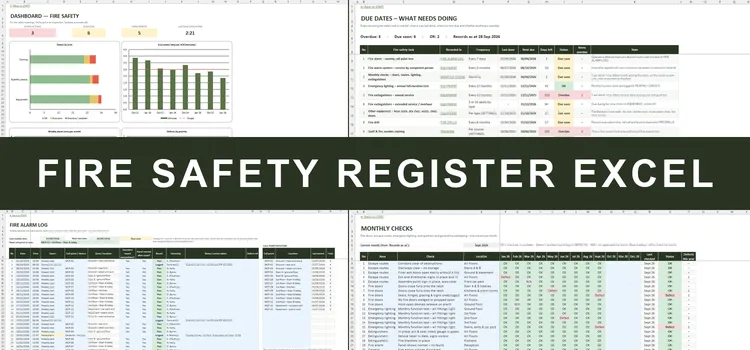
Fire safety log book with due-date alerts for Irish buildings
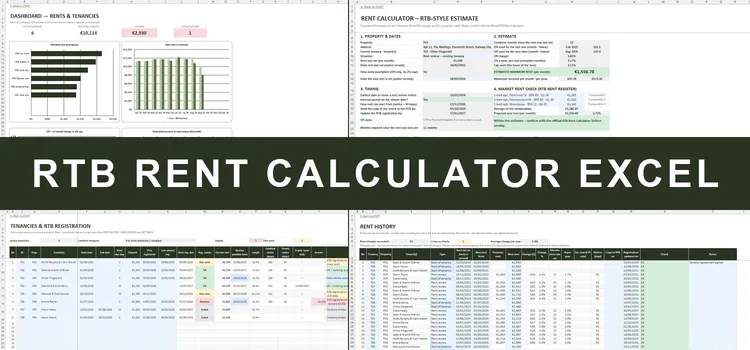
Rent review estimate, tenancy register & RTB deadlines for Irish landlords
Hazard register, 5×5 risk matrix, action plan & Safety Statement checklist · €79
A risk assessment template helps you record the hazards in your workplace, who could be harmed, the controls in place and what more is needed. This Excel version uses a 5×5 risk matrix (likelihood × severity) with colour-coded ratings and doubles as a risk register template: every hazard has an owner, a review date and a status.
For Irish businesses it also supports the Safety Statement: a safety statement template checklist, names and job titles of the people responsible, emergency arrangements, consultation with employees and a record of who has been briefed. Use it alongside the HSA's BeSMART tool or your own documents to keep your risk assessment up to date.