Statutory Sick Pay Ireland 2026: How Many Days, the Rate, the €110 Cap and the Records to Keep
Why it is still 5 days in 2026, how to work out the daily rate, a worked example with two employees, how Illness Benefit takes over – and the records the Sick Leave Act requires.
Contents
Statutory sick pay Ireland 2026, in one line: an employee with at least 13 weeks' continuous service gets up to 5 paid sick days per calendar year, paid by the employer at 70% of normal daily pay, capped at €110 a day, for days covered by a medical cert. The rules come from the Sick Leave Act 2022, and the 5 days have applied since 1 January 2024.
Getting it wrong costs money either way. Underpay and the employee can bring a complaint to the Workplace Relations Commission (WRC). Pay a sixth day by mistake and you have paid for a day the law doesn't require. The usual cause isn't the law – it's that nobody knows how many statutory days each person has already used this year.
Statutory sick pay Ireland 2026: still 5 days
The Act started at 3 days and lets the Minister raise the number by order. The plan was 7 days in 2025 and 10 in 2026. That plan was dropped: on 8 April 2025 the Minister for Enterprise, Tourism and Employment confirmed the entitlement stays at 5 days per calendar year.
| Year | Statutory sick days | Legal basis |
|---|---|---|
| 2023 | 3 | Sick Leave Act 2022, s. 5(2) |
| 2024 | 5 | S.I. No. 10 of 2024 |
| 2025 | 5 | No new order (7 days not introduced) |
| 2026 | 5 | No new order (10 days not introduced) |
You will still find payroll and HR pages saying "10 days from 2026". They describe the old plan. The Irish Statute Book's list of orders under the Act, updated to 13 October 2026, still shows only S.I. No. 10 of 2024.
What about 2027? Nothing has been announced. Budget 2027 (6 October 2026) did not touch sick leave, and in January 2026 the Minister said the door to more days was "firmly closed" (Irish Examiner). Any increase would need a new ministerial order, and the Act limits each order to 3 extra days. Plan on 5 days for 2027 unless an order is made.
Who qualifies: 13 weeks' service and a medical cert
Section 5 of the Act sets three conditions:
- 13 weeks' continuous service with you before the sick day. Someone who left and came back within 26 weeks keeps their earlier service.
- A medical cert signed by a registered medical practitioner, stating the employee is unable to work. Citizens Information says the cert should cover the absence from day 1.
- A day they would normally work. A Monday-to-Friday employee who is sick over a weekend uses no statutory days for Saturday and Sunday.
There are no waiting days: the first certified day is the first statutory sick day. The days don't have to be in a row. Part-time staff get the full 5 days, and probationers, apprentices and agency workers are covered too. A person with two jobs gets 5 days from each employer once they have 13 weeks with that employer (WRC).
How much to pay: 70% of normal pay up to €110 a day
The daily rate is set by S.I. No. 607 of 2022. It is a gross amount: the lower of €110 or 70% of normal daily pay. Regular bonuses and allowances that don't depend on the work done are included; overtime and commission are not. What "normal daily pay" means depends on how the person is paid:
| How the employee is paid | Daily statutory sick pay |
|---|---|
| Fixed salary or wage, or fixed hours at a fixed rate | 70% of the pay for the normal daily hours last worked, max €110 |
| Fixed hourly rate, variable hours | 70% of what they would have earned on the sick day, max €110 |
| Anything else | 70% of the average hourly rate over the previous 13 weeks × hours due that day, max €110 |
The cap bites once normal daily pay passes €157.14. For someone on a five-day week, that's weekly pay above about €785.71. Below that, you pay 70%. A part-timer on 5 hours at €16 an hour earns €80 a day, so statutory sick pay is €56 a day.
Worked example: two employees, two sick spells
Example (fictional): a garden centre in Co. Tipperary with two full-time staff on a Monday-to-Friday week, both with no company sick pay scheme.
| Aoife | Ciarán | |
|---|---|---|
| Weekly pay | €650 | €1,050 |
| Normal daily pay (÷ 5) | €130.00 | €210.00 |
| 70% of daily pay | €91.00 | €147.00 |
| Statutory sick pay per day | €91.00 | €110.00 (cap) |
Aoife has been with you since 2024. She is certified sick Monday 9 to Friday 13 March 2026: 5 working days × €91 = €455. That uses all 5 of her days for 2026. When she is out sick again, certified, from Tuesday 6 to Friday 9 October, there is no statutory sick pay left. If she has enough PRSI contributions, she claims Illness Benefit instead: Tuesday to Thursday are waiting days, so it can start on Friday 9 October, day 4 of that illness.
Ciarán started on Monday 6 July 2026, so he reaches 13 weeks' service on Monday 5 October. His one-day illness on Thursday 1 October gets no statutory sick pay, cert or not. Certified sick from Monday 12 to Wednesday 14 October, he gets 3 × €110 = €330 and has 2 days left for the rest of 2026.
Your statutory sick pay for the year so far: €455 + €330 = €785. The most it can ever be is 5 × €110 = €550 per employee per year.
Notice what the example needed: a count of each person's days per calendar year, their start date, the cert, and a daily rate per person. Those are the same items the law asks you to keep.
Statutory sick pay, Illness Benefit and your company sick pay scheme
Three different things often get mixed up:
- Statutory sick pay is paid by you, the employer, for up to 5 days.
- Illness Benefit is a weekly social welfare payment from the Department of Social Protection. The employee claims it, needs enough PRSI contributions and must apply within 6 weeks. It can't be paid for the same days as statutory sick pay.
- A company scheme is whatever your contract or handbook offers on top.
How they fit together, according to Citizens Information: Illness Benefit normally has 3 unpaid waiting days. If the illness lasts more than 5 days and the employee is getting statutory sick pay, Illness Benefit starts from day 6. If the 5 days are already used up and they get sick again later in the year, it starts from day 4. The maximum personal rate in 2026 is €254 a week, and Budget 2027 adds €10 from January 2027.
Two rules catch employers out. First, statutory sick days can't be tacked on to a spell that is already running (section 5(4A)). An employee still out sick on 1 January, or already on Illness Benefit when they reach 13 weeks' service, stays on Illness Benefit for that spell; the statutory days only become available once they are back at work. Second, your own scheme replaces statutory sick pay only if it is more favourable as a whole. Section 9 of the Act compares the service needed, waiting days, how long and how much it pays, and the reference period. A scheme that pays full salary but only after three unpaid days isn't automatically better – check it, and don't pay both.
The records an employer should keep
Section 13 of the Act requires a record of statutory sick leave for every employee who takes it, with:
- the employee's period of employment;
- the dates and times of the statutory sick leave;
- the rate of statutory sick pay paid.
You must keep the record for 4 years. Failing to make or keep it without reasonable cause is an offence carrying a class C fine, up to €2,500 according to the WRC. In practice, keep the medical certs with the record too: they are the proof that each paid day was a certified day.
A good record also answers the questions you'll get every time someone rings in sick: how many statutory days has this person used this year, have they passed 13 weeks, and what is their daily rate? If a sick day was shorter than a full day, note the times – the Act asks for them.
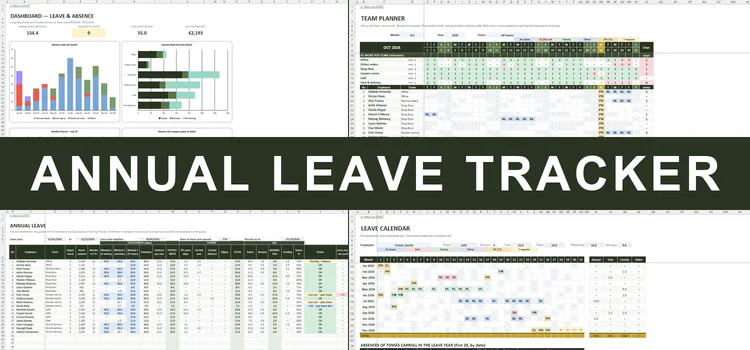
Our annual leave and sick leave tracker for Irish employers keeps this in one workbook. You log each absence on one line with the type (certified or uncertified sick leave), dates, half days and whether there's a medical cert. It counts working days on each person's own pattern, works out the date they pass 13 weeks, and shows statutory sick days used, left and paid per calendar year. It flags sick days marked "no cert" and those that fall before the 13 weeks are up. The daily rate is weekly pay ÷ days per week at 70%, capped at €110, and the figures are editable in SETTINGS; for variable pay you check the 13-week average yourself. If the sick day leaves a shift short, a staff rota with cover per time slot shows who else is on.
This guide is a plain-English summary of the law as of 21 October 2026, not legal or payroll advice. Sectoral agreements, company schemes and unusual pay patterns can change the answer – check with the WRC, Citizens Information or your adviser.
Frequently asked questions
Is statutory sick pay taxable?
Yes. Revenue treats pay an employer makes while an employee is out sick like any other pay, so Income Tax, PRSI and USC are deducted through payroll. Illness Benefit is different: Revenue collects the tax on it by reducing the employee's tax credits, not through wages.
Can unused sick days be carried over to next year?
No. Statutory sick days run per calendar year and unused days lapse on 31 December. A sick spell can't continue from one year into the next either: the new year's days only become available once the employee has returned to work.
Is there a form for statutory sick pay?
No. The Sick Leave Act has no claim form: the employee gives you a medical cert from a registered medical practitioner, you pay the sick days through payroll and you record them as section 13 requires. The forms people usually mean are for Illness Benefit – the online claim on MyWelfare.ie or the paper IB1 form – which the employee sends to the Department of Social Protection.
Do certified sick days reduce annual leave?
No. Certified sick days during a holiday don't count as annual leave, and employees keep building up annual leave while on certified sick leave. Leave they couldn't take because of illness can be carried over for up to 15 months after the end of the leave year.
Can an employer refuse to pay statutory sick pay?
Only with an exemption from the Labour Court, granted for 3 to 12 months to a business in severe financial difficulty. Otherwise the employee can complain to the WRC within 6 months (extendable by another 6 for reasonable cause), and compensation can be up to 4 weeks' pay.
Sources
- Irish Statute Book – Sick Leave Act 2022 (No. 24 of 2022) – s. 5 (13 weeks, medical cert, 'would ordinarily work'), s. 6 (orders, max +3 days), s. 7, s. 9 (more favourable scheme), s. 10 (Labour Court exemption), s. 13 (records, 4 years), s. 14 (4 weeks' compensation)
- Irish Statute Book – S.I. No. 607/2022, Sick Leave Act 2022 (Prescribed Daily Rate of Payment) Regulations 2022 – lower of €110 or 70%; three pay categories; 13-week average
- Irish Statute Book – S.I. No. 10/2024, Sick Leave Act 2022 (Increase of Statutory Sick Leave Days) Order 2024 – 5 days from 1 January 2024
- Irish Statute Book – Legislation Directory: Sick Leave Act 2022 (updated to 13 October 2026) – only S.I. 10/2024 made under s. 6; amendments by the Social Welfare (Miscellaneous Provisions) Act 2023
- Irish Statute Book – Social Welfare (Miscellaneous Provisions) Act 2023, s. 21 – new s. 5(4A): no statutory sick leave if the previous working day was sick leave in the previous year or on Illness Benefit
- Department of Enterprise, Tourism and Employment (gov.ie) – Entitlement to statutory sick leave to remain unchanged at 5 days (8 April 2025)
- Workplace Relations Commission – Sick Leave – conditions, records, fine up to €2,500
- Citizens Information – Sick leave and sick pay – cert from day 1, no waiting days, agency workers, s. 5(4A) in practice, annual leave, WRC 6 months
- Citizens Information – Illness Benefit (edited 7 October 2026) – 3 waiting days, day 6 / day 4, rates 2026, Budget 2027 +€10, MyWelfare / IB1 claim
- Irish Statute Book – Social Welfare and Automatic Enrolment Retirement Savings System (Amendment) Act 2025, Schedule 1 – Illness Benefit personal rate €254.00 from 2026
- Citizens Information – Budget 2027 – €10 increase in weekly payments from January 2027
- Revenue – Benefits, advanced payments and sick pay
- Revenue – Taxation of illness, occupational injury and partial capacity benefits
- Irish Examiner – 'Door firmly closed' on increased sick days for workers (2 January 2026)