RTB Registration and Rent Increases in 2026: The Rules After Rent Pressure Zones
When each tenancy must be registered and renewed, what late fees and fines apply, and how far the rent can rise under the national CPI / 2% cap – with a rent review worked out after 12 and after 18 months.
Contents
- RTB registration: when, how and what it costs
- Annual renewal, late fees and penalties
- Why registration also matters for your tax return
- Rent pressure zones are gone: the 2026 rent cap explained
- Worked example: a rent review after 12 and after 18 months
- The steps before a new rent applies
- Keeping every tenancy's dates in one place
RTB registration is not a one-off job. Every private tenancy has to be registered with the Residential Tenancies Board within one month of its start date and again every year, at €40 per tenancy, plus a late fee of €10 for each month or part of a month you are late. On top of that, since 1 March 2026 the rent is capped nationwide: it can be reviewed once every 12 months and can rise by no more than the lower of CPI inflation and 2% a year, with at least 90 days' notice to the tenant and a copy of the notice to the RTB.
The two jobs are linked. Revenue will not allow mortgage interest on a property whose tenancies are not registered, and a rent review only holds up if the dates line up: when the rent was last set, which CPI month applies, when the notice was served and when the RTB got its copy.
RTB registration: when, how and what it costs
Under section 134 of the Residential Tenancies Act 2004, a landlord must apply to register a tenancy when it begins and annually during the tenancy. A new tenancy must be registered within one month of its start date. The RTB's own example: a tenancy that starts on 15 May 2025 must be registered by 14 June 2025, and then by 14 June every year while it continues (RTB – When to register). The RTB's how-to guide talks about 30 days, so registering inside 30 days keeps you right on either reading.
You register online through your Tenancy Registration Account. The RTB asks for your PPS number, the Eircode, floor area, bedrooms and BER of the property, the start date, rent and deposit, and the tenants' names and contact details.
| RTB fee (private tenancies, 2026) | Amount |
|---|---|
| Registration, per tenancy per year | €40 |
| Late fee, per month or part of a month | €10 |
| Composite fee: up to 10 tenancies in one building, registered on time | €170 |
Source: RTB – Registration fees. Approved housing bodies pay €20 and €5.
Annual renewal, late fees and penalties
Annual registration has applied since 4 April 2022. The renewal is due within one month of each anniversary of the tenancy's start date, and it costs the same €40.
Take a tenancy that began on 1 September 2023. It had to be registered by 30 September 2023 and must be renewed by 30 September each year. If the 2026 renewal is only paid on 12 December 2026, it is two full months and part of a third late: €40 + 3 × €10 = €70.
A rent change triggers a separate duty. Under section 139, you have one month from the date the new rent takes effect to update the registration. There is no fee for the update.
Not registering at all is an offence, and the RTB has three ways to deal with it:
| Route | What it can cost |
|---|---|
| Fixed payment notice (from 14 September 2026) | €100 if you ignore the RTB's 14-day notice to register; paying within 28 days avoids prosecution |
| Investigation and sanction | Up to €15,000, plus up to €15,000 in costs, per unregistered tenancy |
| Prosecution | Class A fine of up to €5,000, up to 12 months in prison and up to €1,000 a day while the tenancy stays unregistered (offences from 14 September 2026) |
Why registration also matters for your tax return
Revenue only allows interest on a loan used to buy, improve or repair a residential rental property if you have met the RTB registration requirements for all the tenancies in that property for the tax year (section 97(2I) TCA 1997, Tax and Duty Manual 04-08-06). A missing registration can cost far more than the late fee: the interest goes back into your taxable profit.
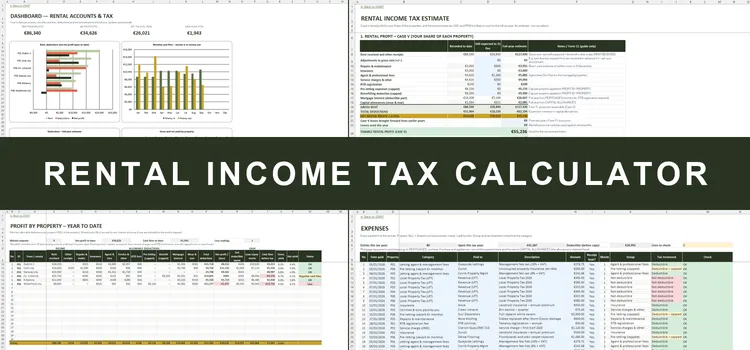
Also, the RTB fee itself is an allowable expense, and the Residential Premises Rental Income Relief requires the property to be let under an RTB-registered tenancy on 31 December of the year you claim for. If you keep your rental accounts in Excel, the rental income tax calculator for Irish landlords only treats mortgage interest as deductible for properties marked as RTB-registered.
Rent pressure zones are gone: the 2026 rent cap explained
Rent pressure zones (RPZs) started in December 2016 and covered the whole country from 20 June 2025. The RPZ system ended on 28 February 2026, and from 1 March 2026 the Residential Tenancies (Miscellaneous Provisions) Act 2026 put a national system of rent control in its place. It covers all private tenancies and student-specific accommodation, but not approved housing body or cost rental tenancies.
| Tenancy | Annual increase | Reset to market rent |
|---|---|---|
| Created before 1 March 2026 | CPI or 2%, whichever is lower | Not allowed |
| Created from 1 March 2026 | CPI or 2%, whichever is lower | At the start of a new tenancy (not after a no-fault termination) and at the end of each 6-year cycle |
| New apartment, construction commenced from 10 June 2025 | CPI, no 2% cap | As for tenancies from 1 March 2026 |
Source: RTB – Rental law changes from 1 March 2026.
The maths is in section 19(4). The new rent cannot exceed the old rent by more than 2% for each year since the rent was last set (pro rata for part of a year), and cannot rise by more than the change in the CSO all-items CPI. Two CPI months are compared:
- Now: the CPI for the month before the month in which the new rent is set (or the month before that, if the CSO has not yet published it).
- Then: for a rent set before 1 March 2026, the CPI for the month in which it was set; for a rent set from 1 March 2026, the month before.
Rent can be reviewed once every 12 months. If a tenancy already existed when its area became a rent pressure zone in the last two years, such as the areas added on 20 June 2025, the first review cannot take place until 24 months after the rent was last set (RTB – Setting and reviewing private rents).
New tenancies from 1 March 2026
Every new private tenancy now runs in 6-year cycles (a tenancy of minimum duration). With 4 or more tenancies, or as a company, you can only end it if the tenant breaches their obligations or the property no longer suits their needs. Landlords with 1–3 tenancies have a few extra grounds, such as selling to avoid undue hardship or needing the home for the family.
Worked example: a rent review after 12 and after 18 months
Example (fictional): a two-bed apartment let at €1,800 a month under a tenancy that began before 1 March 2026. The area was already a rent pressure zone before June 2025, so the normal 12-month rule applies. The landlord serves the rent review notice on 20 October 2026. The current CPI is September 2026: 107.6, published by the CSO on 8 October 2026.
| A: rent last set 20 Oct 2025 | B: rent last set 20 Apr 2025 | |
|---|---|---|
| Months since rent last set | 12 | 18 |
| CPI then | 103.9 (Oct 2025) | 102.6 (Apr 2025) |
| CPI change to 107.6 | 3.56% | 4.87% |
| 2% a year, pro rata | 2.00% | 3.00% |
| Cap that applies (the lower) | 2.00% | 3.00% |
| Maximum new rent | €1,836.00 | €1,854.00 |
| Increase per month (per year) | €36 (€432) | €54 (€648) |
Inflation has been above 2% a year, so in both cases the 2% limit decides. Applying the full CPI change in case A would give €1,864.10, which is €28.10 a month over the legal maximum. Waiting longer only adds 2% a year pro rata: case B gets 3%, not two annual increases. When inflation falls below 2%, the CPI change becomes the limit.
The dates for case A:
| Step | Date |
|---|---|
| Notice served on the tenant | 20 October 2026 |
| Copy to the RTB, at the latest | 27 October 2026 |
| New rent can start, at the earliest (90 days) | 18 January 2027 |
| Registration updated with the new rent by | 18 February 2027 |
| Next review possible from | 20 October 2027 |
This is an illustration. What goes with your notice is the printout from the RTB Rent Calculator, which may count part-years differently. Starting the new rent on the next rent day after the 90 days (here 1 February 2027) leaves a margin for postal delays.
The steps before a new rent applies
- Check the timing: 12 months since the rent was last set, or 24 months for the first review in a recently designated area.
- Calculate the maximum with the RTB Rent Calculator and keep the printout.
- Check market rent: the new rent cannot be above market rent. Take 3 comparable tenancies from the RTB Rent Register (similar size, bedrooms, type, character and BER) and quote them in the notice.
- Complete the current Notice of Rent Review from rtb.ie, including the floor area and BER of your property.
- Serve it on the tenant by post, email or by hand, at least 90 days before the new rent starts.
- Send a copy to the RTB within 7 days through the RTB Service Centre or by post. Until 14 September 2026 it had to be the same day.
- Update the registration within one month of the new rent taking effect.
Skip the RTB copy and the notice is invalid: the new rent does not take effect until a correct notice has run its 90 days. The tenant can dispute the review with the RTB before the date the new rent starts or within 28 days of receiving the notice, whichever is later.
New tenancies from 1 March 2026 have a matching duty at the start: the tenant gets the previous rent, how the new rent was calculated and 3 comparables, and the RTB must get the same information within one month.
Keeping every tenancy's dates in one place
Each tenancy runs on its own clock: registration anniversary, date the rent was last set, earliest review, 90-day notice, RTB copy, registration update and, for new tenancies, the end of the 6-year cycle. With three or four properties that is over a dozen dates a year, spread across emails, the RTB portal and bank statements.
The RTB Rent Calculator Excel keeps them in one workbook. TENANCIES shows the next registration date, when a review is possible and when the 6-year cycle ends. RENT HISTORY records every rent set with the notice days, RTB copy and registration update. RENT CALCULATOR estimates the CPI / 2% limit from the CSO figures in CPI INDEX, which you top up monthly. It is a planning tool: it does not apply the 24-month first-review rule by itself and does not replace the RTB's printout.
Frequently asked questions
Do I need a new RTB registration when a tenant changes?
If some tenants leave but at least one of the original tenants stays, the tenancy continues and you update the existing registration. If all the tenants leave and someone new moves in, that is a new tenancy and it must be registered within one month of its start.
My area only became a rent pressure zone in June 2025. When can I review the rent?
For a tenancy that already existed when the area was designated, the first review can only take place 24 months after the rent was last set (or the tenancy began). After that first review, the normal 12-month interval applies.
Does the 2% cap apply to a newly built apartment?
Not if the apartment is in a development where the commencement notice (or 7-day notice) was submitted on or after 10 June 2025. Those rents can rise in line with CPI, without the 2% cap, but still only once every 12 months.
Can I set a market rent when a tenant leaves?
For a new tenancy created from 1 March 2026, yes in certain cases, for example if the previous tenant left by choice, breached their obligations or the home no longer suited them. Not if the previous tenancy ended through a no-fault termination in the last 2 years, such as a sale or family use. The rent must be backed by 3 comparables from the RTB Rent Register.
What is an RTB fixed payment notice?
Since 14 September 2026 the RTB can offer a fixed payment instead of prosecution for six breaches, including failing to register a tenancy or update its details: €100, or €200 for rent breaches such as setting rent above the legal limit. It is served after you ignore an RTB notice to put the breach right, and if you pay within 28 days you are not prosecuted for that offence.
Sources
- RTB – When to register – one month from the start; annual registration since 4 April 2022; 15 May / 14 June example
- RTB – Registration fees – €40, late fee €10 per month or part, composite €170, AHB €20/€5
- RTB – How to register – information required; 30-day wording
- RTB – Consequences of not registering – €100 fixed payment, sanction up to €15,000 + €15,000 costs, Class A fine, 12 months, €1,000 a day
- RTB – Late fees recommence from 1 March 2024
- RTB – Setting and reviewing private rents – 12/24 months, 3 comparables, copy to the RTB within 7 days
- RTB – Rental law changes from 1 March 2026: a guide for landlords (PDF)
- RTB – Setting and reviewing rent from 1 March 2026: a guide for landlords (PDF)
- RTB – Important changes to rental law from 14 September 2026
- RTB – Rent Calculator
- Irish Statute Book – Residential Tenancies (Miscellaneous Provisions) Act 2026 (No. 3 of 2026)
- Irish Statute Book – S.I. No. 67/2026 (commencement 28 February and 1 March 2026)
- Irish Statute Book – Housing and Residential Tenancies (Miscellaneous Provisions) Act 2026 (No. 33 of 2026)
- Irish Statute Book – S.I. No. 434/2026 (commencement 14 September 2026)
- Law Reform Commission – Residential Tenancies Act 2004, s. 19 (revised) – CPI / 2% formula and CPI months
- Law Reform Commission – Residential Tenancies Act 2004, s. 20 (revised)
- Law Reform Commission – Residential Tenancies Act 2004, s. 22 (revised) – 90 days, notice contents, copy to the RTB within 7 days, 28-day dispute window
- Law Reform Commission – Residential Tenancies Act 2004, s. 134 (revised)
- Law Reform Commission – Residential Tenancies Act 2004, s. 139 (revised)
- Citizens Information – Rent increases in private rented housing
- CSO – Consumer Price Index September 2026
- CSO – PxStat table CPM24 (CPI, Dec 2023 = 100)
- Revenue – Irish rental income: what expenses are allowed?
- Revenue – Tax and Duty Manual Part 04-08-06 (loan interest)
- Revenue – RPRIR qualifying conditions