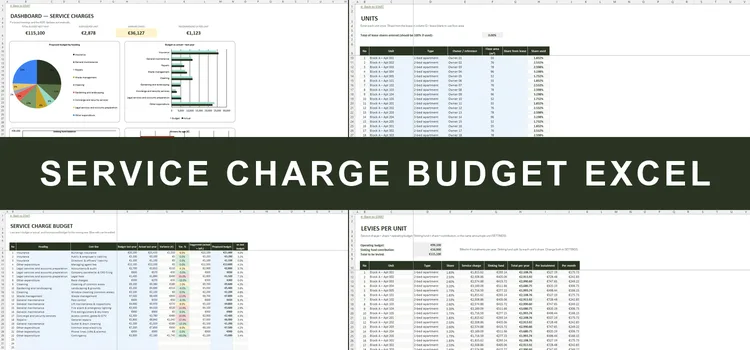
Service Charge Budget Excel
Budget, levies, arrears & sinking fund for OMCs
- Budget in the 9 categories of the MUD Act, vs actual
- Levy per unit from the lease share or floor area
- Arrears aged 0–30 / 31–60 / 61–90 / 90+ days
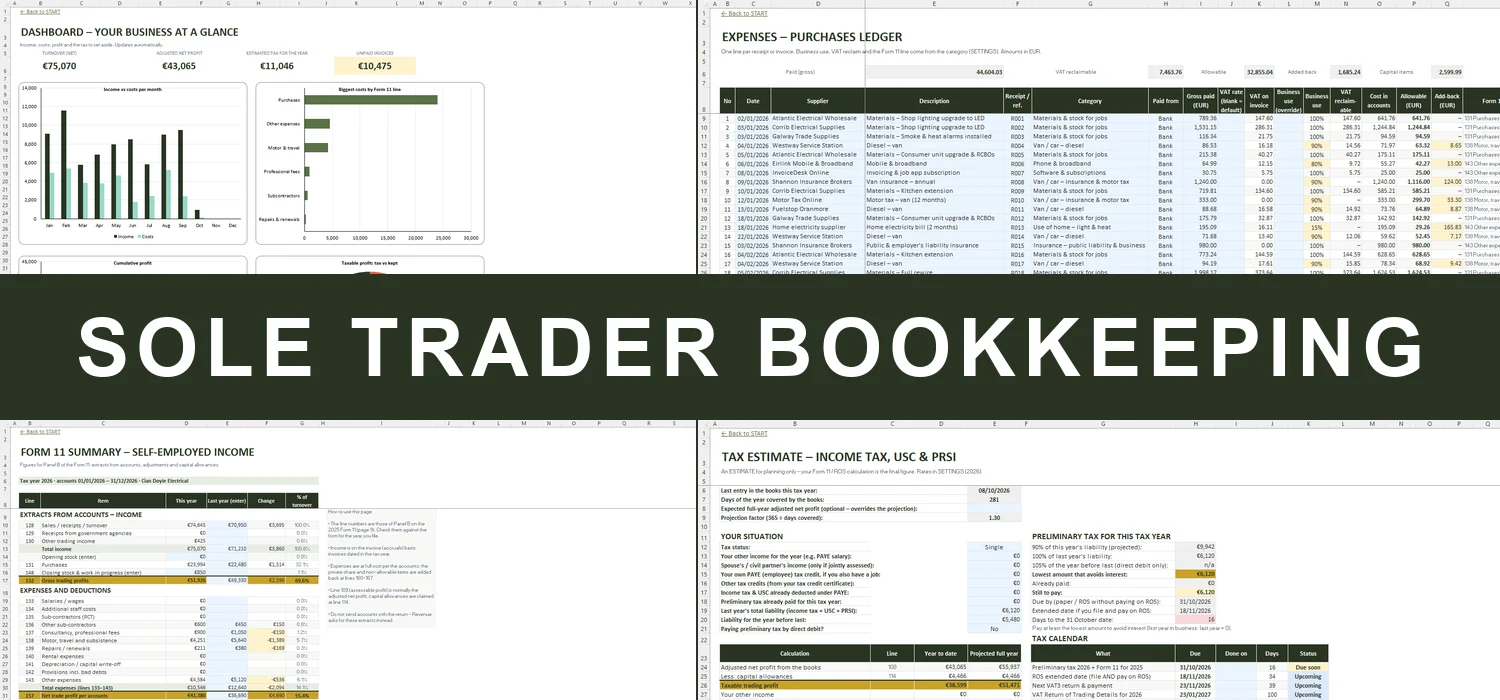
Income and expenditure books, bank reconciliation, VAT and Form 11 figures for Irish sole traders – with a tax estimate


Record each invoice and each receipt once. The workbook sorts every cost onto its Form 11 line, works out the VAT, reconciles the bank and shows roughly what tax to set aside for 31 October.
Most sole traders don't need accounting software – they need tidy books. Invoices in one place, receipts with the VAT and the business share worked out, the bank agreeing with the books, and a clear idea of the tax bill before the accountant sends it. Instead, October arrives with a bag of receipts, a year of bank statements and a Form 11 that asks for figures nobody has added up.
This workbook keeps the income and expenditure books the Irish way. Each expense category is mapped to a line of the Form 11 'Extracts from Accounts' panel, the private share of the van, phone or home is added back automatically, and VAT-registered traders get the bi-monthly VAT3 figures. Wear and tear on tools, vans and computers, a monthly bank reconciliation and an estimate of income tax, USC and PRSI Class S – with the preliminary tax options – complete the picture.
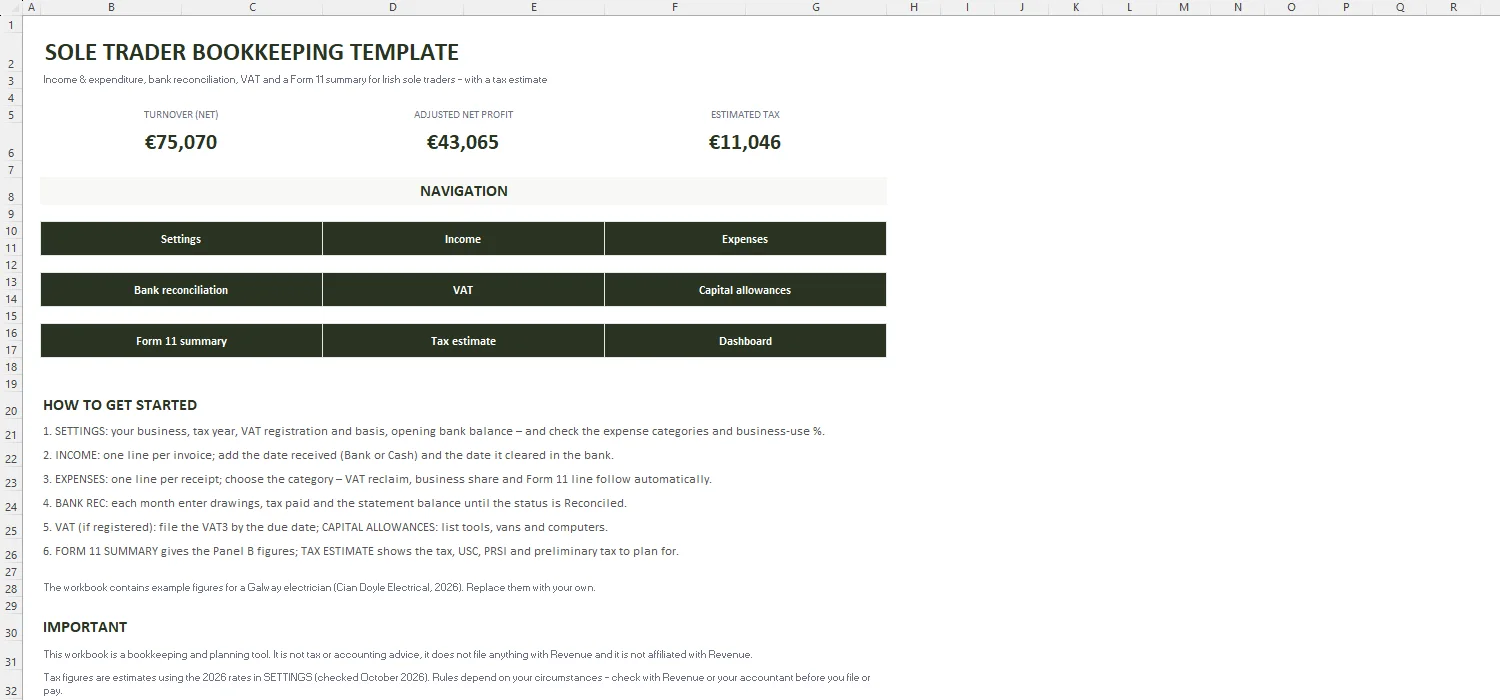
Key figures, quick links and a step-by-step guide.
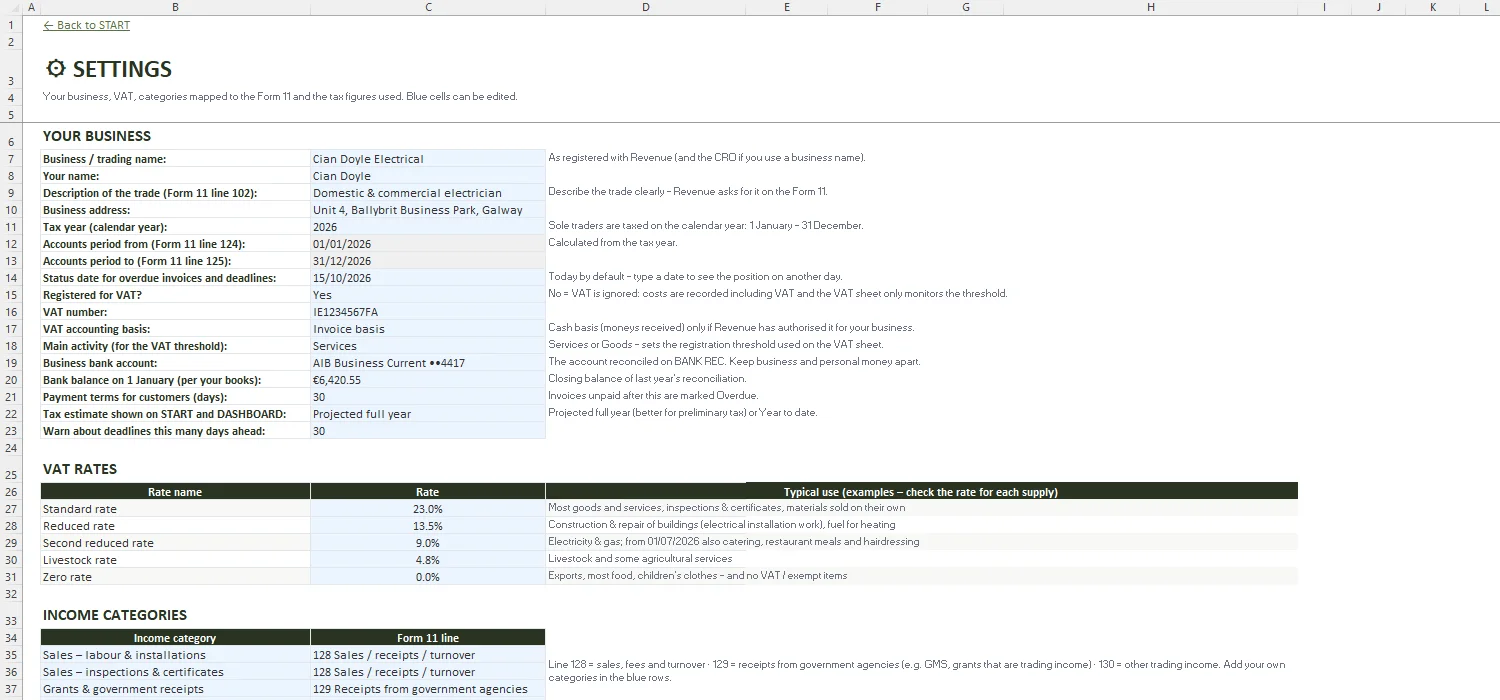
Business and trade description, tax year, VAT registration and basis, VAT rates, income and expense categories mapped to the Form 11 with business use and VAT rule, and the 2026 tax figures with source and date checked.
400 invoices and credit notes: customer, category, net, VAT, gross, date received (bank or cash), cleared date, outstanding, days overdue, status and checks.
600 receipts: supplier, category, paid from, gross, VAT on the invoice, business use, VAT reclaimable, cost in the accounts, allowable part, add-back, Form 11 line and checks.
Twelve months: opening and closing book balance, drawings, tax paid, lodgements and payments not yet cleared, statement balance, difference – plus the uncleared items for any month.
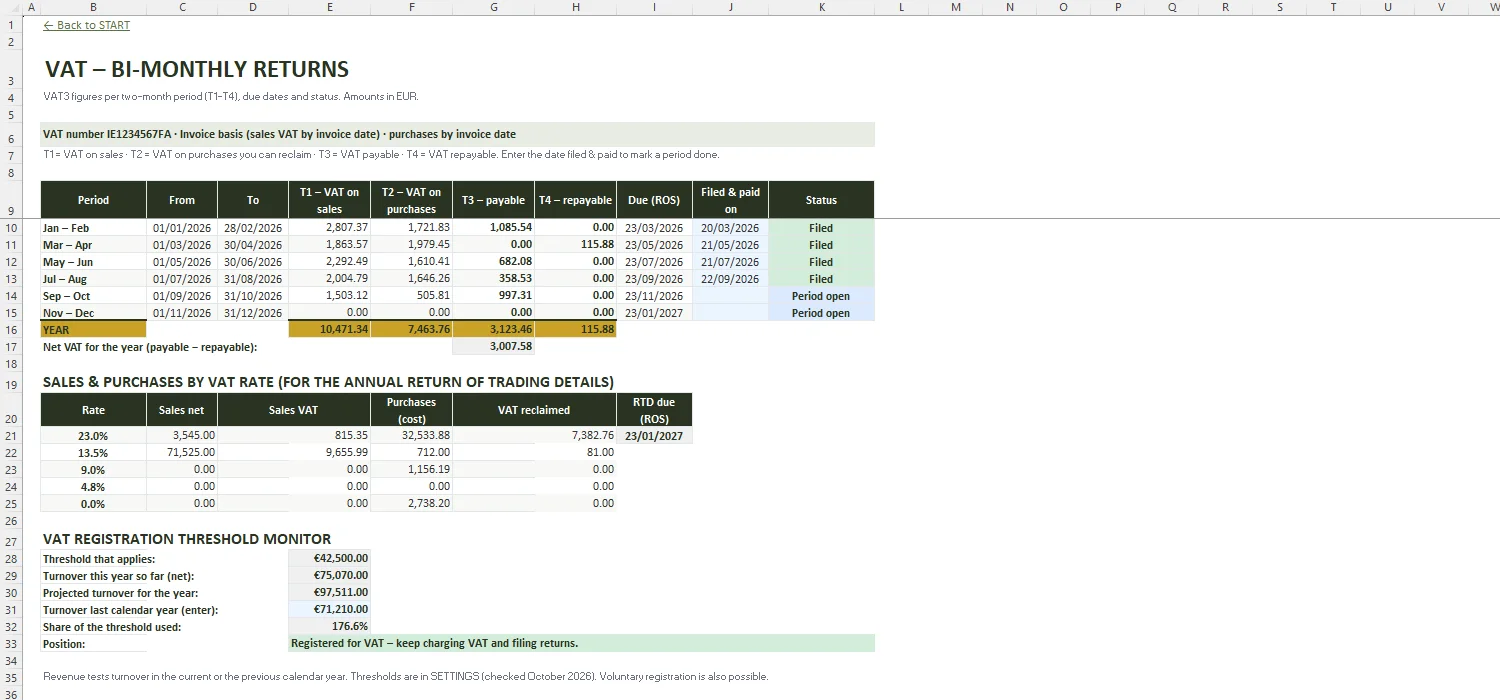
Bi-monthly VAT3 figures (T1–T4) on the invoice or cash basis, due dates and status, sales and purchases by rate for the RTD, and a VAT registration threshold monitor.
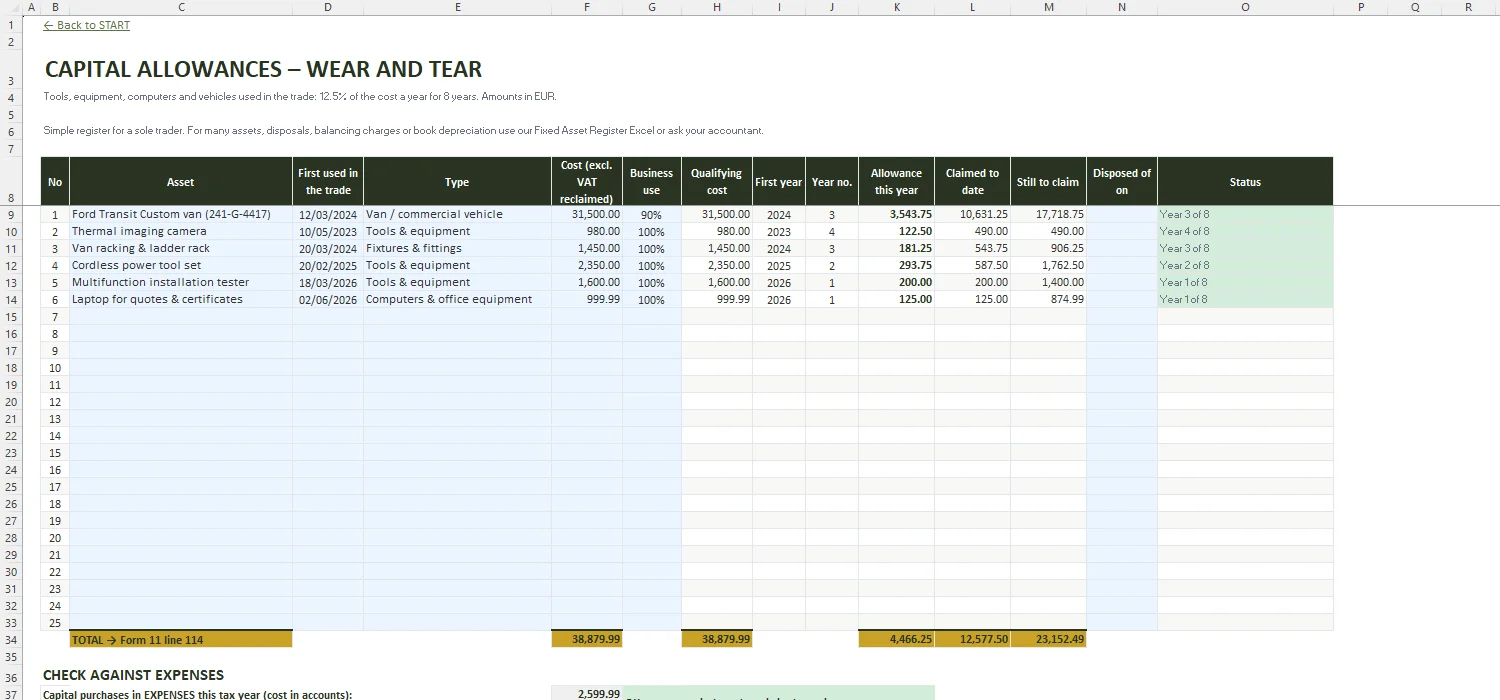
25 assets: type, cost, business use, car limits, year of claim, wear and tear this year, claimed to date and still to claim – with a check against EXPENSES.
Extracts from accounts (lines 128–143), net profit, add-backs (160–168), adjusted net profit, capital allowances (114) and balance sheet items, against last year.
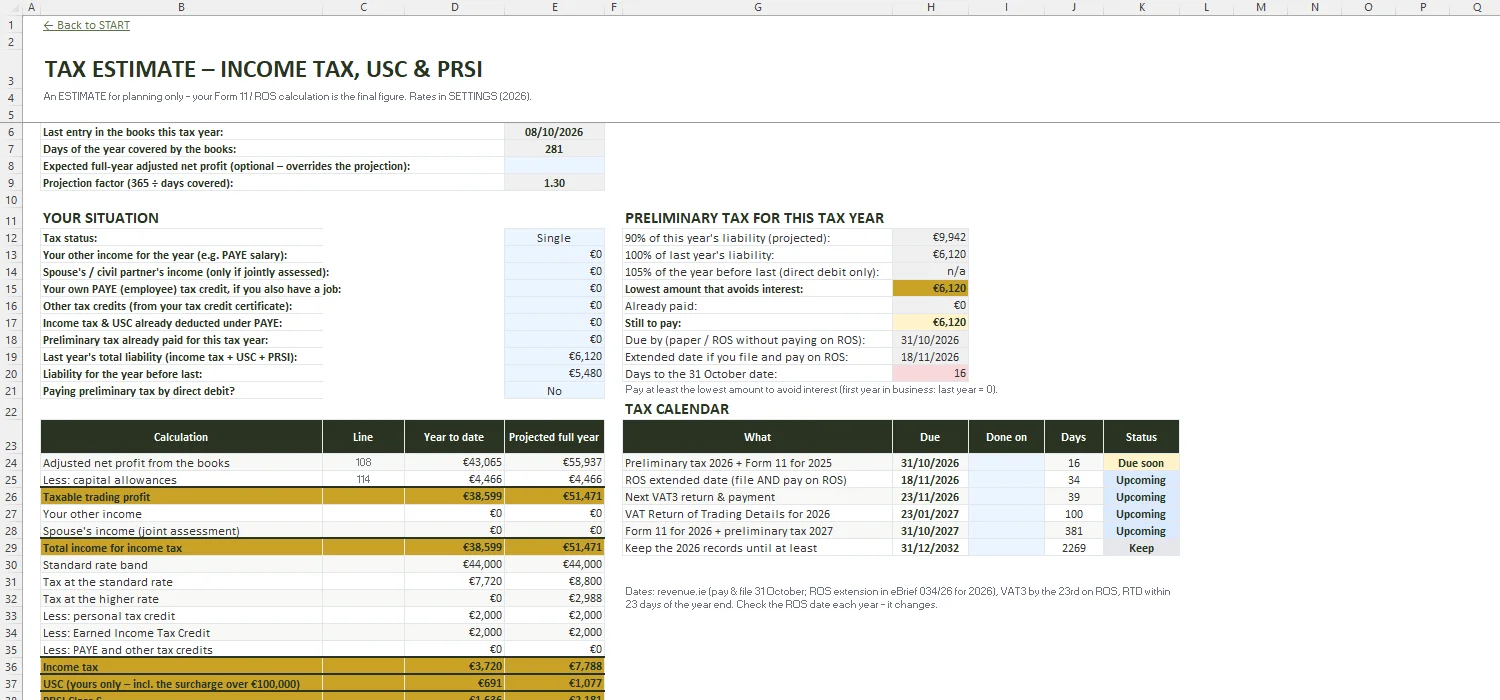
Income tax, USC and PRSI Class S – year to date and projected – preliminary tax at 90% / 100% / 105%, and a tax calendar with the pay & file, ROS and VAT dates.
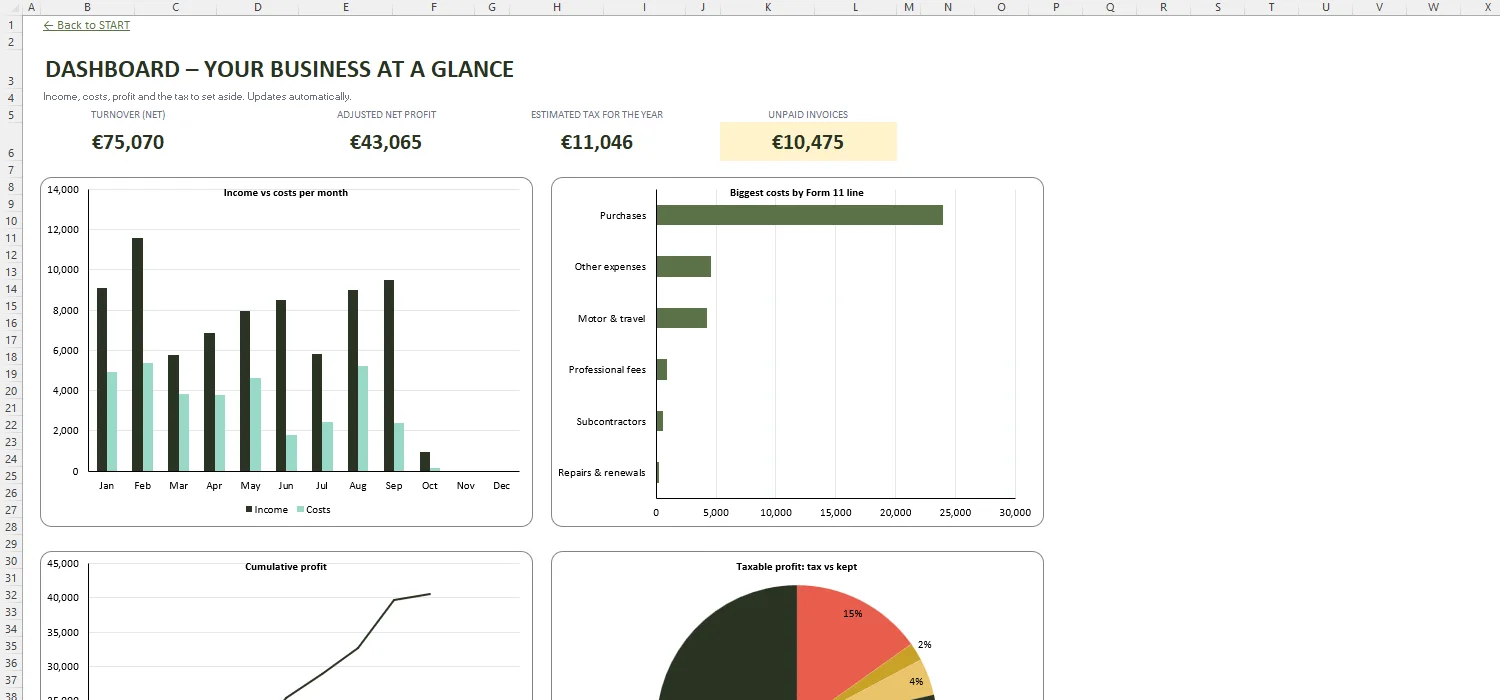
Turnover, adjusted profit, estimated tax and unpaid invoices, with four charts.
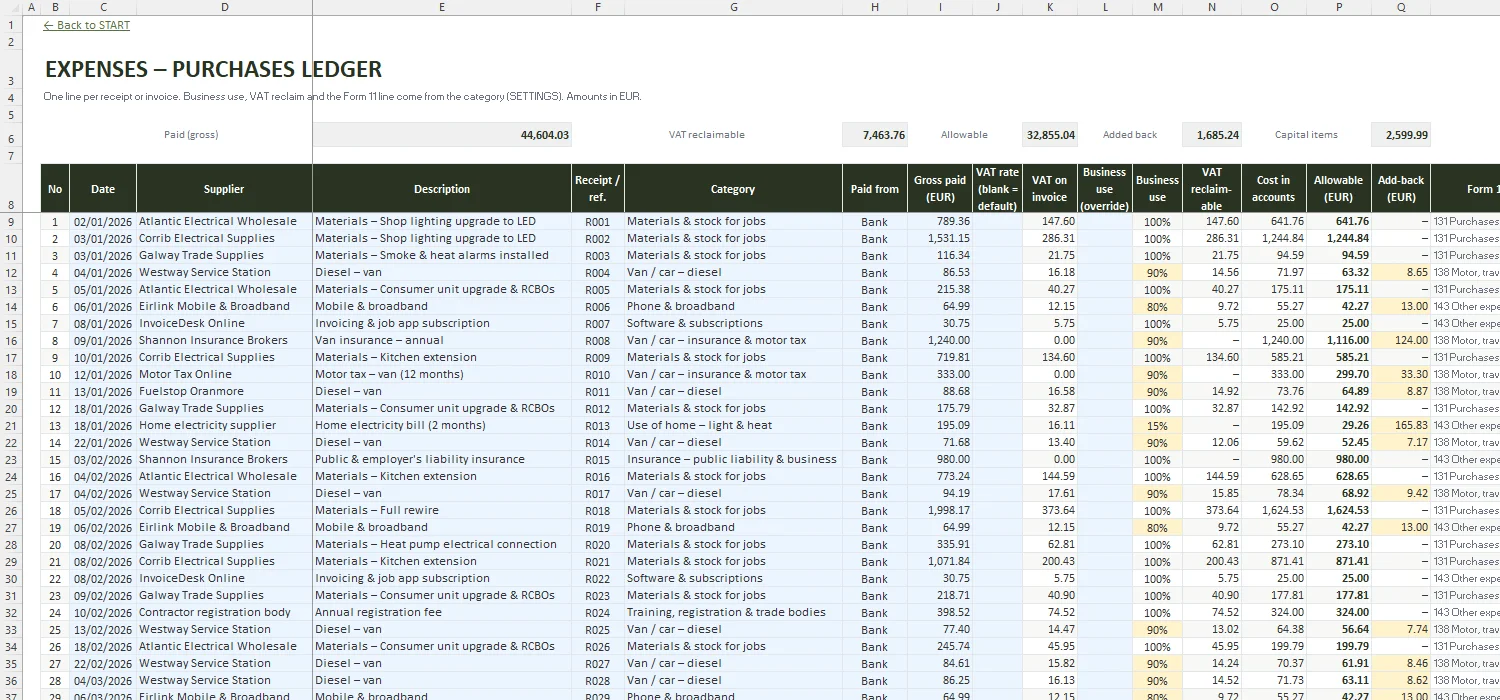
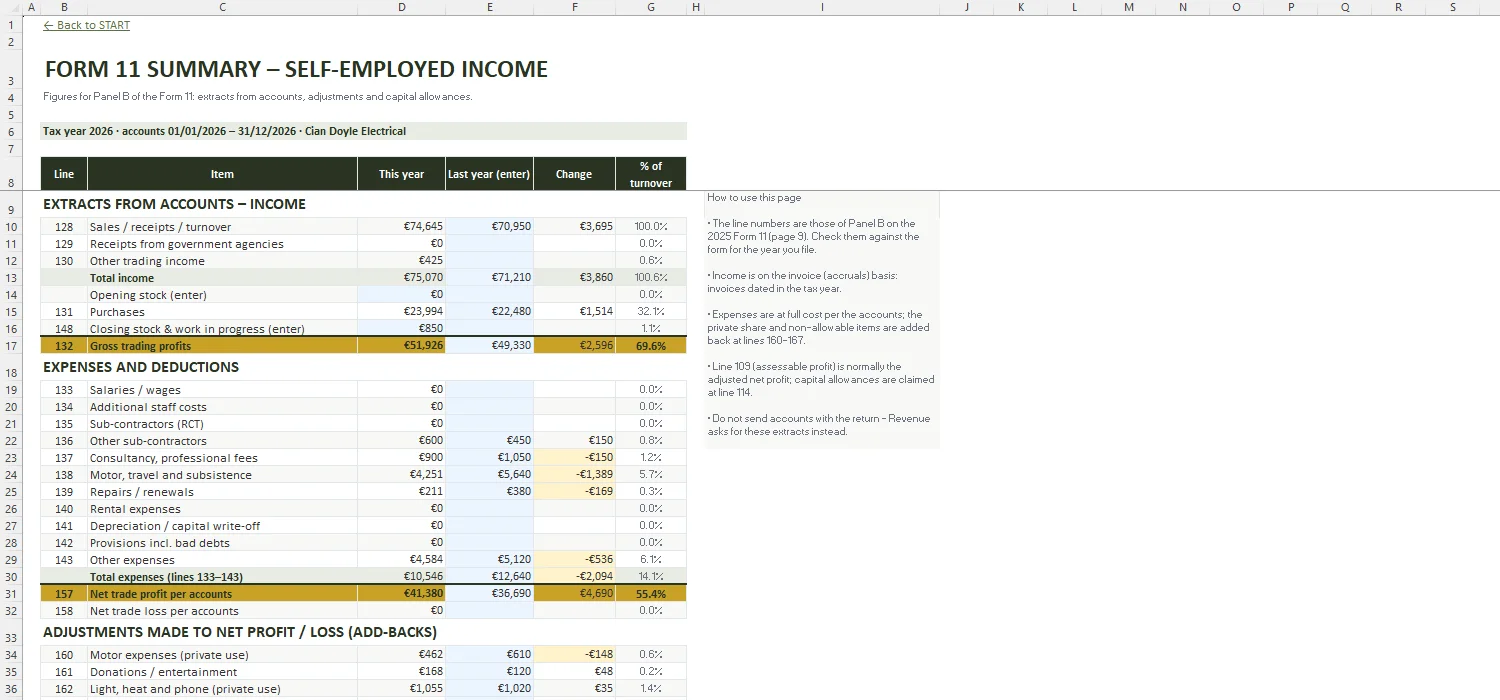
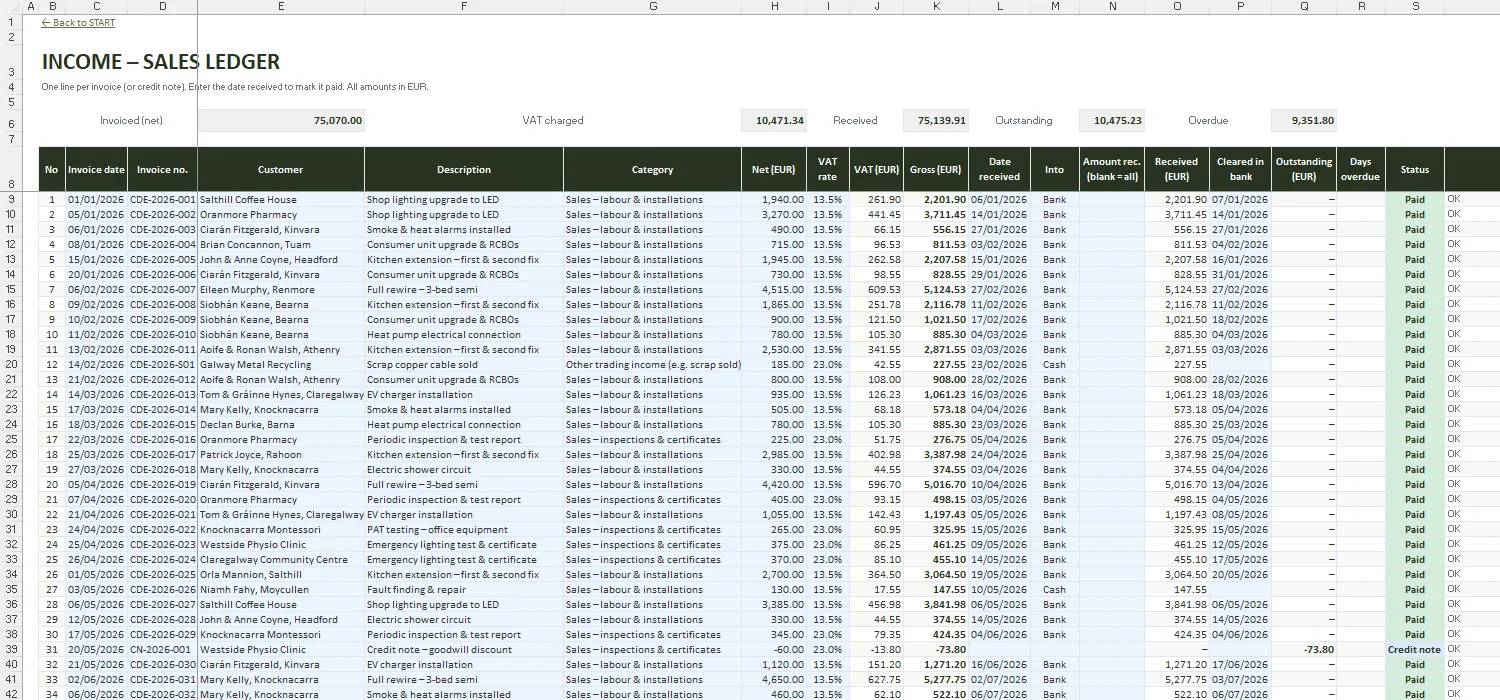
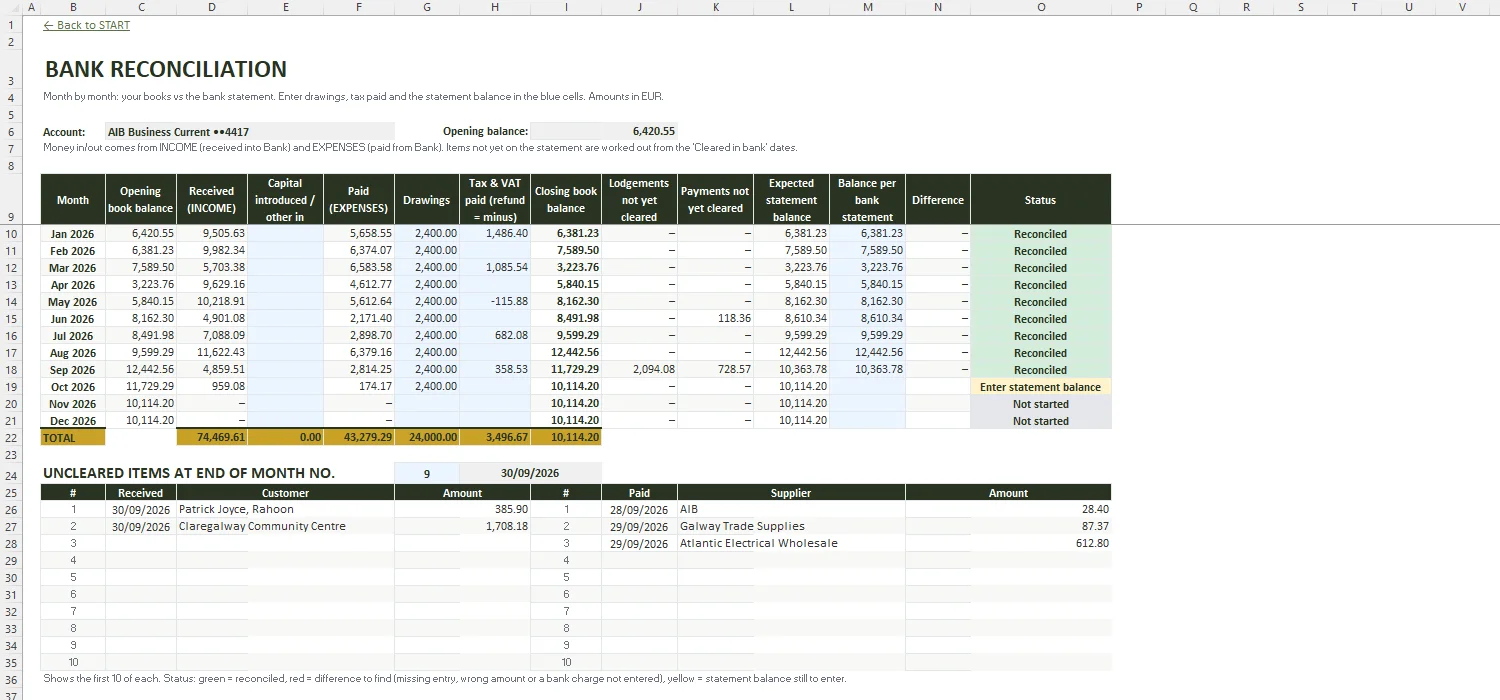
Keep a record of every sale and every business payment, with the invoices and receipts behind them, and check it against your bank statements. Revenue expects full and accurate records from the start and asks you to keep them for six years. In this workbook that means one line per invoice in INCOME, one line per receipt in EXPENSES and a monthly reconciliation in BANK REC.
Costs incurred wholly for the business: goods for resale, materials, wages, rent and bills for business premises, running costs of a van or machine, accountancy fees and interest on business borrowings. Only the business share of mixed costs (car, phone, home) counts, and business entertainment, your own drawings and everyday clothing do not. Equipment and vehicles are claimed through capital allowances – 12.5% a year over 8 years. The categories in SETTINGS carry these rules and you can change them.
Income tax at 20% up to your standard rate band and 40% above it, less your tax credits, plus USC and PRSI Class S on your profit. For 2026 the single person's band is €44,000 and PRSI Class S is 4.2% up to 30 September and 4.35% from 1 October. The TAX ESTIMATE sheet works out an estimate for the year to date and for the projected full year.
By 31 October of the tax year, together with the Form 11 and the balance for the previous year. If you file and pay through ROS the date is extended – to 18 November in 2026. To avoid interest you pay at least the lowest of 90% of this year's liability, 100% of last year's or 105% of the year before last (direct debit only). The workbook calculates all three.
Once your turnover passes the threshold – €42,500 for services or €85,000 for goods in the current or previous calendar year – you must register. Below that, registration is voluntary. The VAT sheet tracks your turnover against the threshold; if you are registered it gives you the T1–T4 figures for each bi-monthly VAT3 return.
No. It keeps your records in order and shows the figures the Form 11 asks for, but it does not file anything with Revenue and it is not tax advice. Many sole traders use it to hand clean books to their accountant – or to complete the self-employed panel themselves with a clear view of each line.
Budget, levies, arrears & sinking fund for OMCs
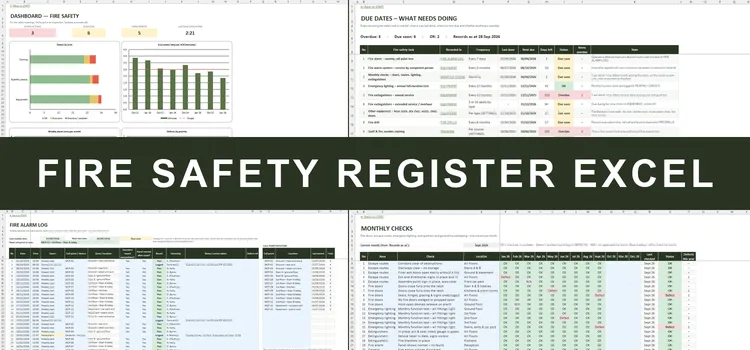
Fire safety log book with due-date alerts for Irish buildings
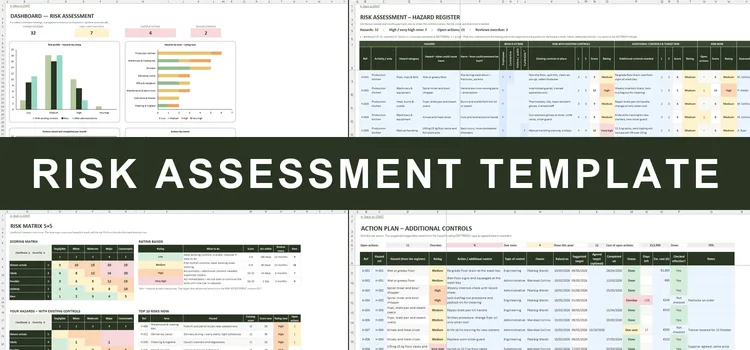
Hazard register, 5×5 risk matrix, action plan & Safety Statement checklist
Income and expenditure books, bank reconciliation, VAT and Form 11 figures for Irish sole traders – with a tax estimate · €49
A sole trader bookkeeping template gives you a simple income and expenditure template that matches Irish tax: invoices and receipts in one bookkeeping spreadsheet, VAT on each line and every cost sorted onto the lines of the Form 11. It is an income and expenses spreadsheet for the self-employed that also reconciles the bank month by month.
Use it as a bookkeeping spreadsheet for Ireland, a self-employed accounts template with a VAT3 summary, or a simple tax calculator for sole traders with income tax, USC, PRSI Class S and preliminary tax – in Excel, with no macros and no subscription.