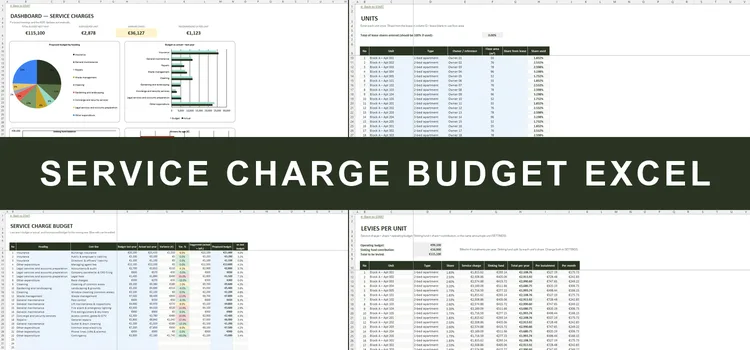
Service Charge Budget Excel
Budget, levies, arrears & sinking fund for OMCs
- Budget in the 9 categories of the MUD Act, vs actual
- Levy per unit from the lease share or floor area
- Arrears aged 0–30 / 31–60 / 61–90 / 90+ days
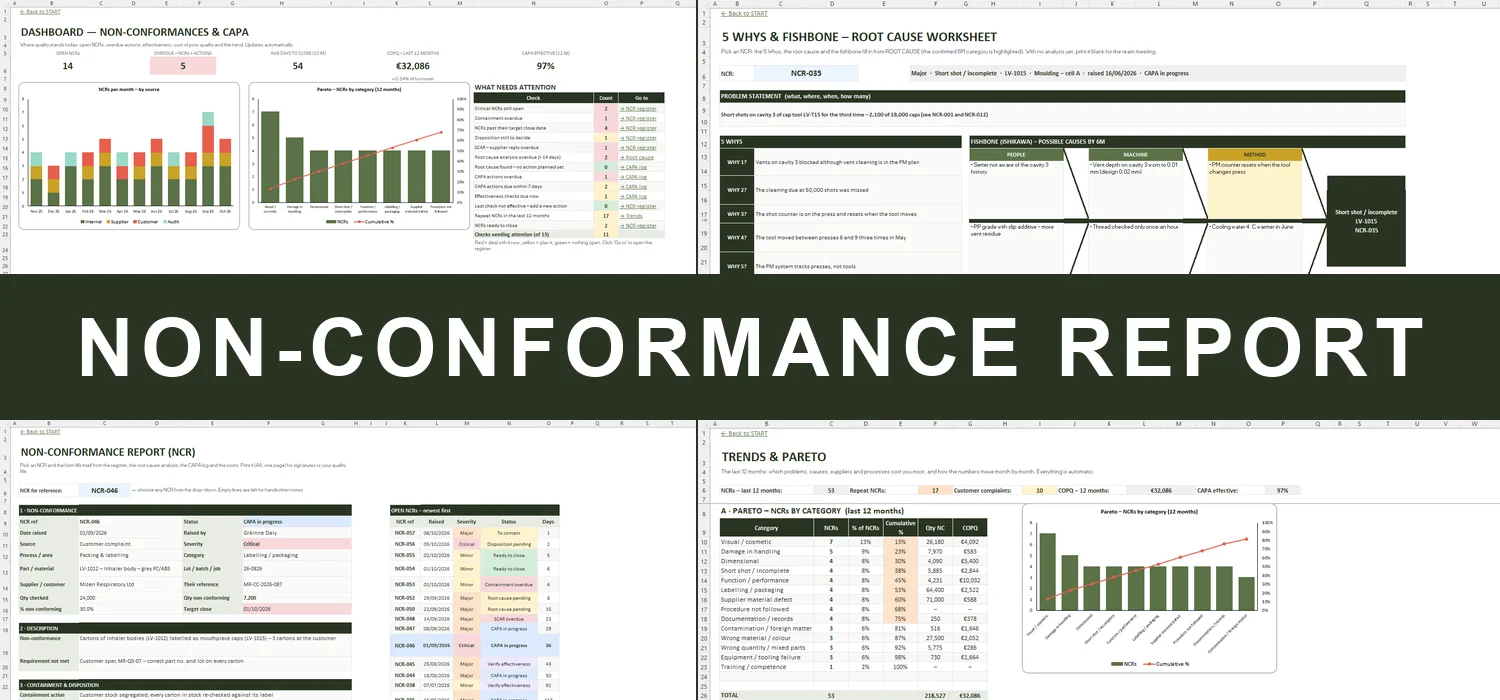
NCR register & CAPA log – root cause (5 Whys & fishbone), corrective actions, effectiveness checks, cost of poor quality and Pareto


Log the non-conformance, contain it and decide the disposition, find the root cause with the 5 Whys and a fishbone, track the corrective actions and check that they worked – with the cost of poor quality and the Pareto worked out for you.
In many Irish plants the NCR process lives in a Word form, an email chain and a spreadsheet of numbers. Corrective actions are agreed at the quality meeting and then forgotten, nobody checks whether the fix actually worked, and when the same short shot, label mix-up or supplier defect comes back for the third time, there is no quick way to see it – or what it has cost.
This workbook keeps the whole loop together. Each NCR gets its containment, disposition and – where needed – a root cause analysis and actions with owners and due dates. The status moves on by itself (to contain, disposition pending, root cause pending, CAPA in progress, verify effectiveness, ready to close), repeat NCRs and overdue items are flagged, and the cost of poor quality, the Pareto and supplier performance update as you go. It supports the nonconformity and corrective action records your quality system needs; it does not certify anything.
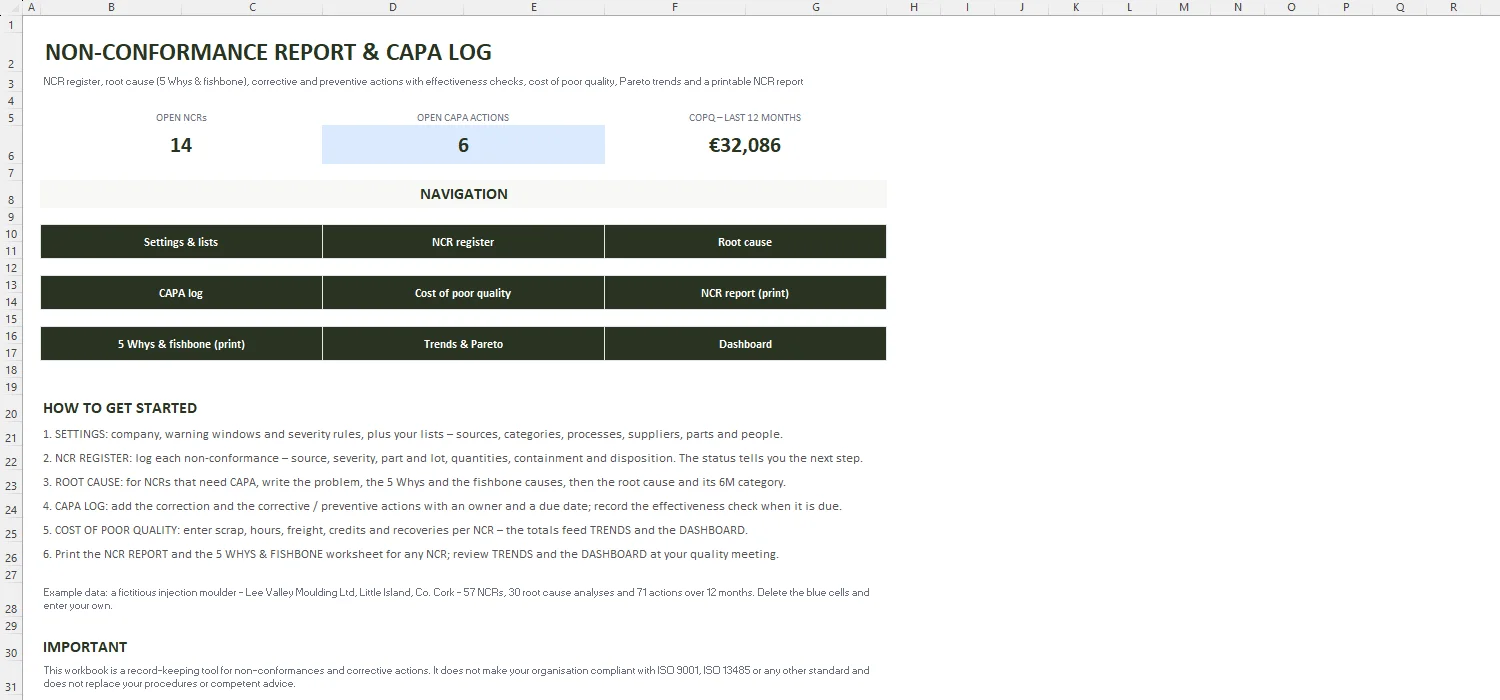
Key figures, quick links and a step-by-step guide.
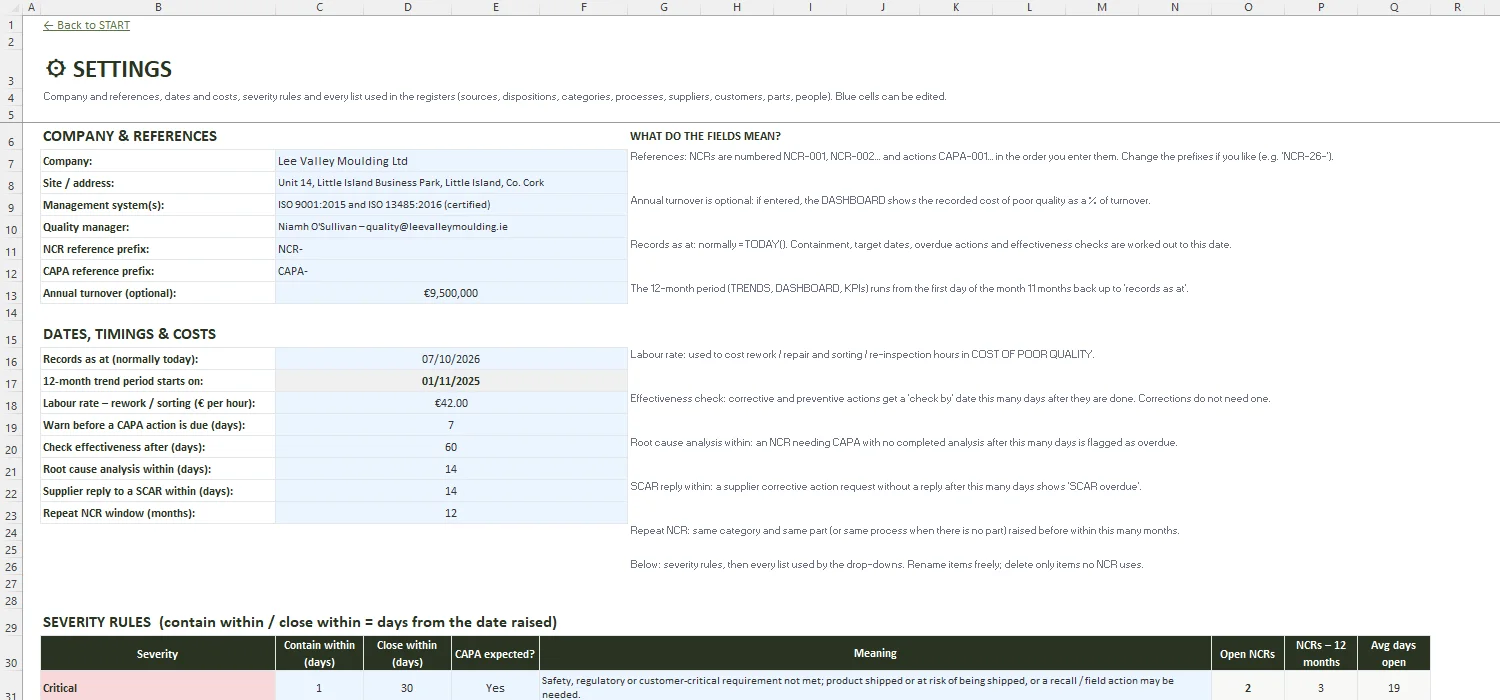
Company, NCR / CAPA prefixes, labour rate and warning windows; severity rules (contain and close within, CAPA expected); sources, dispositions, categories, processes, 6M root cause categories, suppliers, customers, parts with unit cost and people – each with live counts.
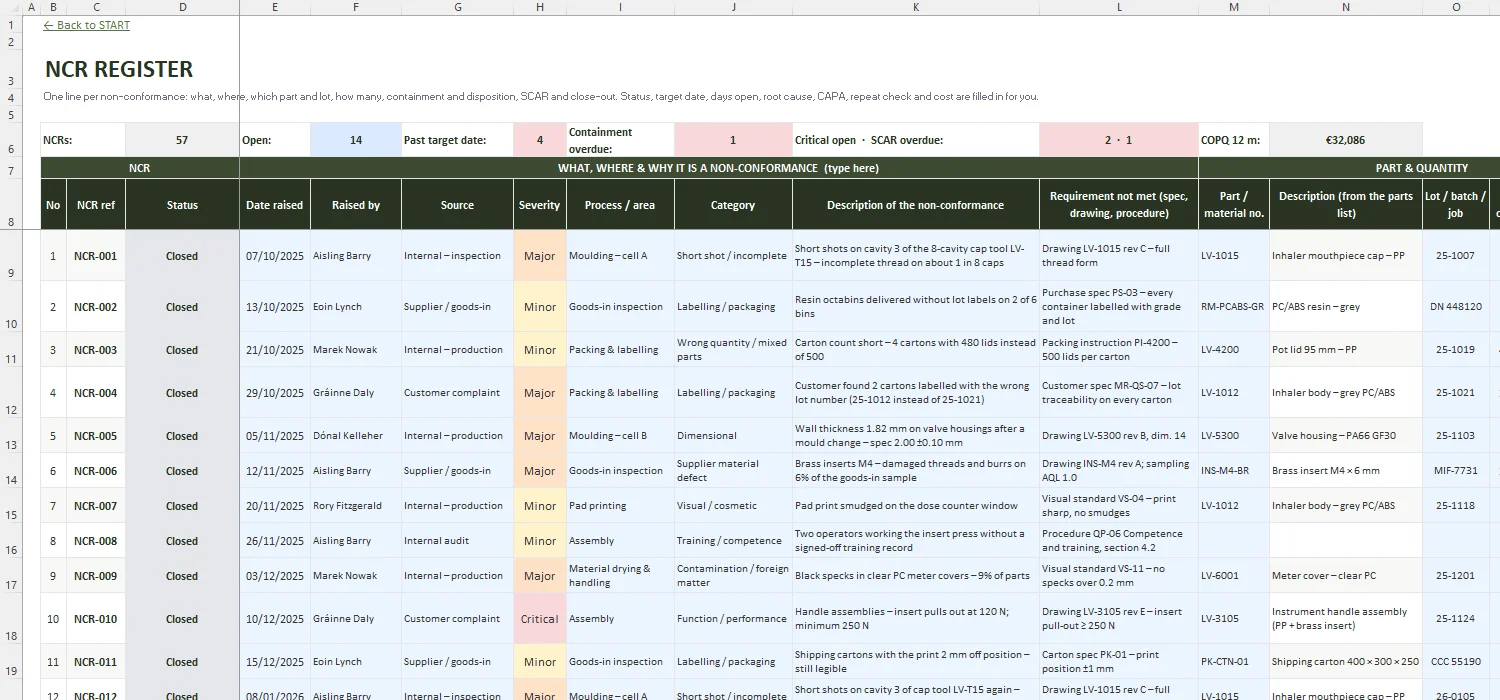
Up to 500 NCRs: date, source, severity, process, category, description, requirement not met, part and lot, quantities, supplier or customer, containment, disposition, SCAR, close-out – with status, target date, days open, root cause, CAPA count, repeat check and cost.
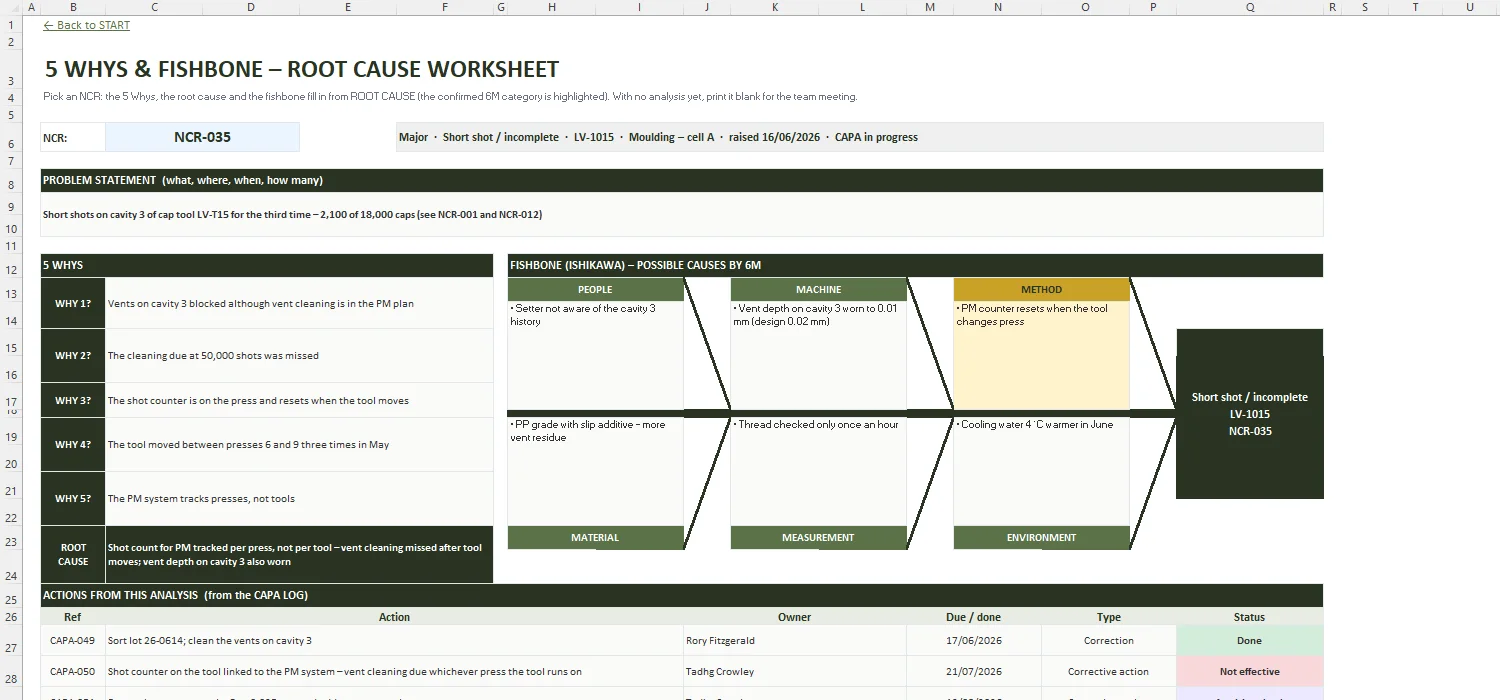
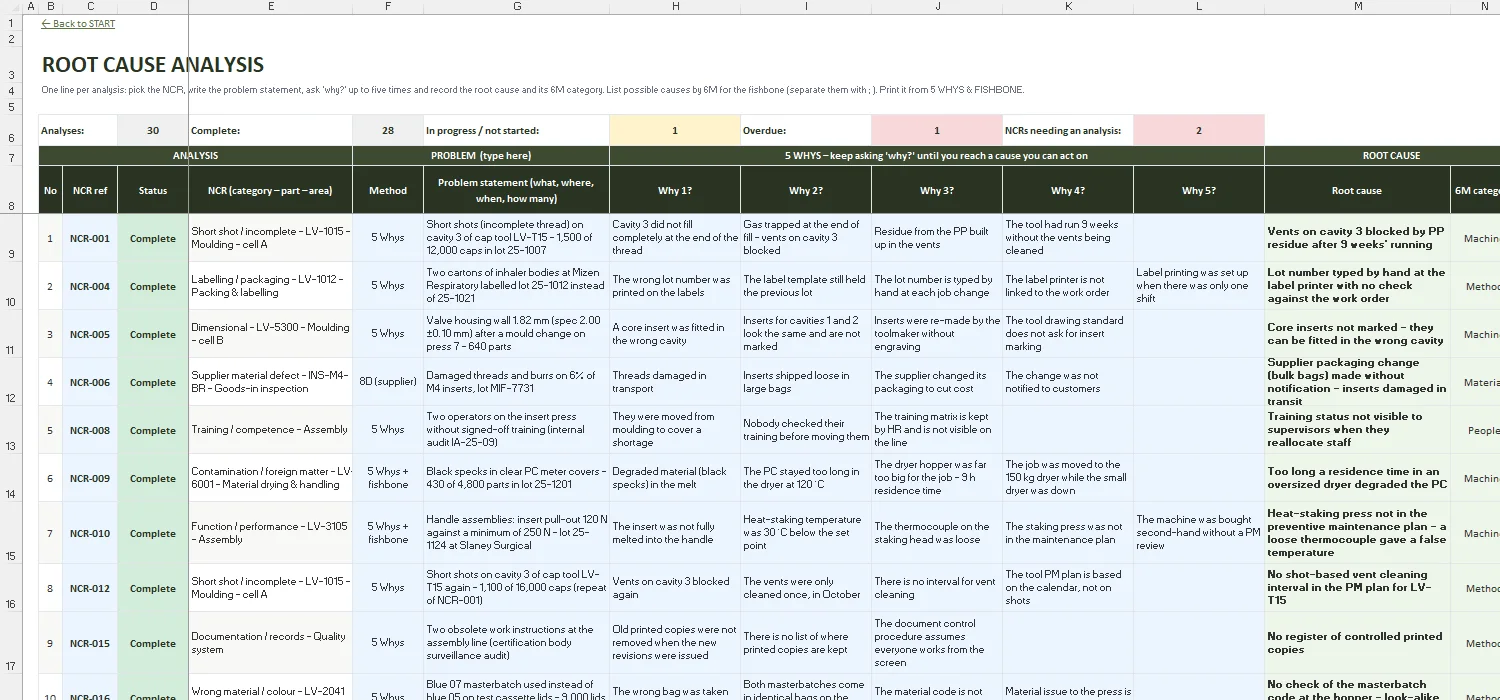
One analysis per NCR: problem statement, 5 Whys, root cause and its 6M category, fishbone causes by People, Machine, Method, Material, Measurement and Environment, team and status.
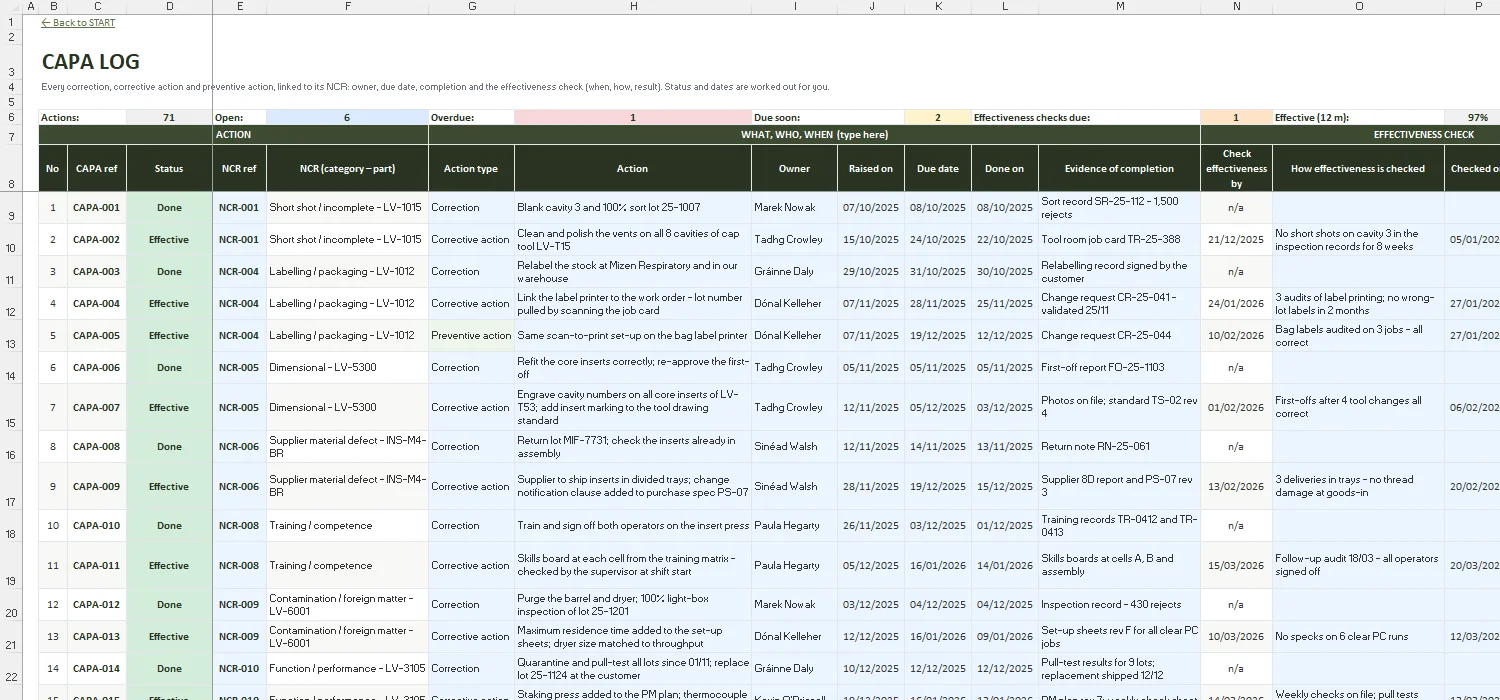
Up to 1,000 corrections, corrective and preventive actions linked to their NCR: owner, due and done dates, evidence, effectiveness check (by when, how, result) and cost.
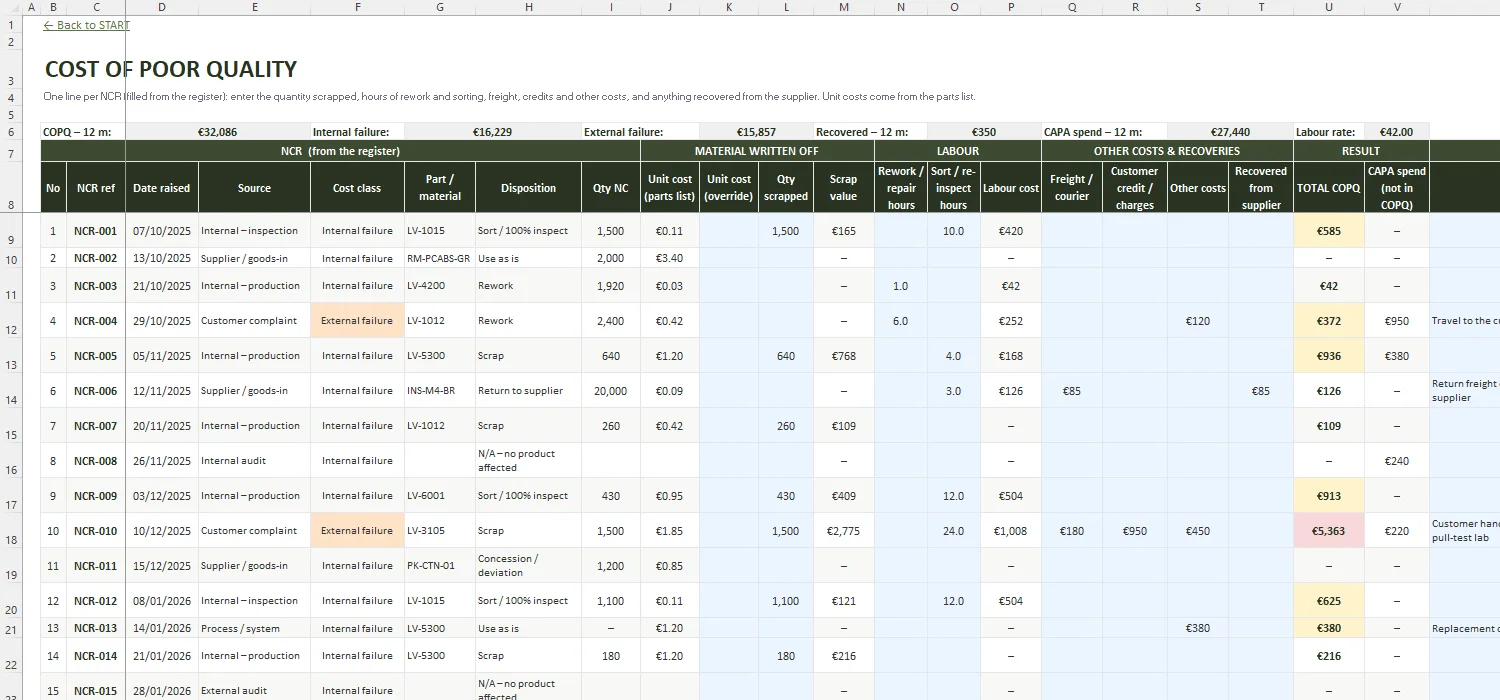
One line per NCR: scrap value from the parts list, rework and sorting hours at your labour rate, freight, customer credits, other costs and recoveries – internal and external failure.
Printable A4 non-conformance report for any NCR, filled from all sheets – description, containment, root cause, actions, cost and sign-off – plus a list of open NCRs.
Printable A4 root cause worksheet: problem statement, 5 Whys ladder, fishbone diagram with the confirmed 6M category highlighted and the linked actions.
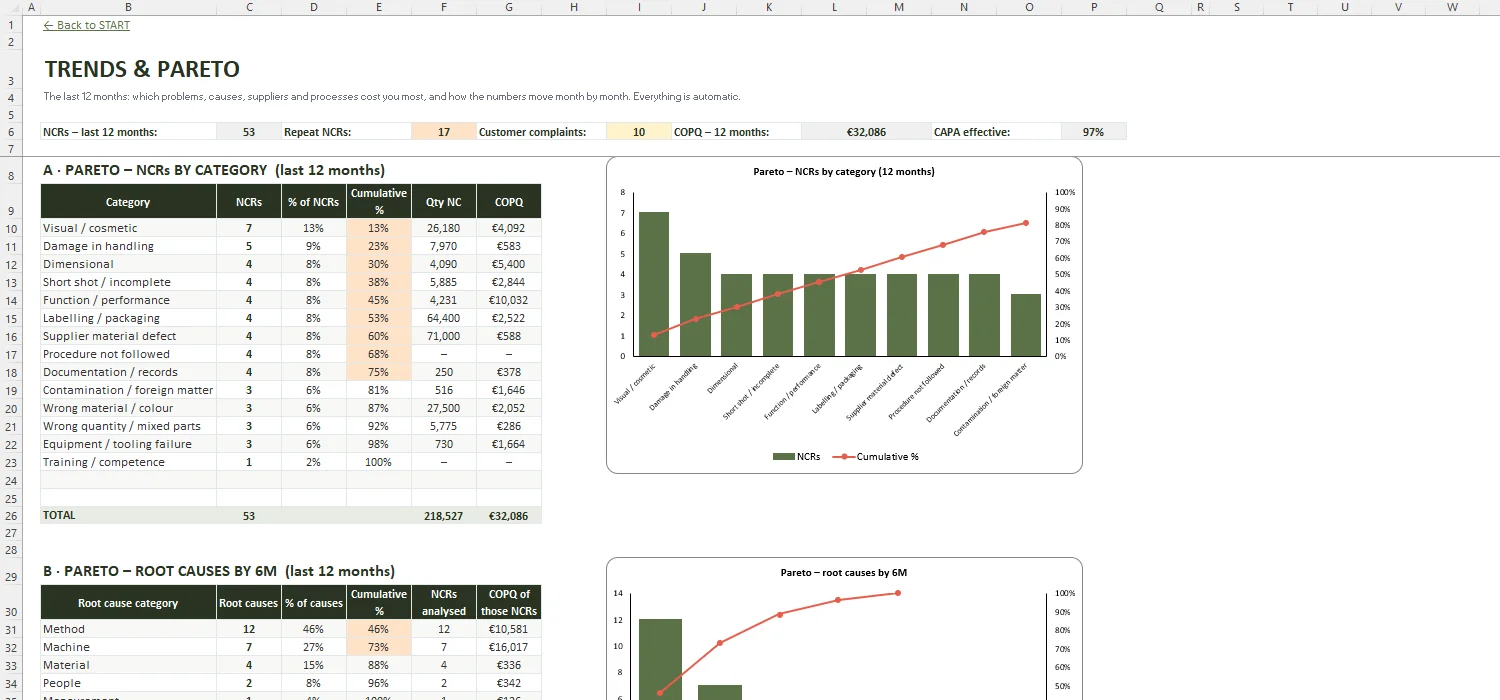
Pareto by category and by root cause, month by month (sources, severity, closed, days to close, cost, repeats), supplier performance with rating, and NCRs by process.
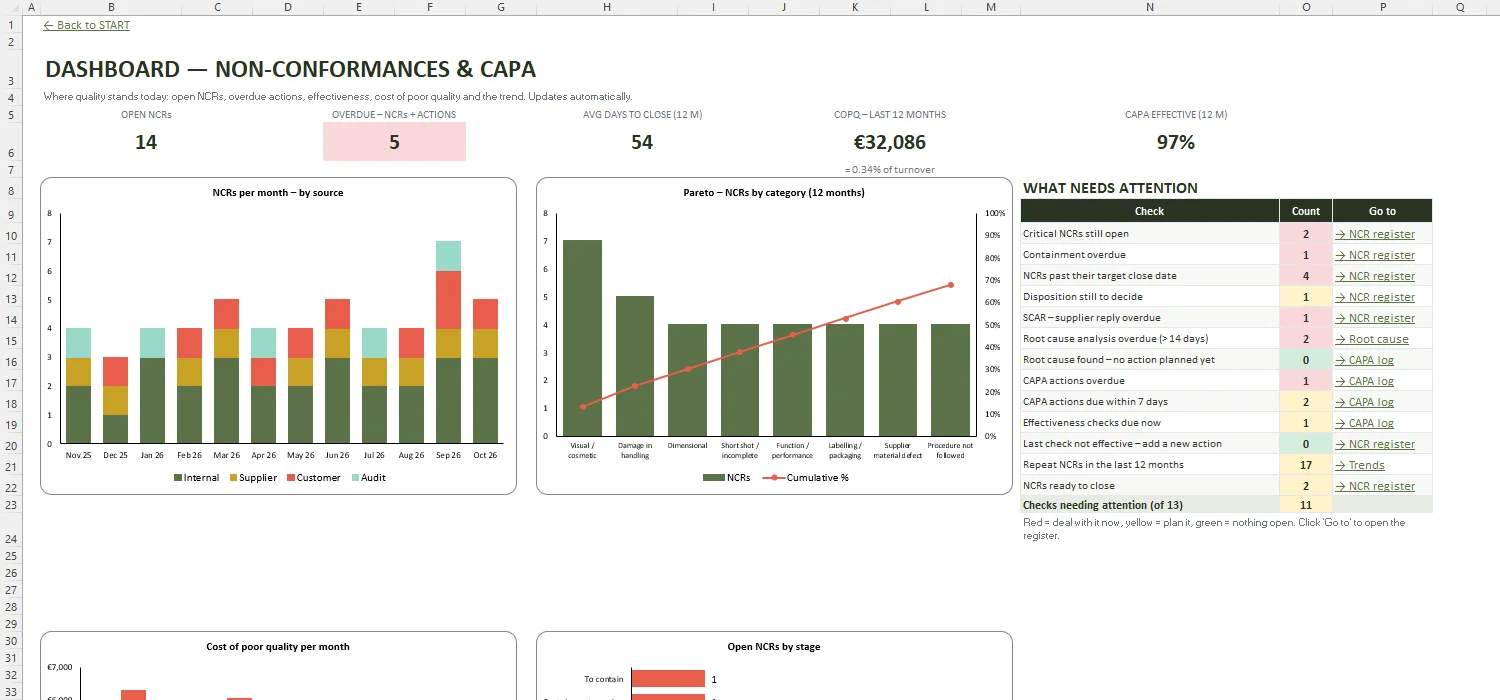
Open NCRs, overdue items, average days to close, cost of poor quality and CAPA effectiveness, four charts and a 'what needs attention' list.
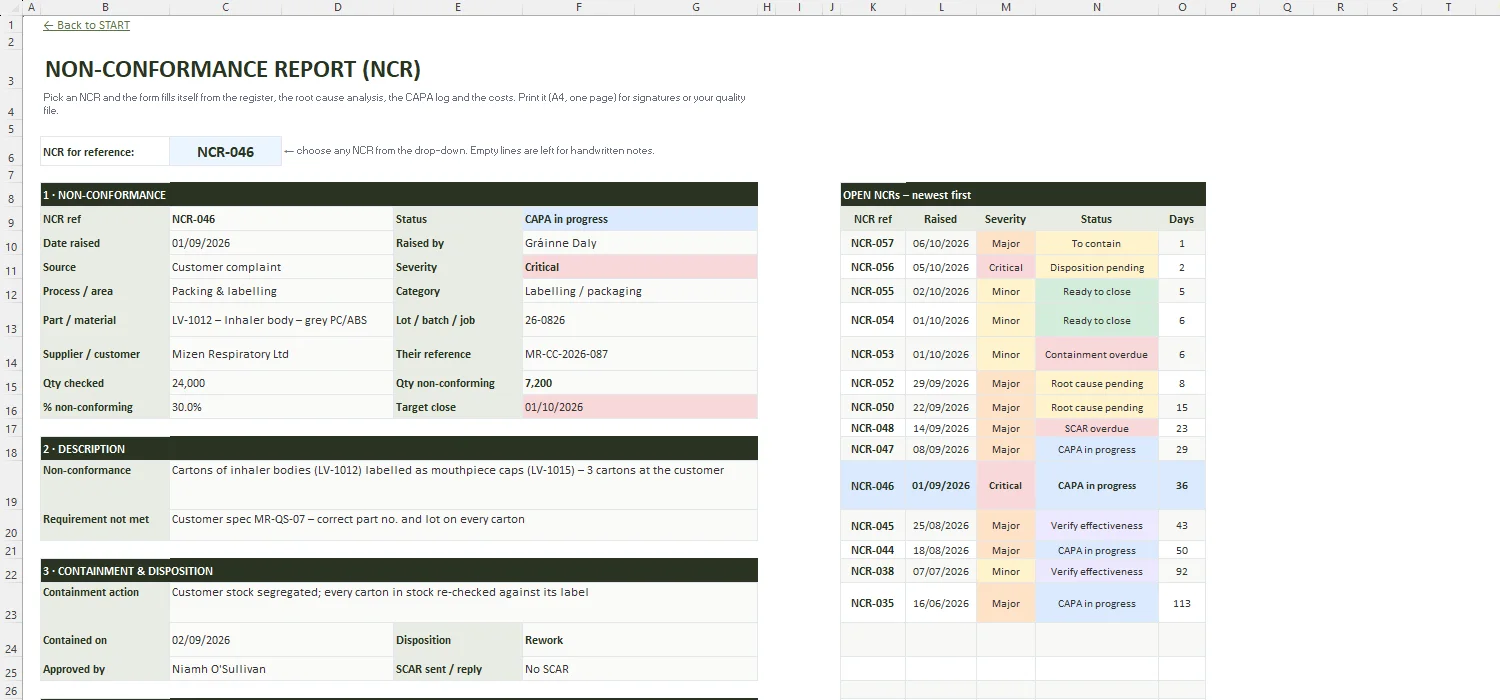
A non-conformance report (NCR) records that a product, process or service did not meet a requirement – a drawing, a specification, a customer requirement or your own procedure. It describes what was found, how much is affected and what was done straight away (containment and disposition), and it is the starting point for finding the root cause and the corrective action.
Typical examples are parts outside a drawing tolerance, wrong or missing labels, contaminated or wrong material, a supplier delivery that fails goods-in inspection, a customer complaint, a skipped first-off approval, obsolete documents at a work station or training records missing for an operator. The example data includes more than 50 of them from a fictitious injection moulding plant.
Write down what was found, where and when, the requirement that was not met, the part, lot and quantity affected, then the containment and the disposition (rework, scrap, use as is, return to supplier or concession). For anything significant, add the root cause and the corrective actions. In this workbook you type it once in the NCR REGISTER and the NCR REPORT sheet prints an A4 form filled from all the sheets.
State the problem as a fact, contain it, find the root cause (for example with the 5 Whys and a fishbone), decide actions that remove the cause, give each one an owner and a due date, and check later that the problem has not come back. The CAPA LOG records each step, including when and how the effectiveness was checked and the result.
A correction fixes the problem in front of you – sorting, reworking or relabelling the affected product. A corrective action removes the cause so the same nonconformity does not happen again. A preventive action stops a potential problem elsewhere, for example applying the fix to similar tools or lines. The CAPA log keeps all three and only asks for an effectiveness check on corrective and preventive actions.
No workbook can do that. It helps you keep clear, dated records of nonconformities, causes, actions and their effectiveness – the kind of evidence ISO 9001 clause 10.2 asks you to retain – but it does not replace your procedures, your certification body or competent advice.
Budget, levies, arrears & sinking fund for OMCs
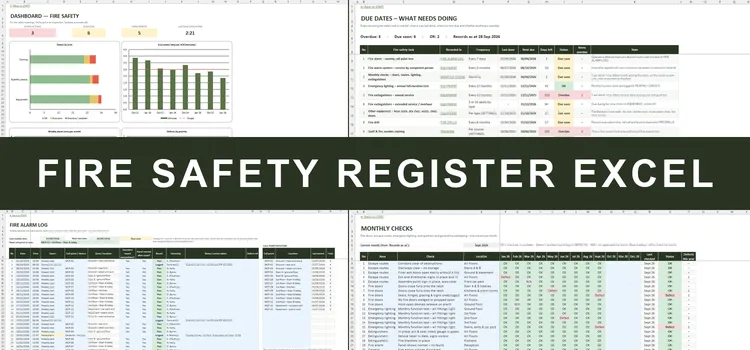
Fire safety log book with due-date alerts for Irish buildings
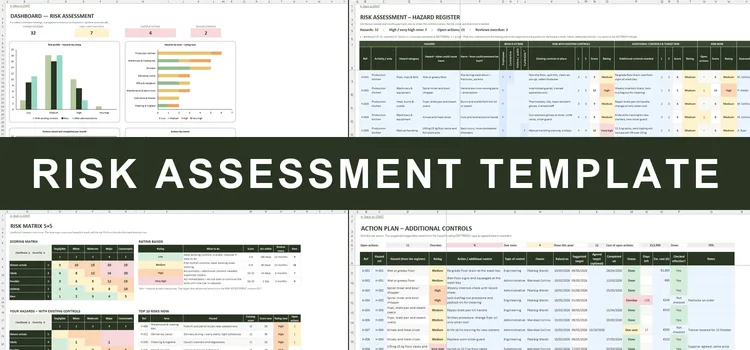
Hazard register, 5×5 risk matrix, action plan & Safety Statement checklist
NCR register & CAPA log – root cause (5 Whys & fishbone), corrective actions, effectiveness checks, cost of poor quality and Pareto · €69
A non-conformance report template and NCR log in one Excel file: a non-conformance register for internal, supplier and customer NCRs, a printable NCR form, and a CAPA template that tracks corrections, corrective and preventive actions through to an effectiveness check – useful as an ISO 9001 non conformance report template and for ISO 13485, food and construction quality systems.
It also works as a root cause analysis template with a 5 Whys template and a fishbone diagram template (6M) for each NCR, a corrective action report template, a supplier non-conformance report with SCAR (supplier corrective action request) tracking and a cost of poor quality tracker with Pareto charts by category, root cause, supplier and process.