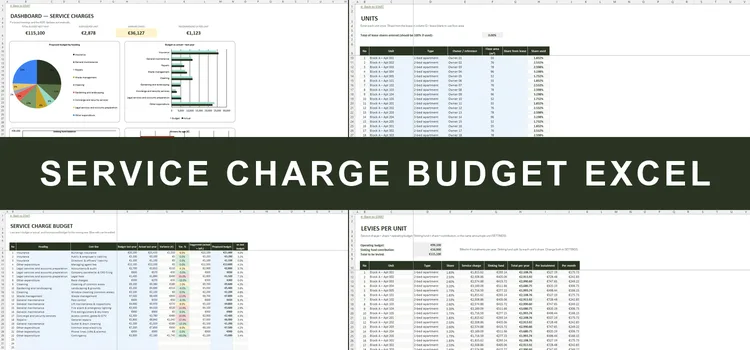
Service Charge Budget Excel
Budget, levies, arrears & sinking fund for OMCs
- Budget in the 9 categories of the MUD Act, vs actual
- Levy per unit from the lease share or floor area
- Arrears aged 0–30 / 31–60 / 61–90 / 90+ days
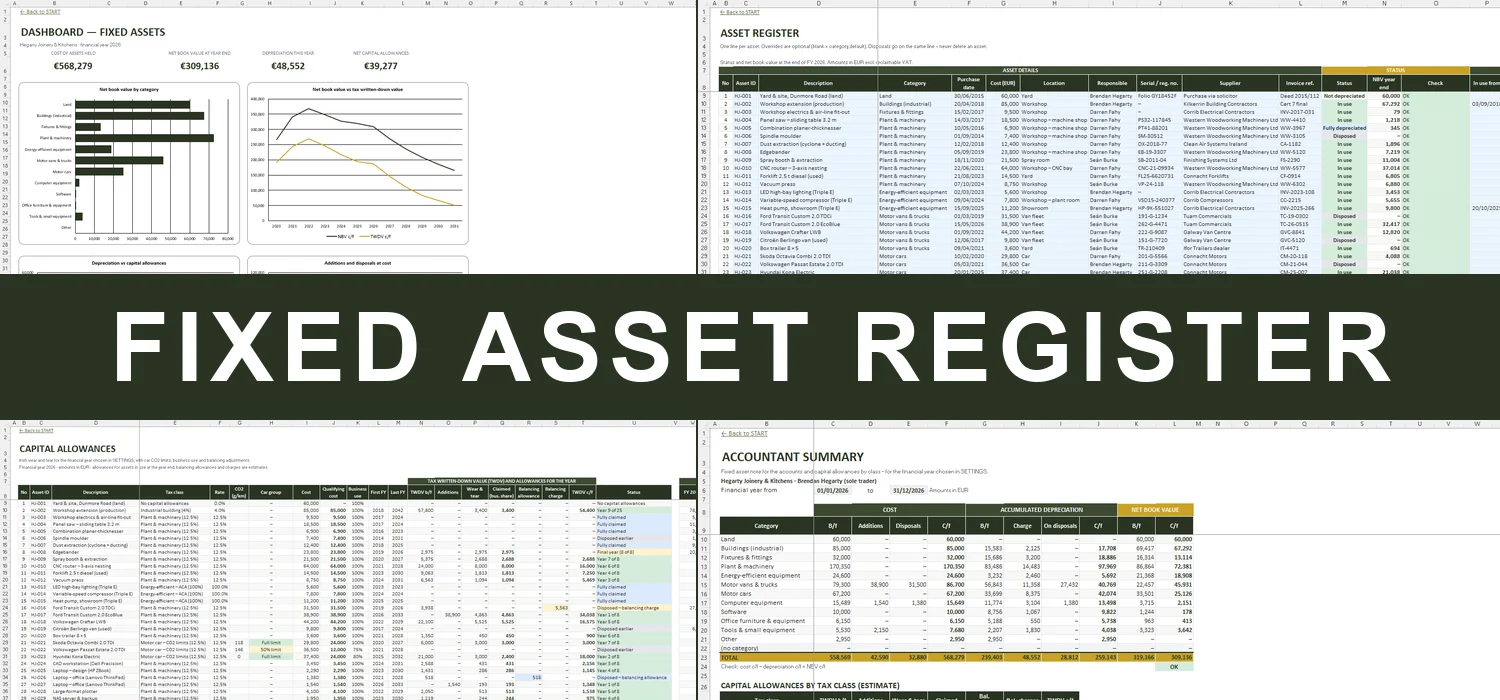
Asset register, book depreciation and Irish capital allowances for sole traders, small companies and their accountants


List every van, machine, laptop and fit-out once. The workbook works out the depreciation for your accounts, the wear and tear for Revenue, and what happens when you sell – year after year.
Most asset register templates stop at straight-line depreciation. In Ireland your accountant needs two sets of figures: depreciation for the accounts, and capital allowances for the tax return – 12.5% a year for 8 years on plant and machinery, cars limited by their CO2 emissions and the €24,000 specified amount, the business share for sole traders, and a balancing allowance or charge when an asset is sold, traded in or scrapped.
This workbook keeps both side by side. Enter each asset once with its category, cost, date and where it is. DEPRECIATION charges the year month by month, CAPITAL ALLOWANCES works out the wear and tear and the tax written-down value, DISPOSALS shows the profit or loss and the tax adjustment, and the ACCOUNTANT SUMMARY gives the fixed asset note and the capital allowances by class for the year you choose.
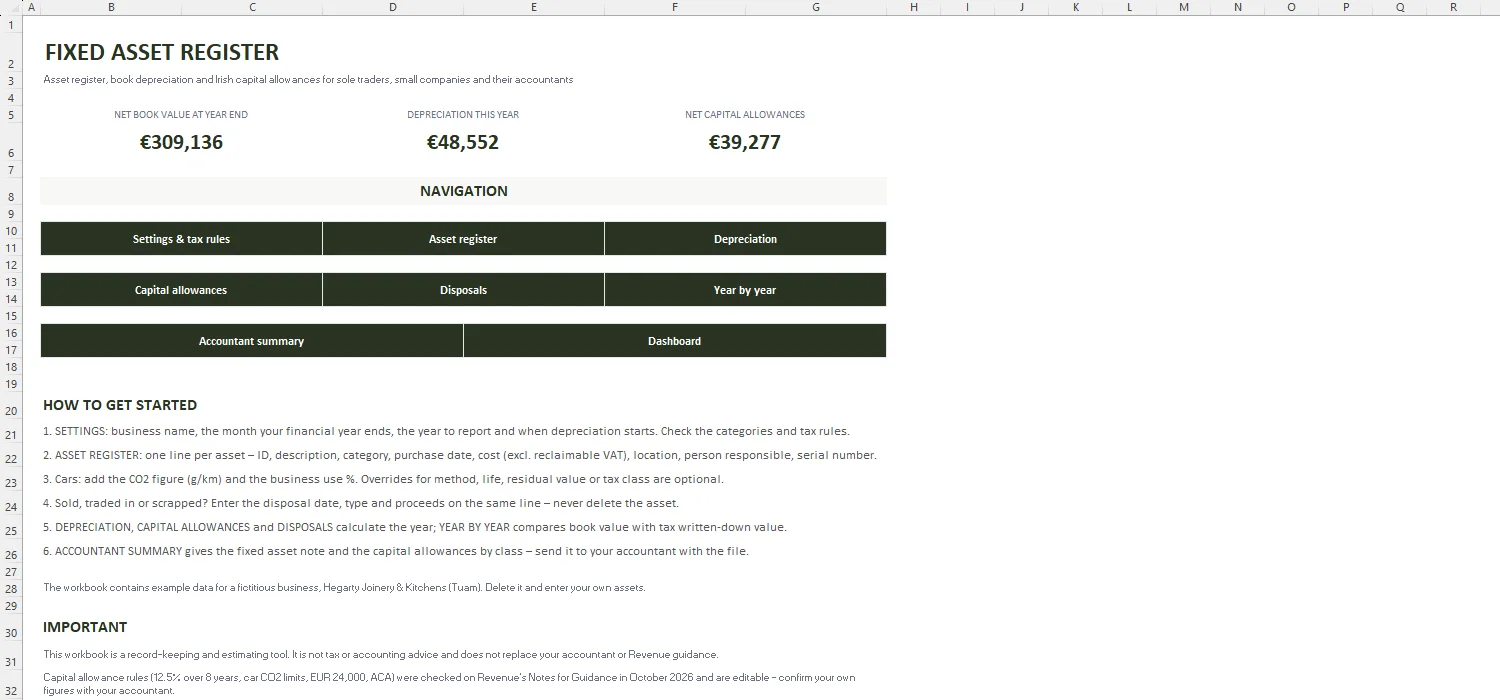
Key figures, quick links and a step-by-step guide.
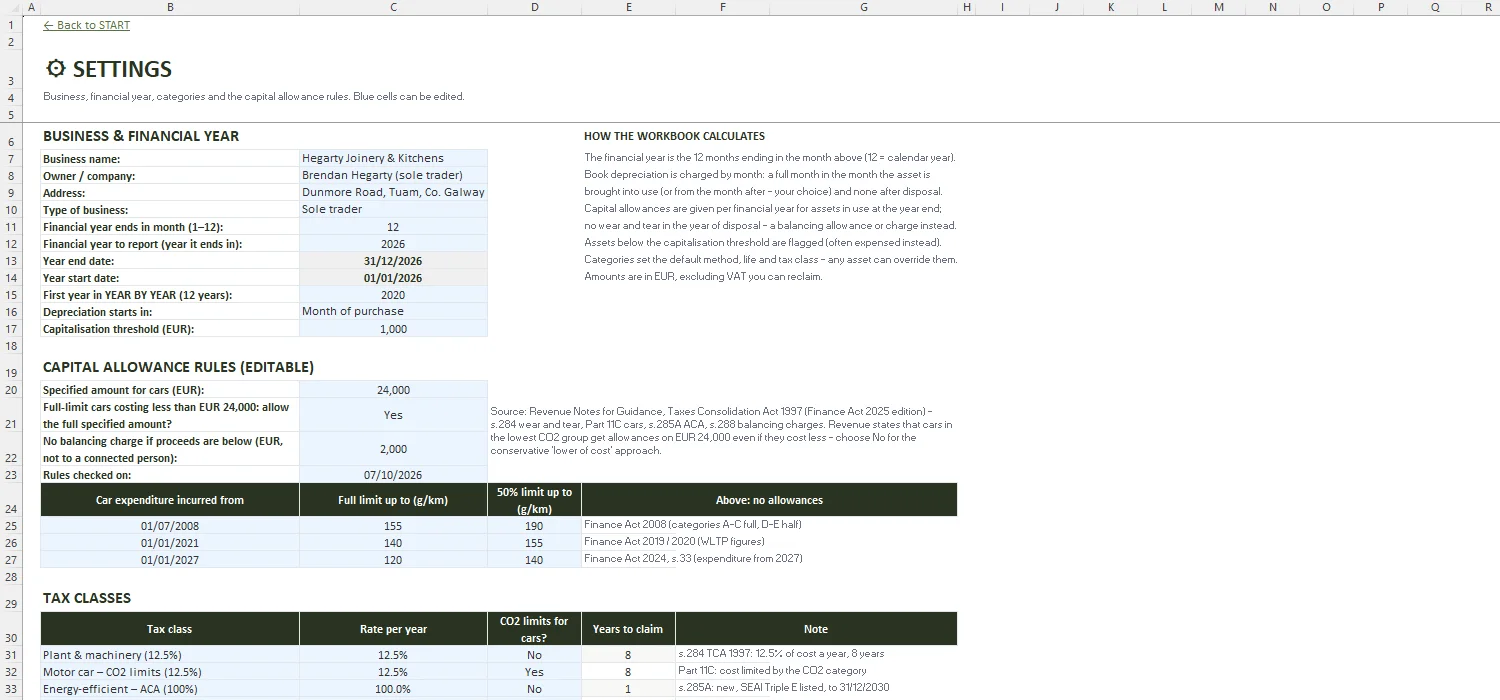
Business, financial year end month, year to report, depreciation start rule, capitalisation threshold, 12 categories with default method, life, rate, residual value and tax class, 6 tax classes and the car CO2 rules – all editable, with the date checked.
200 assets: ID, description, category, purchase date, cost, location, responsible person, serial or reg. number, supplier and invoice – plus optional overrides, CO2, business use and the disposal on the same line, with status, NBV and data checks.
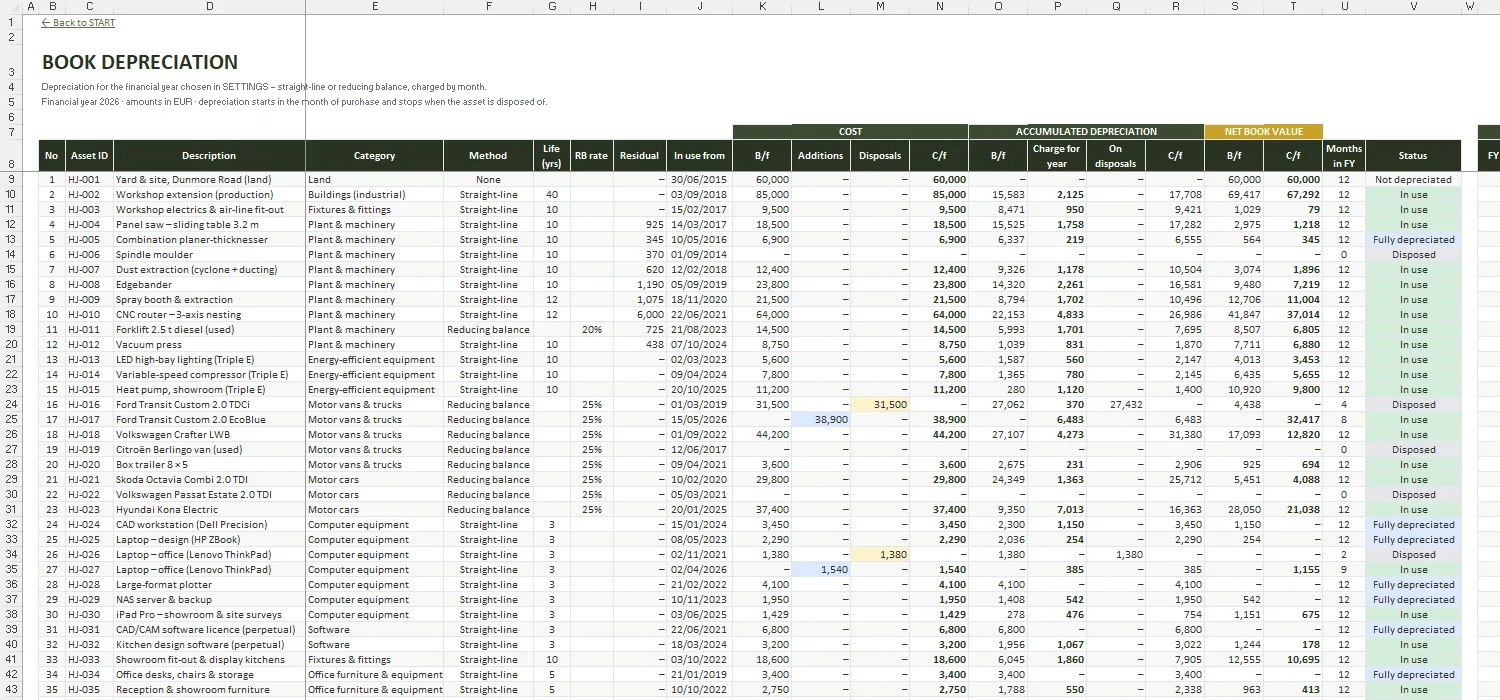
Cost and accumulated depreciation brought forward, additions, disposals, charge for the year and NBV per asset – plus the NBV at 13 year ends.
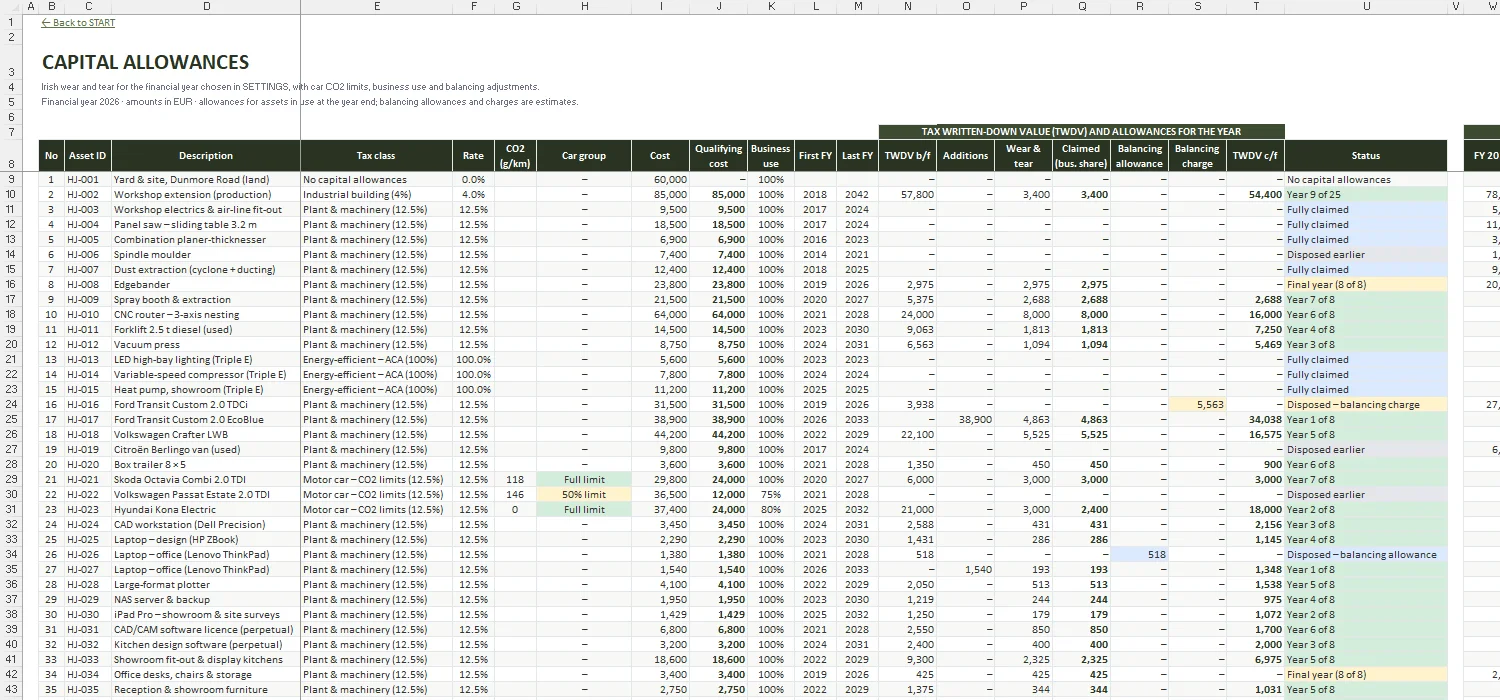
Tax class, CO2 group, qualifying cost, business use, first and last year, wear and tear, balancing allowance or charge and TWDV per asset – plus TWDV and allowances claimed for 13 years.
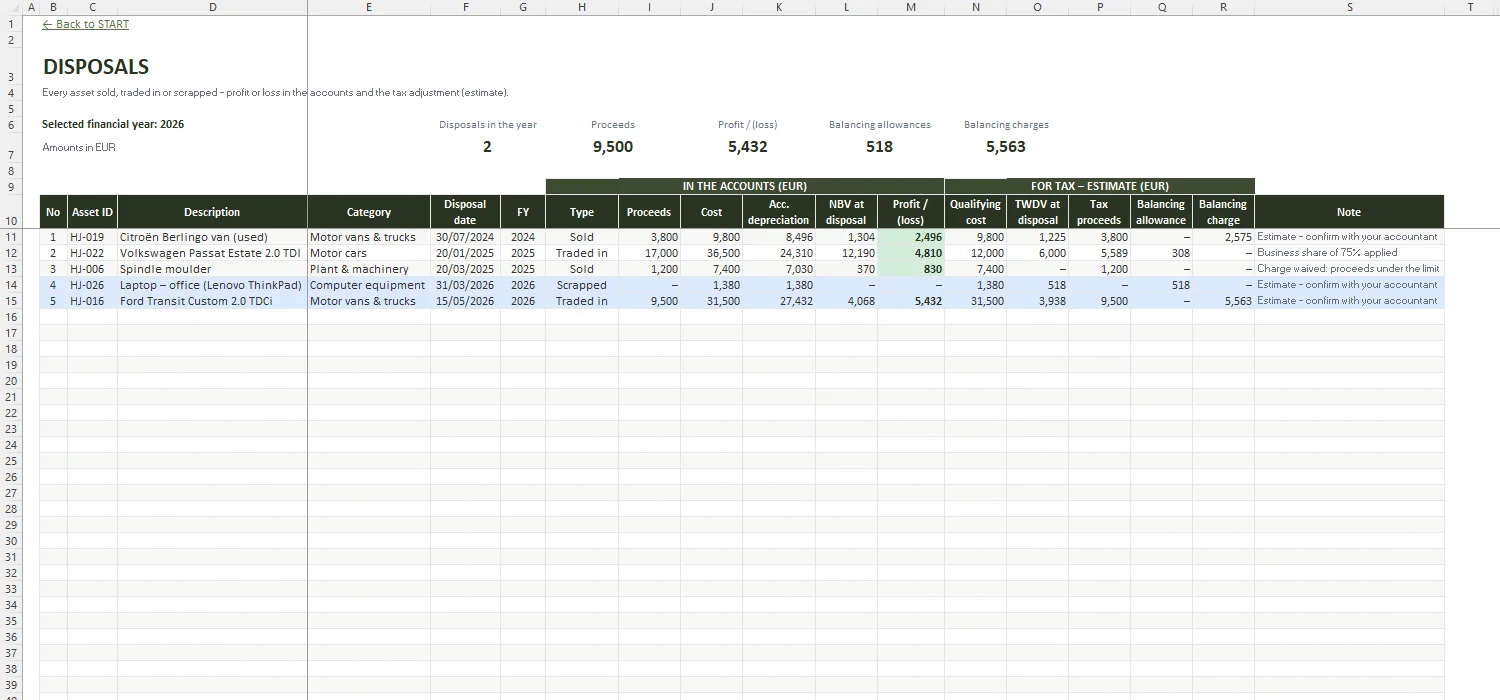
Every sale, trade-in or write-off in date order: proceeds, NBV, profit or loss, TWDV, tax proceeds and the estimated balancing adjustment.
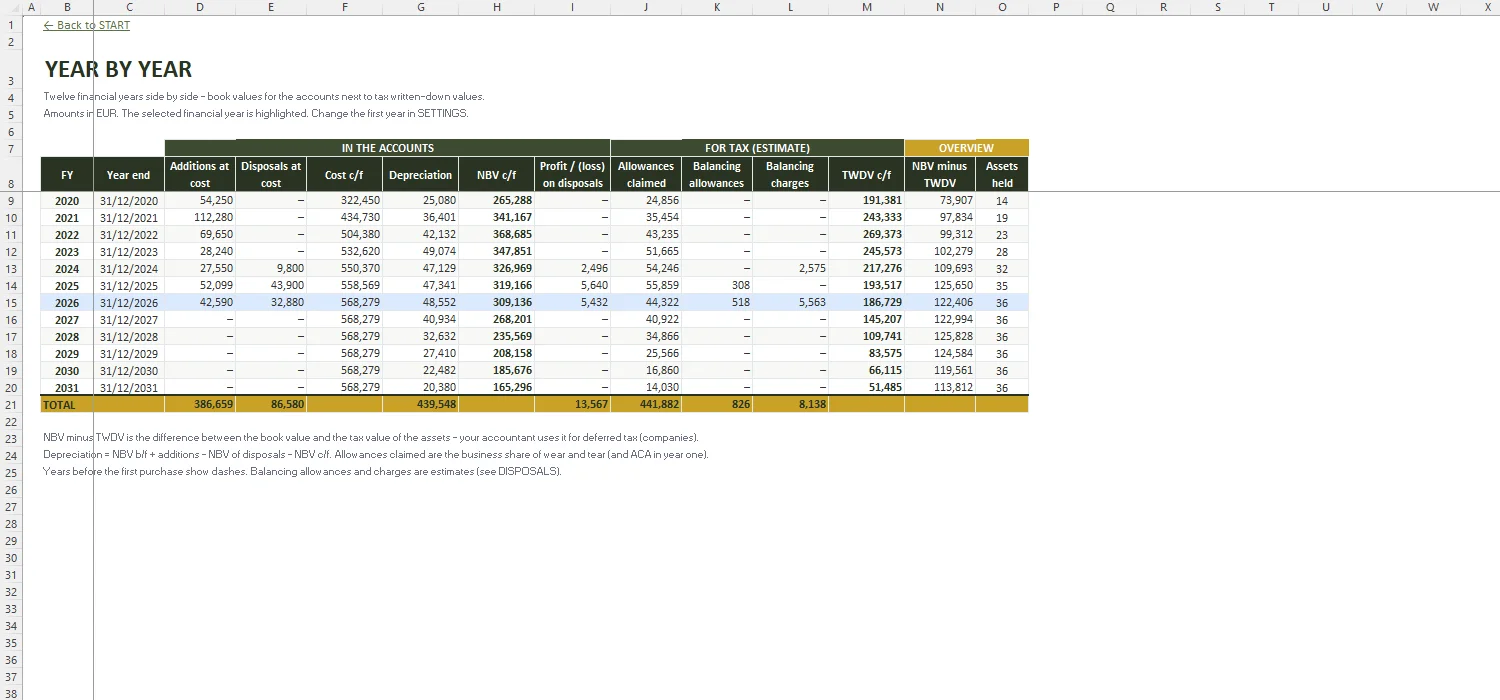
Twelve financial years: additions, disposals, cost, depreciation, NBV, allowances, balancing items, TWDV and the NBV–TWDV gap.
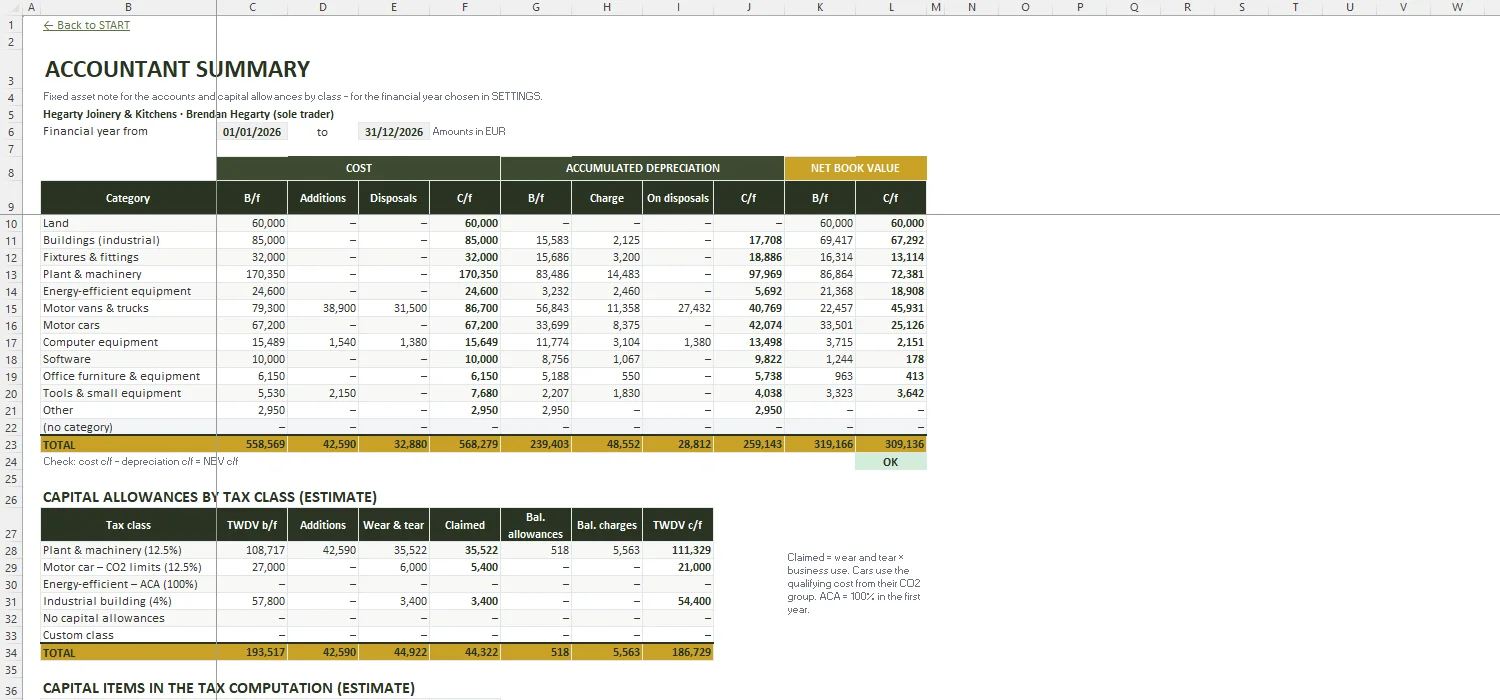
Fixed asset note by category (cost, depreciation, NBV), capital allowances by tax class, the capital items in the tax computation and data checks.
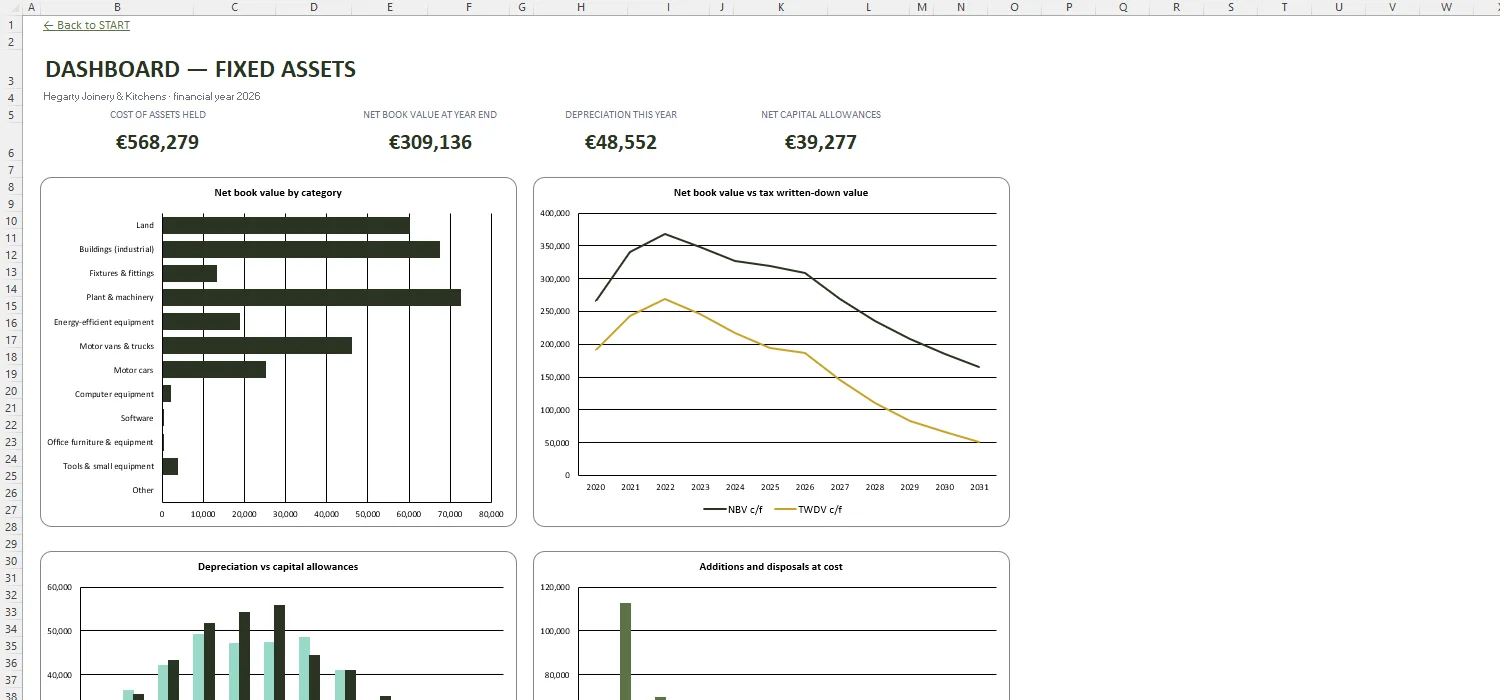
Cost held, NBV, depreciation and net capital allowances, with four charts.
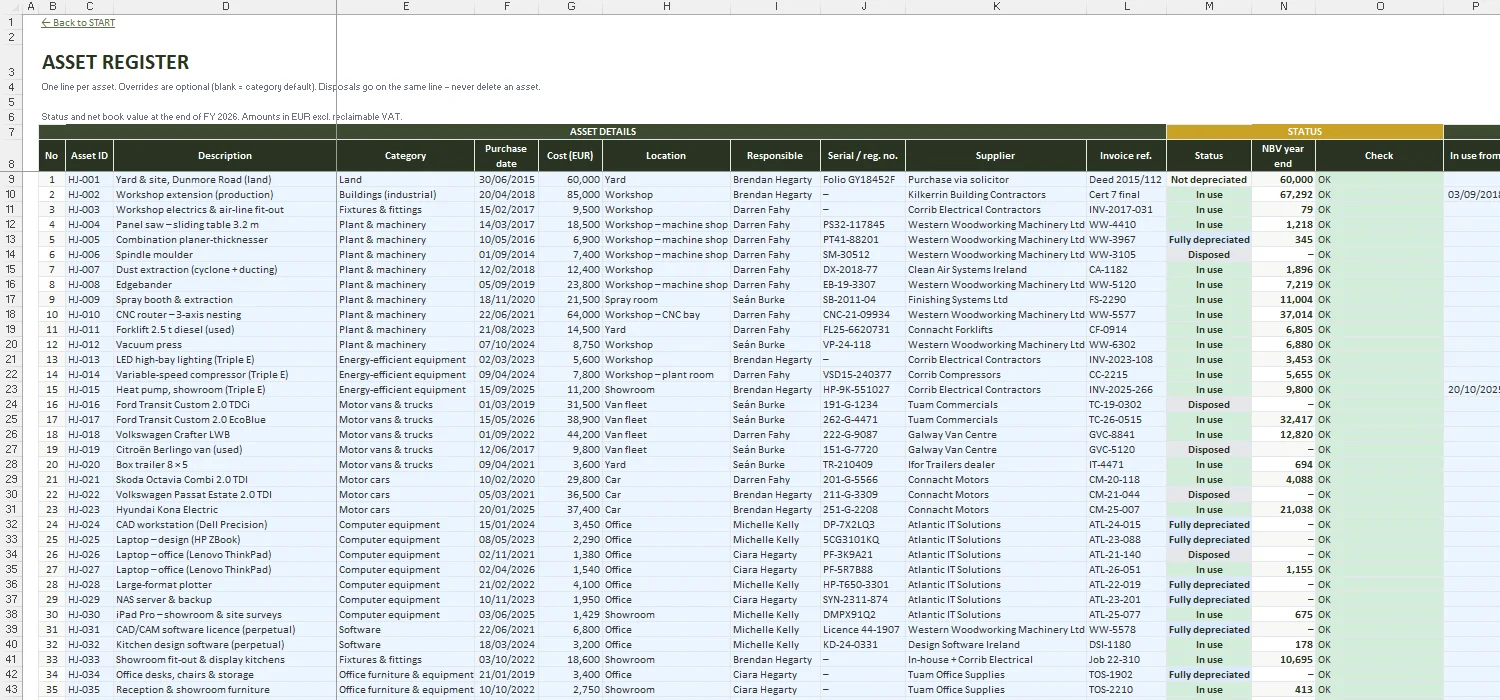
At least an asset ID, a description, the category, purchase date, cost and supplier, where the asset is and who is responsible for it, and a serial or registration number. For the accounts you also need the depreciation method, useful life, residual value and net book value, and for tax the capital allowance class. When an asset is sold or scrapped, record the date and the proceeds. The ASSET REGISTER sheet has a column for each of these.
Depreciation is what you charge in your accounts, based on your own estimate of the asset's useful life. Revenue does not allow it for tax: it is added back, and you claim capital allowances instead – for most plant and machinery 12.5% of the cost a year for 8 years, as long as the asset is in use at the end of the period. This workbook calculates both side by side and shows the gap year by year.
They depend on the car's CO2 emissions and when you bought it. For cars bought from 2021 to 2026, cars up to 140 g/km qualify on €24,000, cars from 141 to 155 g/km on half (at most €12,000), and higher-emission cars get nothing; from 1 January 2027 the limits drop to 120 and 140 g/km. The allowance is 12.5% a year for 8 years, and sole traders claim only the business share. These rules are pre-filled and editable in SETTINGS.
Instead of wear and tear in that year, you compare the tax written-down value with the sale proceeds: if the proceeds are lower you get a balancing allowance, if they are higher a balancing charge is added to your profit. No balancing charge is made when the proceeds are under €2,000, unless you sell to a connected person. The DISPOSALS sheet estimates this for every disposal, alongside the profit or loss in the accounts.
Yes. Choose the month your financial year ends and the year you want to report in SETTINGS. Depreciation is charged month by month, and capital allowances are worked out per financial year.
No. It keeps your assets and the figures in order and gives your accountant a clear summary – the fixed asset movements, the capital allowances by class and the disposals. Your accountant prepares the final accounts and tax computation.
Budget, levies, arrears & sinking fund for OMCs
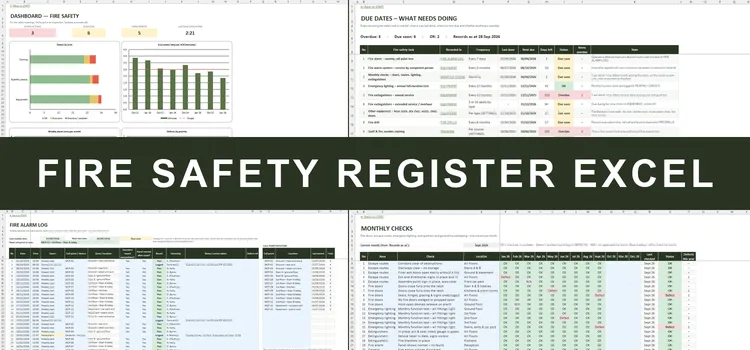
Fire safety log book with due-date alerts for Irish buildings
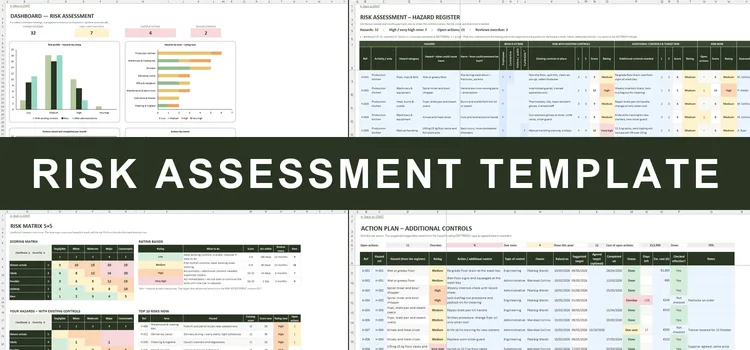
Hazard register, 5×5 risk matrix, action plan & Safety Statement checklist
Asset register, book depreciation and Irish capital allowances for sole traders, small companies and their accountants · €59
A fixed asset register template in Excel lets a small business keep every asset in one place – what it cost, when it was bought, where it is and who has it – and works out the net book value at each year end. This asset register template goes further for Ireland: book depreciation (straight-line or reducing balance) next to wear and tear, tax written-down value and the capital allowance schedule your accountant needs.
Use it as a fixed asset register for a sole trader or a small company, as a depreciation schedule in Excel, or as a capital allowances calculator for plant and machinery, vans and cars with CO2 limits. Disposals, balancing allowances and charges, and a year-by-year view of book value against tax value are all included – with no macros and no subscription.