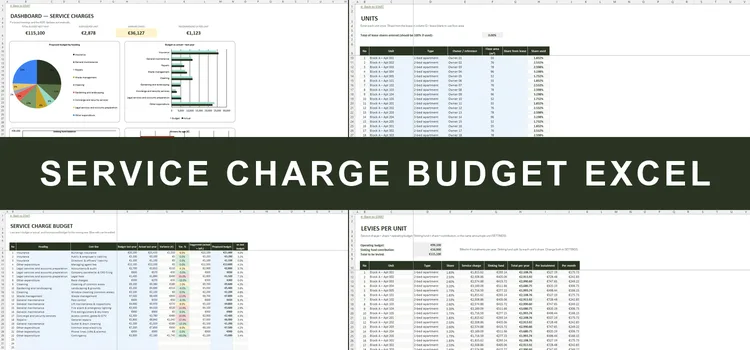
Service Charge Budget Excel
Budget, levies, arrears & sinking fund for OMCs
- Budget in the 9 categories of the MUD Act, vs actual
- Levy per unit from the lease share or floor area
- Arrears aged 0–30 / 31–60 / 61–90 / 90+ days
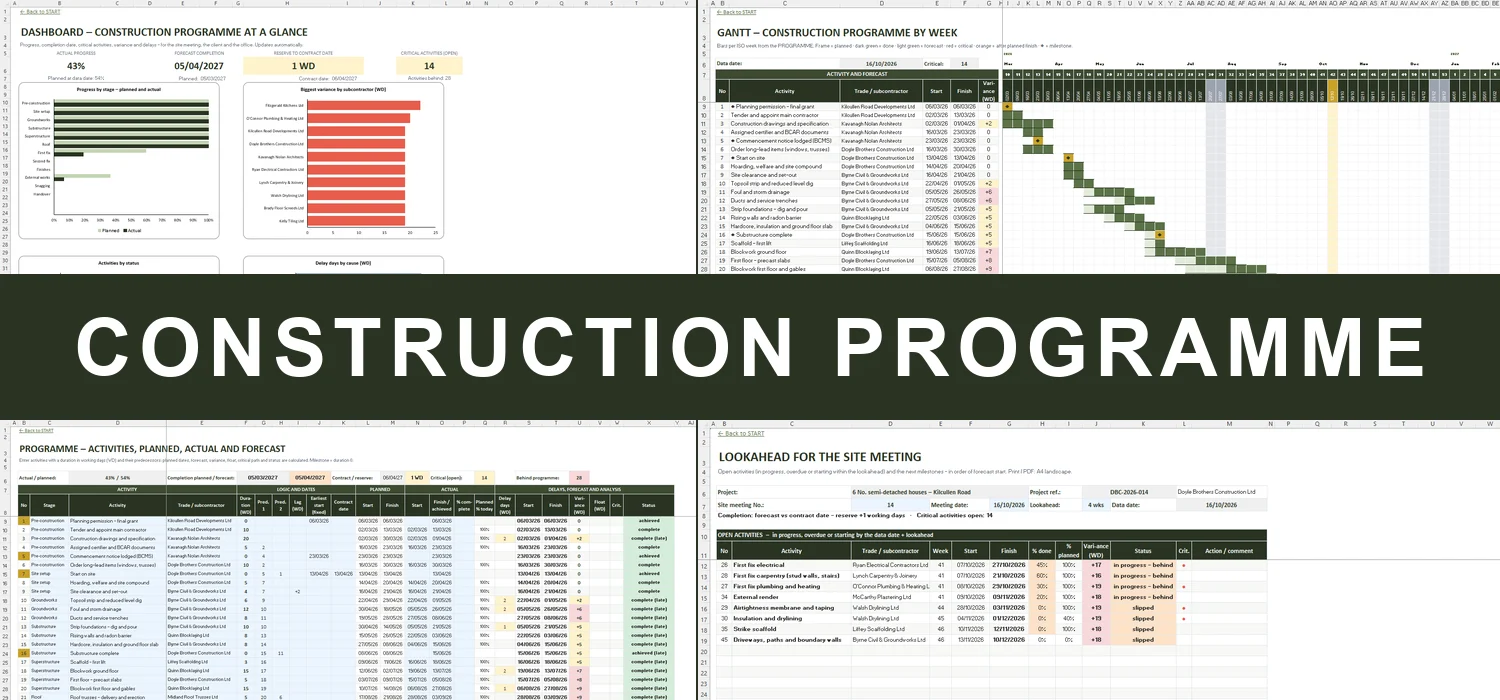
Gantt programme with predecessors, Irish public holidays, builders' holidays, critical path, delay register and a lookahead for the site meeting


Enter each activity with a duration and its predecessors. The workbook works out the planned dates without weekends, public holidays or builders' holidays, forecasts the finish from what is actually happening on site, and gives you the lookahead for Thursday's site meeting.
A programme drawn as bars is quick to make and just as quick to go out of date. The groundworker loses three days to rain, the blocklayers start late, and suddenly every bar after them is wrong – so somebody spends an evening dragging bars across, counting bank holidays and the builders' holidays in their head, and hoping the completion date still holds.
This workbook calculates the programme for you. Each activity has a duration in working days, up to two predecessors and, if needed, a lag or a fixed earliest start. The planned dates skip weekends, Irish public holidays and the builders' holidays. Add actual starts, finishes and % complete, log delays in the register, and the workbook forecasts every activity, the variance in working days, the reserve to the contract date and the critical path. The Gantt by week, milestones, a subcontractor overview and a printable lookahead for the site meeting update automatically.
Key figures, quick links and a step-by-step guide.
Project, programme start, contract date and driving activity, data date, Mon–Fri or Mon–Sat working week, builders' holidays, defects period, start on site with the commencement notice window, tolerances, a summary per stage and the delay causes.
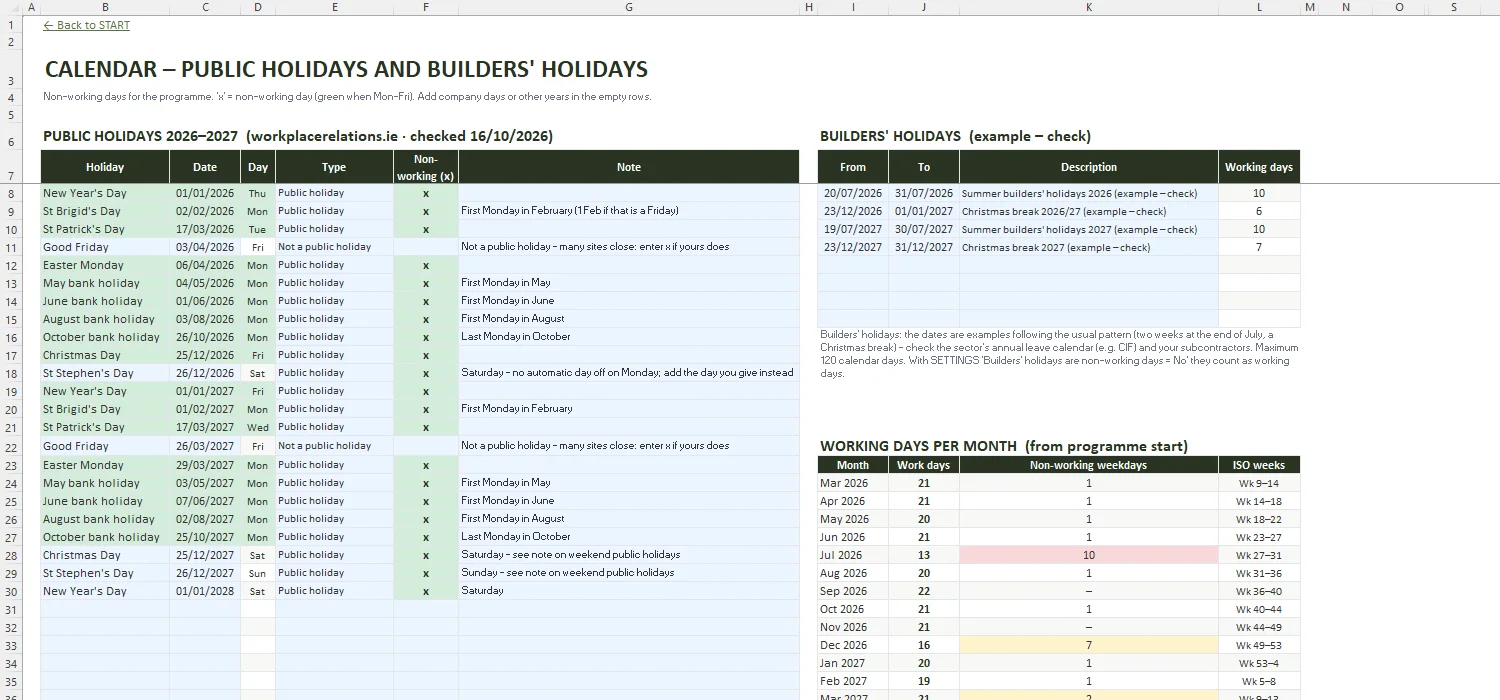
Irish public holidays 2026–2027 (incl. St Brigid's Day), Good Friday option, company days, builders' holidays and working days per month.
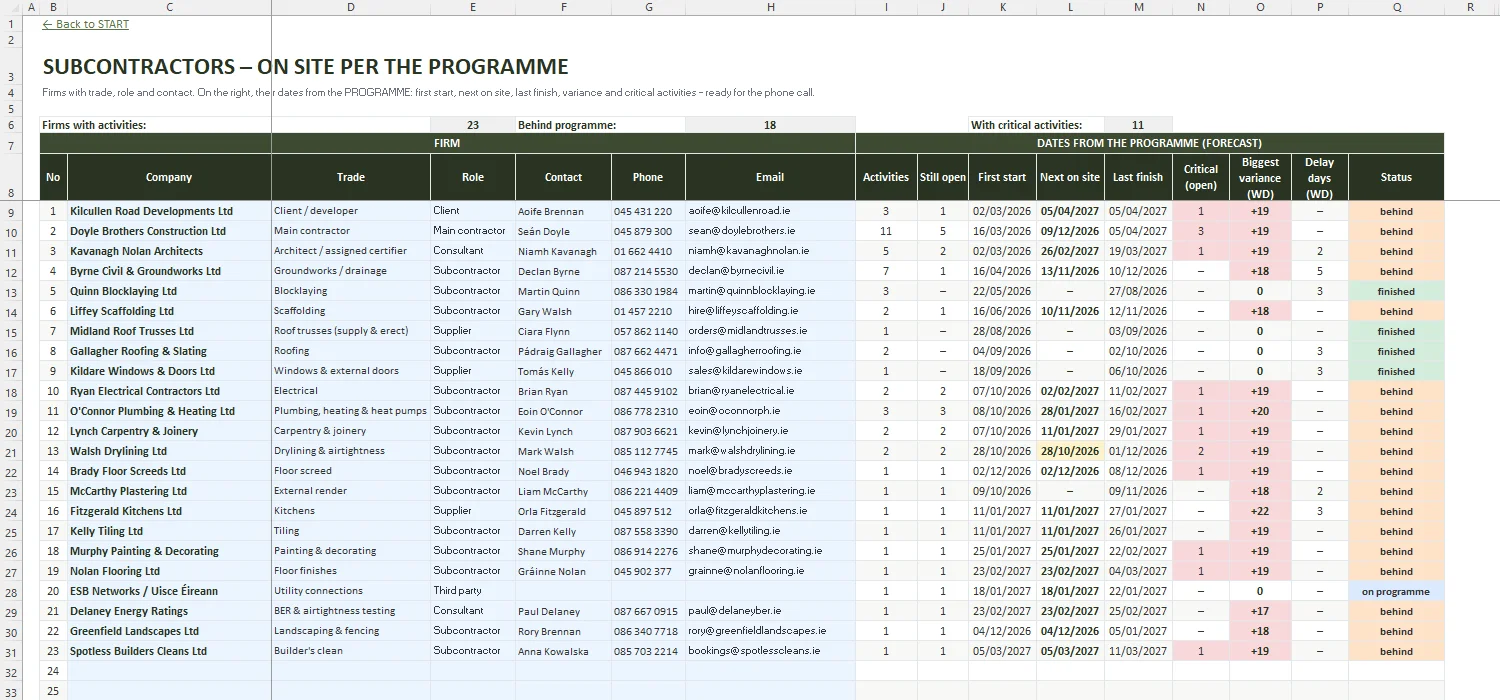
Firms with trade, role and contact – plus first start, next on site, last finish, critical activities, variance and delay days from the programme.
Up to 120 activities with stage, trade, duration, two predecessors, lag, earliest start and contract date – planned, actual, % complete vs planned, delay days, forecast, variance, float, critical path and status.
Bars over 84 ISO weeks: planned frame, work done, forecast, critical activities, slippage, milestones, holiday weeks and the current week.
Weather, client, design, supply, third-party and contractor delays per activity or for the whole site, with working days, description, date of notice and status.
Every milestone with contract date, planned, forecast, achieved date, reserve in working days and status, plus the end of the defects period.
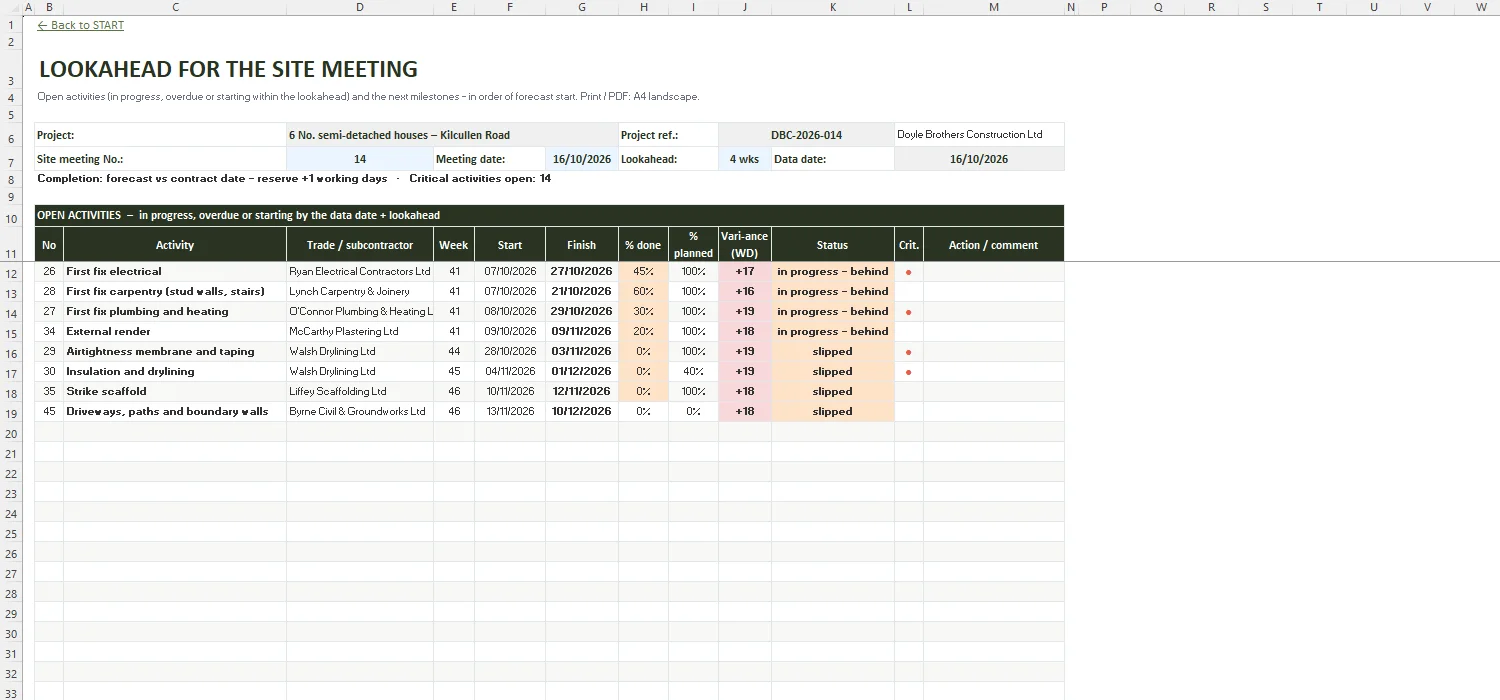
Lookahead for the site meeting (A4 landscape): open activities in the next 1–6 weeks, next milestones and space for the actions agreed.
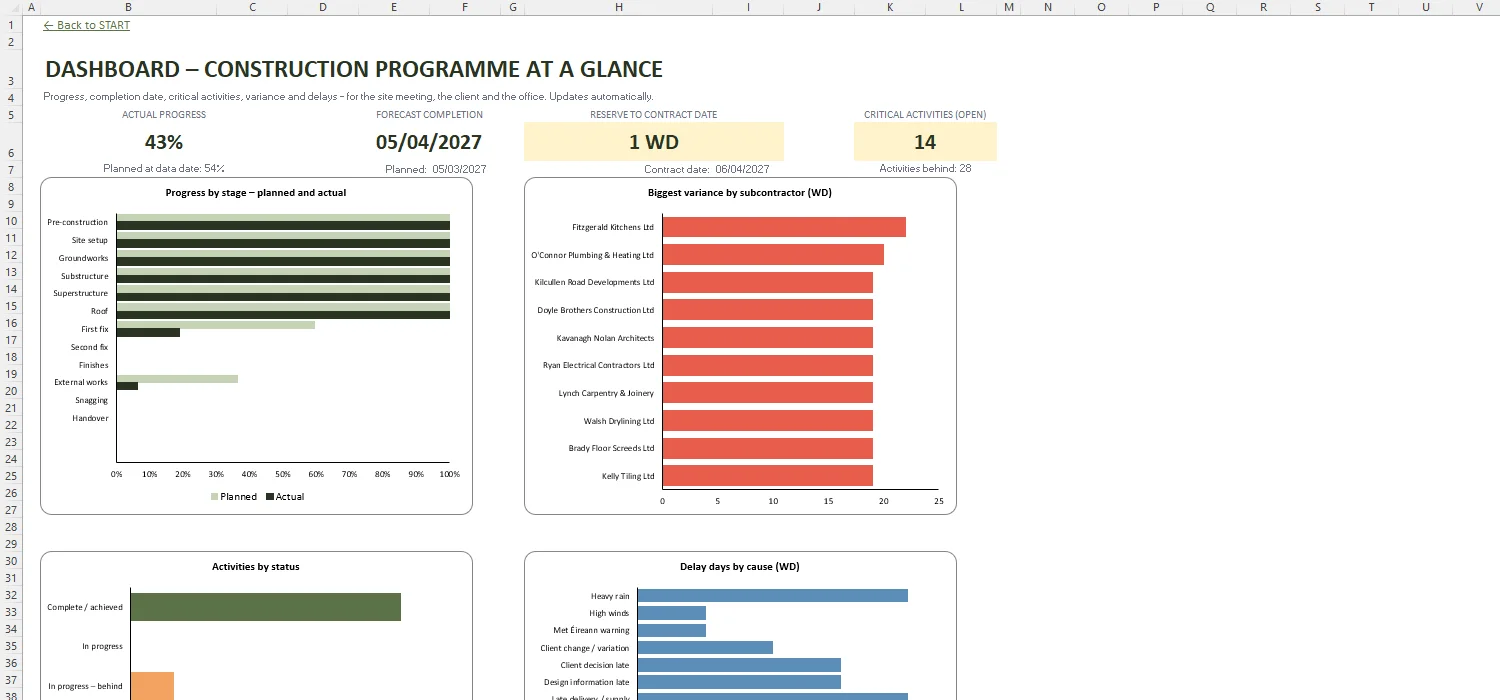
Actual and planned progress, forecast completion, reserve to the contract date, critical activities and four charts.
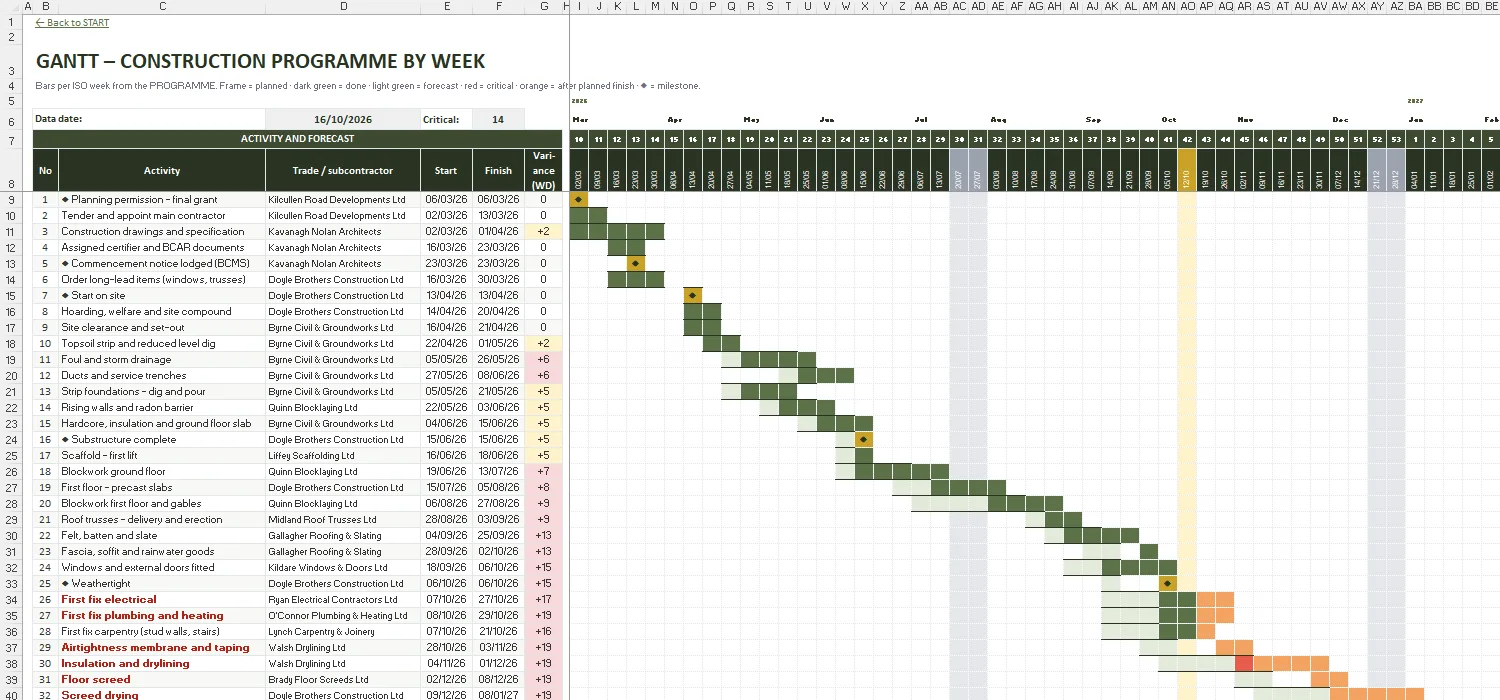
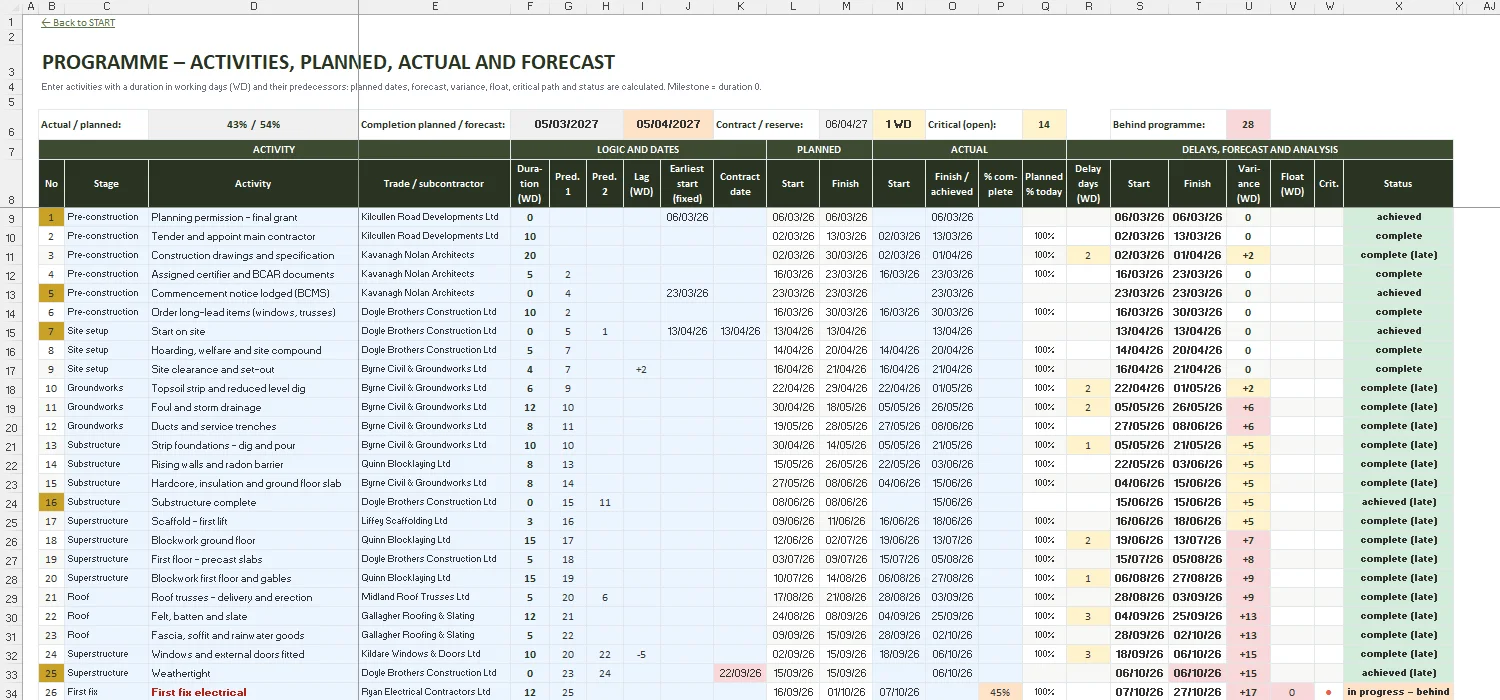
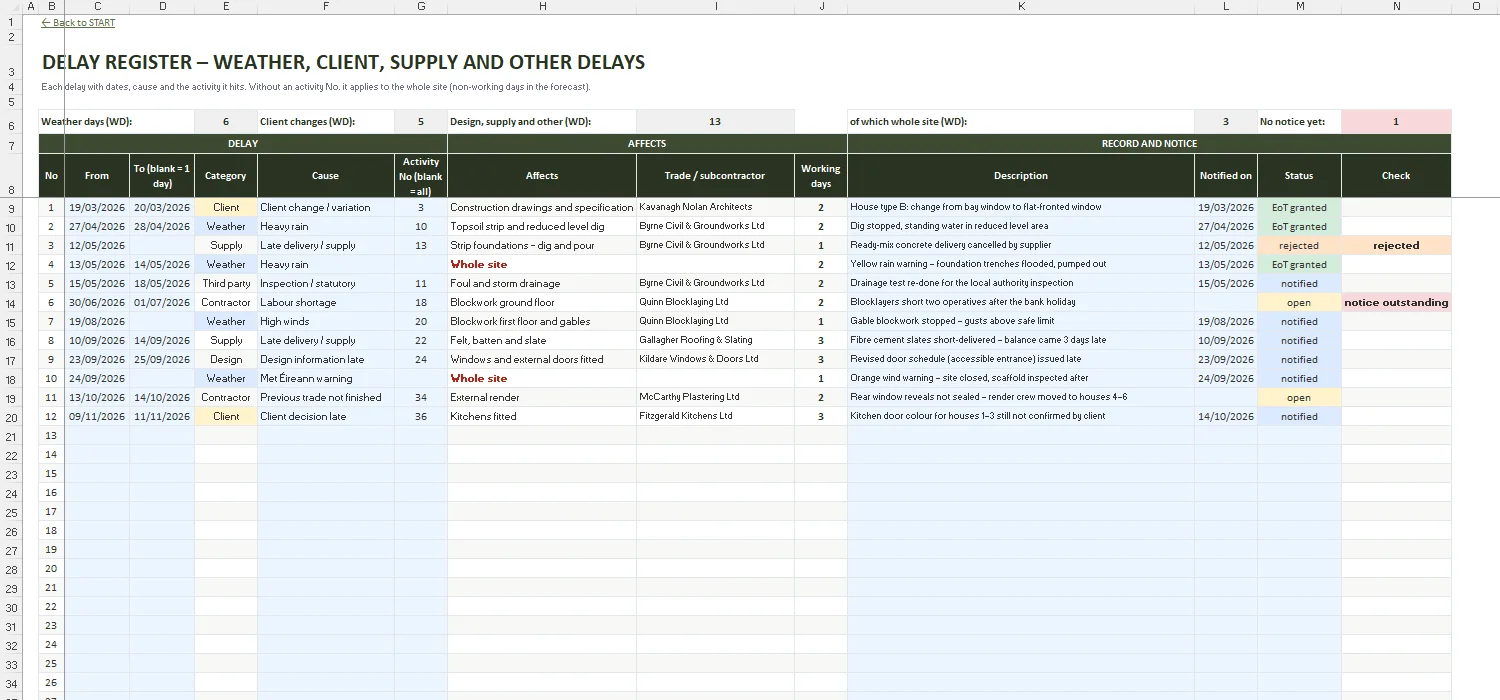
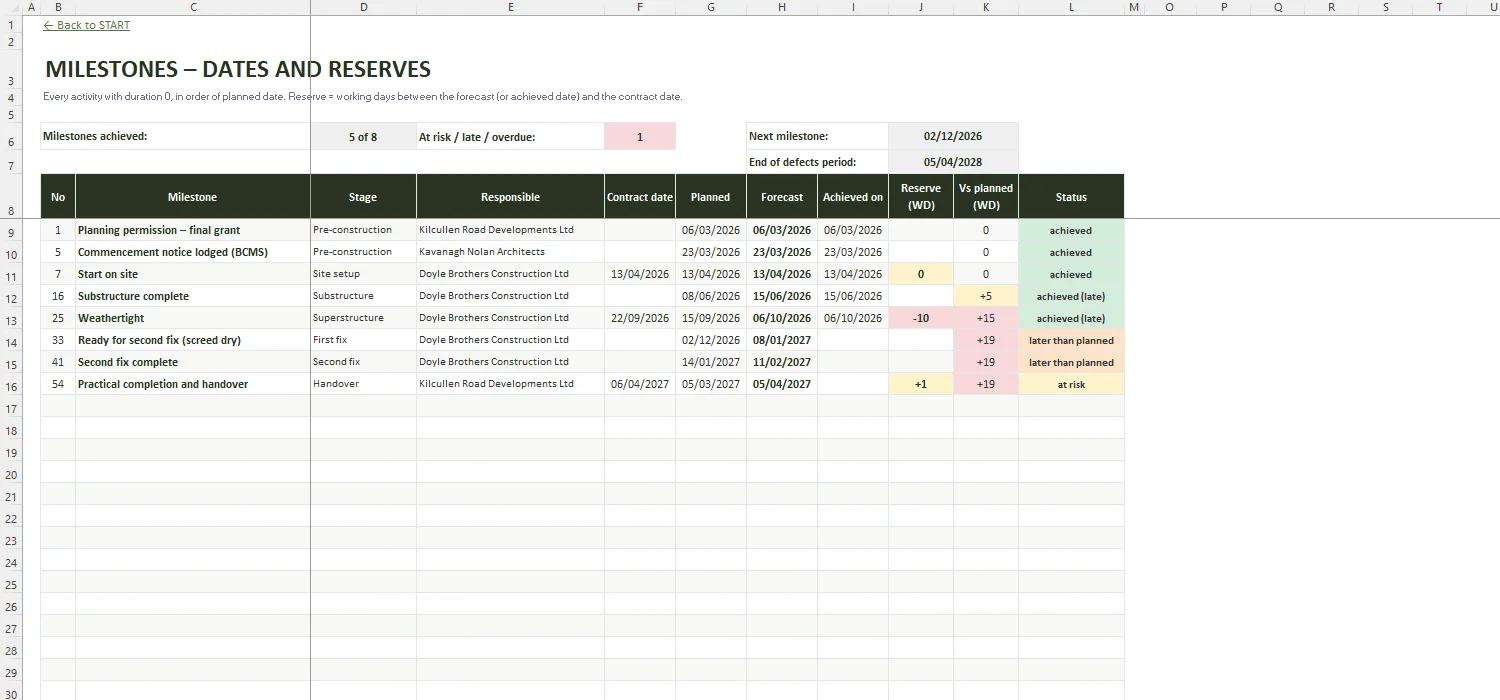
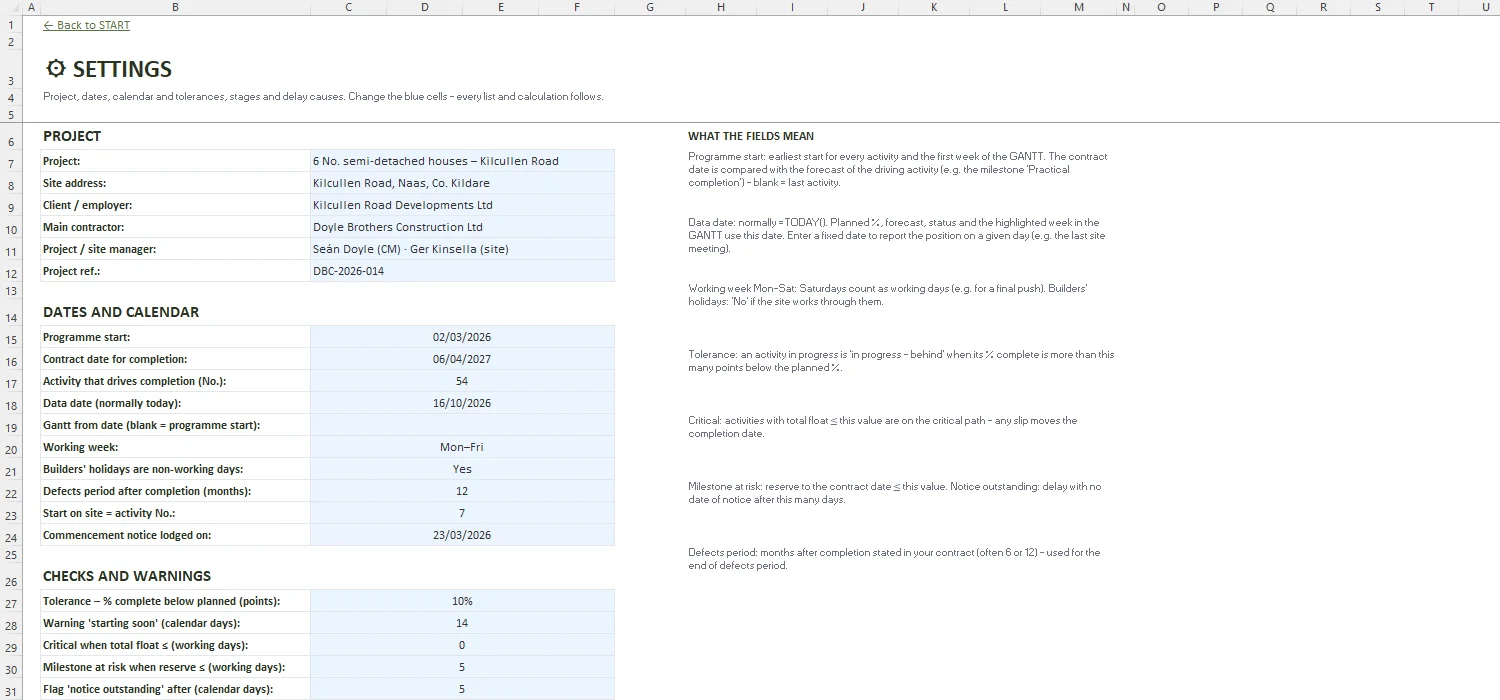
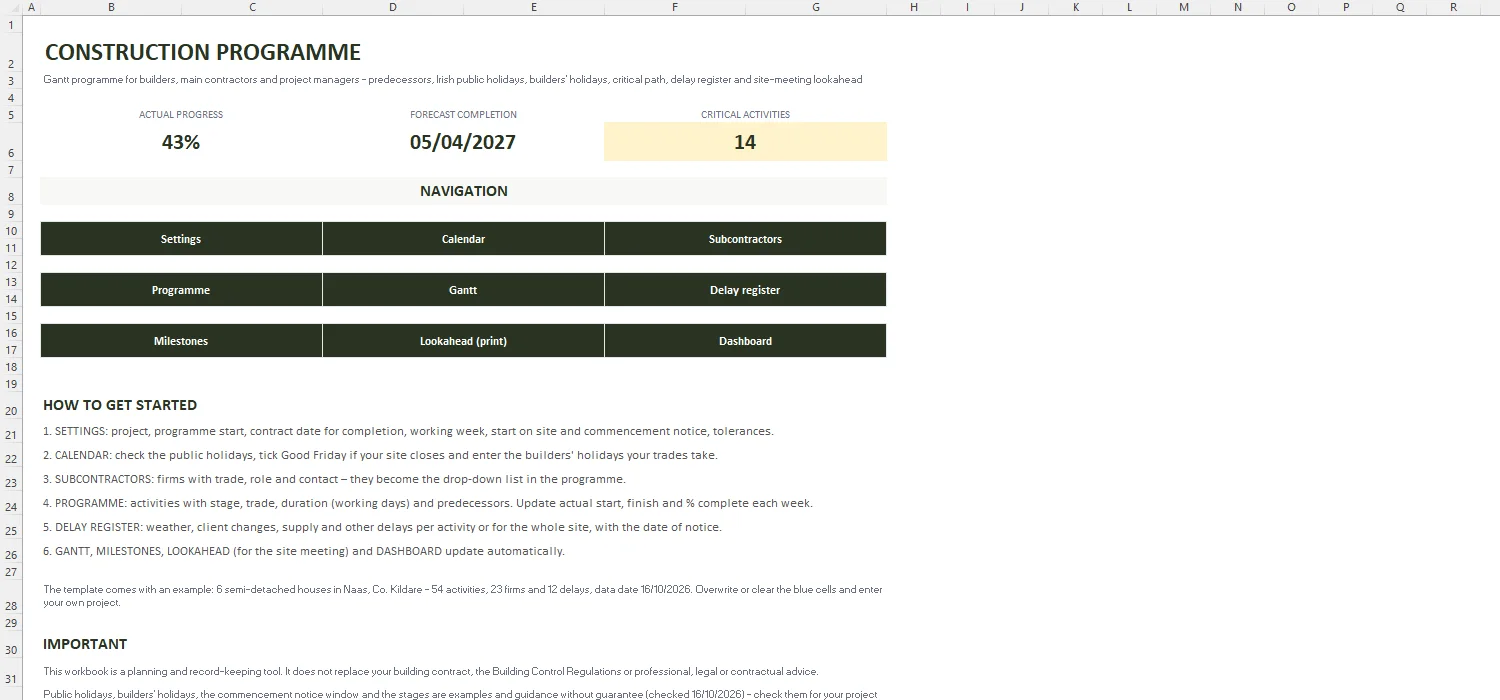
List the activities in the order they happen, give each a duration in working days and say which activity has to finish first. This template does the rest: it calculates the start and finish dates, skips weekends, public holidays and builders' holidays, and draws the Gantt chart by week. When a duration changes, everything that depends on it moves automatically.
Yes – several software companies offer free Gantt templates. Most are bars you move by hand, built for the US, with no Irish holidays and no link between activities. This workbook adds predecessors, a forecast from actual progress, the critical path, a delay register and a lookahead for the site meeting.
Start from the key dates (start on site, weathertight, practical completion), break the job into stages and activities by trade, agree realistic durations with your subcontractors and link the activities with predecessors. Then update it every week with actual progress and delays – the forecast and the critical path show early where completion is at risk.
The CALENDAR lists Ireland's public holidays for 2026 and 2027, including St Brigid's Day; Good Friday is not a public holiday, so you tick it only if your site closes. Builders' holidays are entered as periods – the summer and Christmas dates included are examples to check against the sector's calendar and your trades.
Under the Building Control Regulations a commencement notice is generally lodged through the BCMS not less than 14 and not more than 28 days before works start. SETTINGS shows that window from your start-on-site date and checks the date you lodged. Some works use a 7 Day Notice or are exempt – check with your certifier or the Building Control Authority.
Yes. Snagging and handover are stages in the programme, and the detailed snags can be kept in our Snag List Template. The LOOKAHEAD sheet prints on A4 with the open activities for the next weeks, the next milestones and space for the actions agreed at the meeting.
Budget, levies, arrears & sinking fund for OMCs
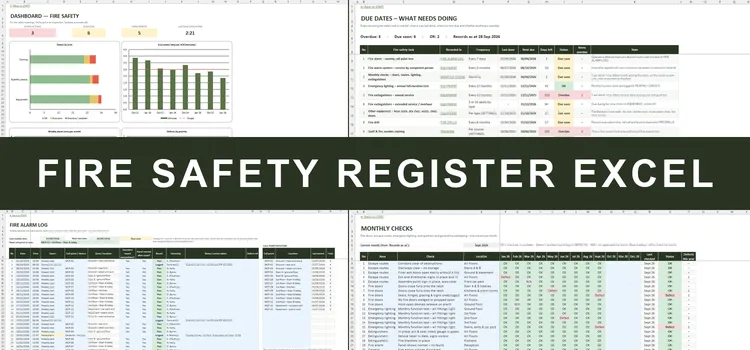
Fire safety log book with due-date alerts for Irish buildings
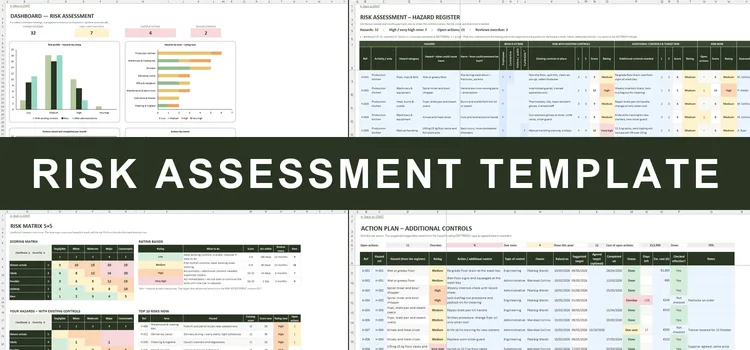
Hazard register, 5×5 risk matrix, action plan & Safety Statement checklist
Gantt programme with predecessors, Irish public holidays, builders' holidays, critical path, delay register and a lookahead for the site meeting · €69
Use this construction programme template to plan a new build, extension or fit-out in Excel: a construction schedule template with a Gantt chart by week, activities by stage and trade, subcontractors, milestones and the contract date for practical completion. Unlike a drawn bar chart, the programme works in working days with predecessors and lags, and skips Irish public holidays and the builders' holidays.
For the site team the Gantt chart for construction is also a control tool: actual progress against planned, forecast, variance, float and critical path show early where completion is at risk. Weather days, client changes and late deliveries go into the delay register, and the 3-week lookahead for the site meeting builds itself – with a filled-in example of six semi-detached houses in Co. Kildare.